In this chapter on electrotherapy, we will discuss electrical stimulation of nerves and muscles. We have already covered the different types of currents. In this lesson, we will discuss short-duration currents and long-duration currents, and the electrical activity of nerve. Finally, we will discuss the effect of the frequency of stimulation.
Let us begin with the first topic, the types of electric currents.
What are the types of electric current used for stimulation?
A current with varying magnitude can stimulate the motor nerve. Even when there is no nerve supply, for example in paralysis, muscle contraction can still be achieved with an appropriate current.
There are two types of current:
- Impulse with short-duration current and
- Impulse with long-duration current.
What is short-duration current?
Short-duration currents are currents with a duration less than 10 milliseconds. Typically, it is used for stimulating the normal innervated muscles.
These impulses are categorised as faradic-type current. Their frequency is 50–100 impulses per second (50–100 Hz).
What is long-duration current?
Long-duration currents are currents with a duration of more than 10 milliseconds.
These currents are mainly used to stimulate the denervated muscle. Example: any type of paralysis, or when the nerve has been cut or damaged. If the nerve supply is completely lost in that muscle, we call it a denervated muscle.
This current is called interrupted direct current or Modified Direct current. We also call it galvanic current.
Galvanic current is a long-duration, low-frequency current. Faradic current is a short-duration, low-frequency current. IFT has two medium-frequency currents that intersect and interfere, and the resultant low-frequency current is produced.
TENS and faradic current are short-duration, low-frequency currents used to stimulate innervated muscles.
How does a nerve conduct an electrical impulse?
Nerve stimulation: The phenomenon of nerve transmission involves the propagation of an electrical impulse along a nerve fibre. It is initiated by a stimulus that can be electrical or chemical.
Let me simplify it: If an electrical impulse is passing along a nerve fibre, we call this phenomenon nerve transmission. And it starts only after a stimulus, whether it is a chemical stimulus or an electrical stimulus. In our body, the natural stimulus is due to chemical changes.
The stimulation alters the permeability of the nerve membrane, allowing the sodium ions to flow through the nerve membrane into the cell, leading to the creation of the depolarisation wave.
At rest, there is a higher concentration of sodium ions outside the nerve and of potassium ions inside it. This causes the outside of the nerve to be positively charged relative to the inside, which is negatively charged. This is called the resting (polarised) state.
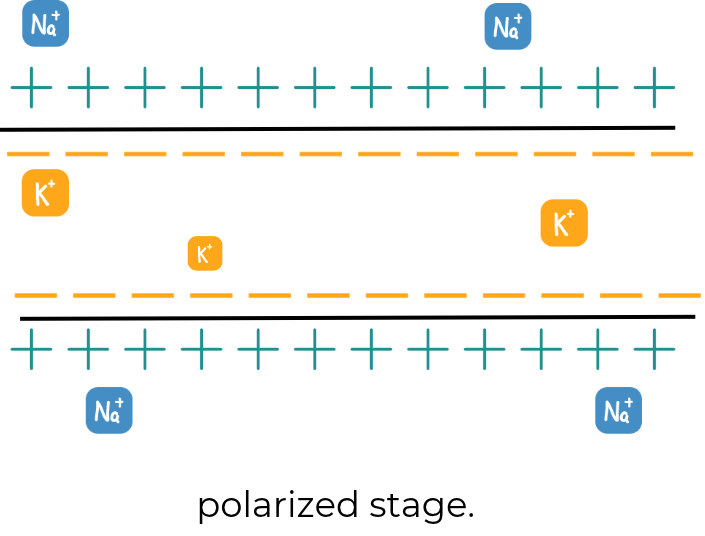
As soon as the nerve receives an electrical impulse, it gets stimulated. Because of this, the permeability of the nerve membrane changes. So sodium ions rush into the nerve, and potassium ions move out. There is an exchange of ions, making the inside positive and outside negative (depolarisation).
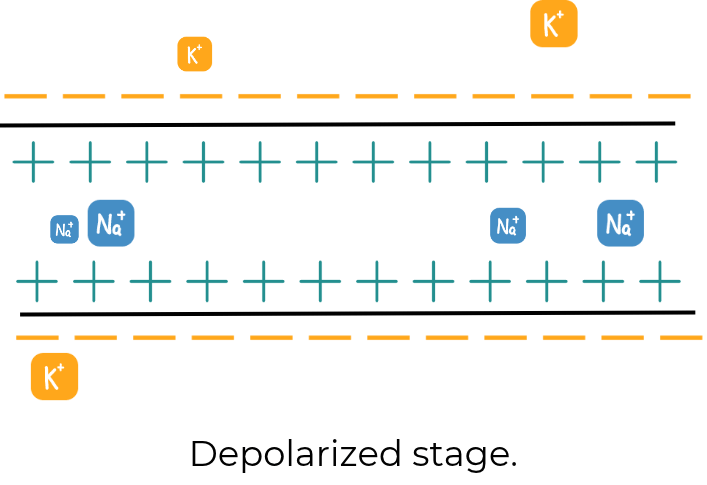
This depolarisation state propagates forward by depolarising the next segment of the nerve. The previously depolarised segment again gets back to a polarised state by exchange of ions (repolarisation).
This process propagates forward, resulting in transmission of the nerve signal.
What is accommodation of nerve?
If we keep stimulating the nerve constantly with the same type of current, then the nerve adapts itself to that intensity; as a result, the same intensity no longer produces the same stimulation.
We can understand this with an example of body spray. When we spray it, it smells to our nose initially for a few minutes. But after some time, our nose adapts, and we cannot appreciate the scent again.
The same thing happens when a nerve adapts and no longer responds to the same current. To reduce this, we use a current with varying intensity and pulse duration.
What happens when a nerve is stimulated?
When a nerve is stimulated, the impulse can travel in both directions from the point of stimulation.
What happens when a sensory nerve is stimulated?
Sensory nerves carry sensations such as touch, pain and heat from the skin. From the point of stimulation, the impulse travels both upward and downward. When a sensory nerve is stimulated, the upward-travelling impulse reaches the brain, and we feel it as a sensation. The downward-travelling impulse has no effect.
The current with different pulse durations has different sensory experiences. A sensory experience with short-duration impulses is different from long-duration impulses.
For example, the long-duration current has an uncomfortable, stabbing sensation, whereas short-duration current of 1 ms (millisecond) or less produces a mild, prickling sensation that is easily tolerated.
What happens when a motor nerve is stimulated?
So now what happens when we stimulate the motor nerve? The impulse travelling upward along the motor nerve (antidromic) goes back to the nerve cell body in the anterior horn of the spinal cord and dies out there. It has no effect.
The impulse travelling downward (orthodromic) reaches the muscle, which responds by contracting.
The muscle responds best at the point where the motor nerve enters the muscle, which is usually also where the nerve is closest to the surface. This point is called the motor point, because here we get the strongest contraction with the least stimulation.
How does stimulation frequency affect muscle contraction?
A single stimulus produces a muscle twitch, which is a brief, slight contraction.
A low-frequency current (about 1–10 Hz) produces separate muscle twitches with full relaxation in between.
If we use an intermediate frequency (about 10–50 Hz), it produces a partial muscle contraction, or we call this an incomplete tetany.
Successive contractions partly fuse together, with only a short relaxation period between them. Because the muscle relaxes only partly between contractions, we call it incomplete tetany. It feels like a vibration.
When we provide a high-frequency current of about 50 Hz or more, it will produce a complete tetanic muscle contraction, i.e., the muscle contraction will be smooth and sustained.
| Frequency | Muscle response | Sensation |
|---|---|---|
| Single stimulus | Muscle twitch: a brief, slight contraction | A single quick tap or jerk |
| 1–10 Hz | Separate twitches with full relaxation in between | Rhythmic tapping |
| 10–50 Hz | Incomplete tetany: partial, fused contraction with a short relaxation between pulses | Vibration |
| 50 Hz or more | Complete tetanic contraction: smooth and sustained | Steady, continuous contraction |
What determines the strength of a muscle contraction?
The strength of muscle contraction depends on two things.
- The number of motor units activated, i.e., how many motor nerve fibres are stimulated. The stronger the stimulation of the motor nerve, the more motor units are activated, and the stronger the muscle contraction.
- The intensity of the current and how quickly it changes. A higher intensity produces a stronger contraction.
If we suddenly increase the intensity of the current, then there is an immediate and strong contraction. If the intensity is increased gradually, the nerve accommodates, resulting in a weaker muscle contraction.
Key points for revision
- Resting potential: at rest, the nerve is in the polarised state, with the outside positive relative to the inside. Sodium is higher outside, and potassium is higher inside.
- Depolarisation: a stimulus changes membrane permeability, sodium rushes in, and the inside becomes positive. The change spreads to the next segment, while the previous segment returns to rest (repolarisation).
- Accommodation: a nerve adapts to a constant stimulus of the same intensity and responds less. A gradual rise in intensity gives a weaker contraction than a sudden rise. Varying the intensity and pulse duration reduces accommodation.
- Motor point: the point where the motor nerve enters the muscle. It gives the strongest contraction with the least stimulation.
- Tetany thresholds: about 1–10 Hz gives separate twitches, about 10–50 Hz gives incomplete tetany, and 50 Hz or more gives complete tetany.
Frequently asked questions

The author is a physiotherapist who has been practising for the last 17 years. He holds a Bachelor's in Physiotherapy (BPT) from SVNIRTAR (Swami Vivekananda National Institute of Rehabilitation and Research), one of the prestigious physiotherapy schools in India.
Whatever he learns dealing with his patient, he shares it with the world through blogs and e-books. He also owns a YouTube channel, "Sunit Physiotherapist" with over 8 lakh active subscribers. Here, he shares everything he gets to learn serving the patient.