
Last Updated on November 27, 2025 by Sunit. S. Ekka
The cardiac cycle describes the sequence of events in the heart that result in the pumping of blood and are reflected in ECG waves. Understanding its phases is essential for accurately interpreting heart function and ECG tracings, which is crucial for physiotherapy and medical students.
The heart is a pumping machine that collects impure blood from our body and pumps it to the lungs for purification. The pure blood is again collected in the heart, which is once again pumped to different parts, muscles, cells, and tissues of our body.
All these events happen smoothly in a cycle known as the cardiac cycle. In this guide, you’ll learn the cardiac cycle phases, their ECG reflections, and clinical relevance for physiotherapy.
- Cardiac Cycle Explained: Definition and Overview
- Phases of the Cardiac Cycle: Step-by-Step Explanation
- Phase 1: Atrial Systole – Active Filling of Ventricles
- Phase 2: Isovolumetric Contraction – Initiating Ventricular Systole
- Phase 3: Rapid Ventricular Ejection – Blood Ejected from Heart
- Phase 4: Reduced Ventricular Ejection – End of Systole
- Phase 5: Isovolumetric Relaxation – Start of Ventricular Diastole
- Phase 6: Rapid Ventricular Filling – Passive Blood Flow
- Phase 7: Reduced Ventricular Filling (Diastasis)
- How Early vs. Late Diastolic Filling Shapes Heart Function
- Clinical Implications
- Cardiac Cycle Phases Table: Summary of Events
- Cardiac Cycle and ECG Correlation: Understanding the Connection
Cardiac Cycle Explained: Definition and Overview
The cardiac cycle is a series of pressure changes within the heart. These pressure changes result in blood movement through different chambers of the heart and the body as a whole. Valves within the heart direct blood movement, which leads to the organized propulsion of blood to the next chamber2.
Our heart consists of four chambers: two on the left and two on the right. We call them the Right atrium, Right ventricle, Left atrium, or Left ventricle (see figure above).
Each chamber has an opening to allow blood to flow inside, and each opening has a lid that checks blood flow. We call this lid a valve. Our heart has four valves.
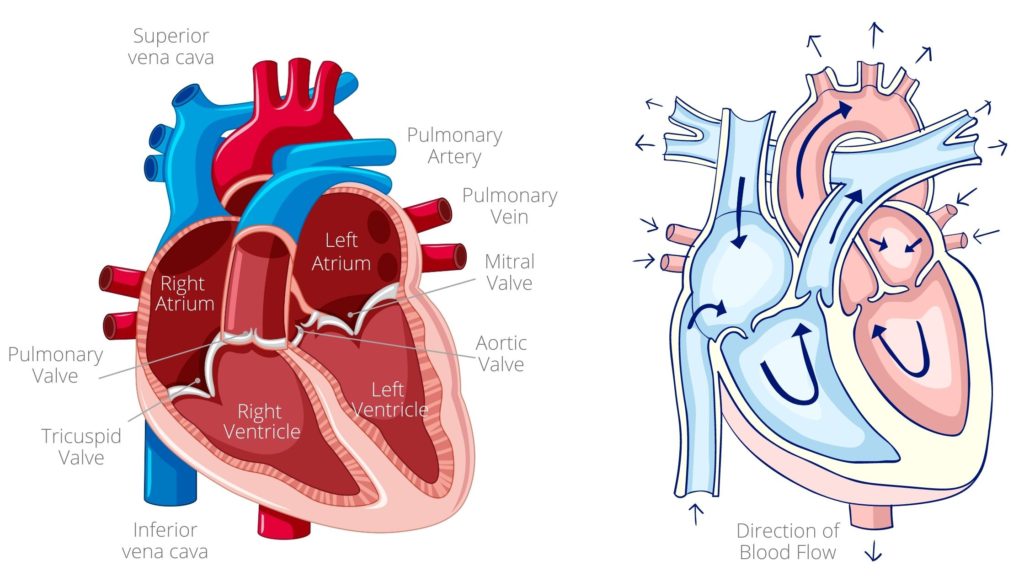
- Between the left atrium and left ventricle is the mitral valve.
- The tricuspid valve is on the right side, between the right atrium and right ventricle.
- The right ventricle opens in the pulmonary artery, and a pulmonary valve exists between them.
- Similarly, the left ventricle opens in the arch of the aorta, and the aortic valve lies between them.
Phases of the Cardiac Cycle: Step-by-Step Explanation
The pressure changes originate as conductive electrochemical changes within the myocardium that result in the concentric contraction of cardiac muscle2. This electrical activity in the heart muscle is measured as an ECG (Electrocardiogram).
Broadly, the cardiac cycle passes through two phases:
- Diastole: It is a period of relaxation of the heart chamber when the heart is refilled.
- Systole: The period of contraction of the heart chamber, and which blood is pumped out of the heart.
These two phases are subdivided into seven phases. These are:
- Atrial systole.
- Isovolumetric contraction.
- Rapid ventricular ejection.
- Reduced ventricular ejection.
- Isovolumetric relaxation.
- Rapid ventricular filling.
- Reduced ventricular filling.
Don’t get confused by all these terms. We will discuss them in detail, and I will try to make it as simple as possible. At the end of this subheading, you will find a table of all phases and their events. So, let us start one by one.
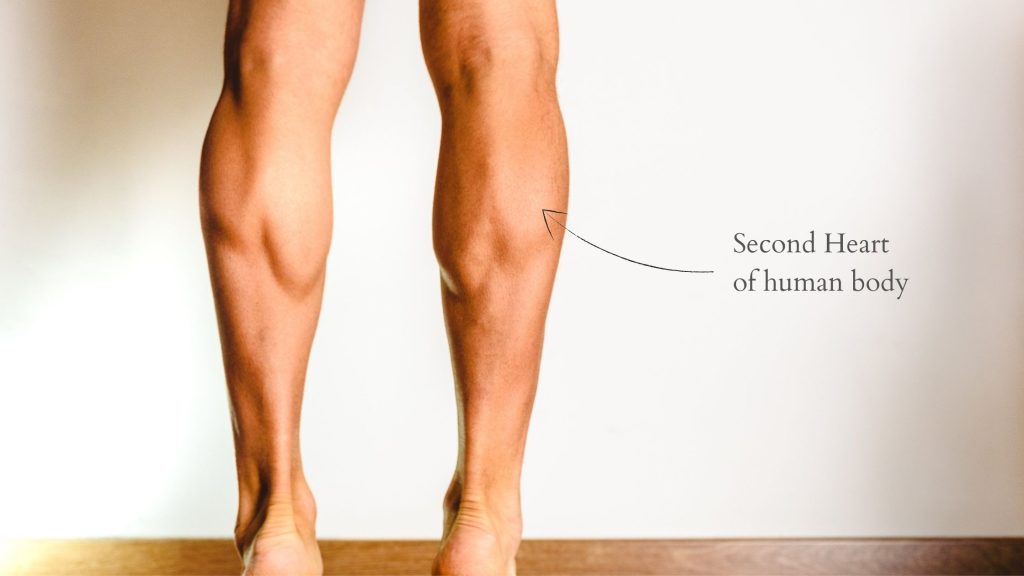
Also read: Which organ is called second heart of the body & why?
Phase 1: Atrial Systole – Active Filling of Ventricles
Atrial systole is the phase of atrial contraction. During this phase:
- The atrium contracts to pump blood into the ventricles. However, only 20% of ventricle filling occurs by atrial systole. The rest of the 80% of ventricular filling has been done passively, even before the onset of atrial contraction. This active filling of the ventricles becomes valuable during physical activity.
- When the pressure in the atrium increases, blood rushes into the ventricles through the opened mitral valve. During left atrium contraction, pressure and volume are transferred into the left ventricle through the opened mitral valve.
Remember, the aortic valve is closed because the pressure in the aorta is greater than the pressure in the left ventricle at this moment.
To understand it clearly, let us once again go back to the above figure and observe the arrow. As you can see, the arrow shows the direction of blood flow from the superior and inferior vena cava, which supplies blood into the right Atrium, and the arrow on the pulmonary Veins shows the direction of blood flow to the left Atrium.
Both atrioventricular valves are open; blood from the left and right atria goes into the left and right ventricles.
Phase 2: Isovolumetric Contraction – Initiating Ventricular Systole
It is the initial phase of the ventricular systole, which means the ventricles are in a state of contraction. In this phase:
- The contraction of the ventricle starts, and the pressure inside the chamber starts to build.
- Initially, the pressure inside the ventricle is not sufficient to push open the semilunar valve. Soon, however, this initial pressure rises above the pressure of the atrium, resulting in the closure of the atrioventricular.
Phase 3: Rapid Ventricular Ejection – Blood Ejected from Heart
This is the second phase of ventricular systole, and pressure inside the ventricles slowly increases.
- As the ventricular pressure builds up, it soon reaches a point where it pushes open the arctic and pulmonary valves and pumps out blood from the heart.
- Since blood is ejaculated rapidly from the ventricle, this phase is called the Rapid ventricular ejection phase. During this phase, 70% of the blood is empty.
Phase 4: Reduced Ventricular Ejection – End of Systole
Contrary to the above, it is a phase of reduced ventricular ejection. It is the last phase of the ventricle systole, during which the pressure inside the ventricles decreases, and the rest 30% of the blood is emptied.
Phase 5: Isovolumetric Relaxation – Start of Ventricular Diastole
It is the early phase of ventricular diastole. During which the ventricle comes to a state of relaxation.
- As the ventricle muscles relax, the pressure inside the ventricle dips.
- When it decreases below the pulmonary trunk and aorta pressure, the blood rushes back towards the heart.
- The backward flow of blood causes the closure of the semilunar valve.
During this phase, the atrioventricular valves remain closed, and the volume of the blood in the ventricle does not change, which is why it is called an isovolumetric relaxation phase.
Phase 6: Rapid Ventricular Filling – Passive Blood Flow
The rapid ventricular filling phase is the second phase of ventricular diastole. During this phase:
- The ventricle muscles relax further, and pressure decreases further.
- Eventually, the pressure inside the ventricle drops to a point where it becomes lower than the pressure inside the atria.
- As a result, blood from the atrium pushes open the atrioventricular valve, and blood rushes into the ventricles. This happens rapidly, so it is called a Rapid ventricle filling phase.
Phase 7: Reduced Ventricular Filling (Diastasis)
During the reduced ventricle filling phase, which is also known as diastasis, the ventricles continue to fill slowly. This phase represents the longest part of the cardiac cycle and occurs after the rapid filling phase.
During diastasis, the heart muscle is in a state of relaxation, allowing for a gradual and steady filling of the ventricles with blood from the atria.
This phase is crucial for ensuring that the ventricles are adequately filled before the next contraction, which is essential for maintaining an efficient cardiac output.
How Early vs. Late Diastolic Filling Shapes Heart Function
- Early Diastolic Filling
After isovolumetric relaxation, as the ventricles relax, the pressure in the left ventricle drops below the left atrial pressure. This pressure gradient opens the mitral valve, causing a rapid, passive influx of blood into the ventricle.
This phase is energy-efficient and depends largely on the elastic recoil and relaxation capacity of the ventricular myocardium1. - Late Diastolic Filling (Atrial Systole)
Late in diastole, the atria contract to push the remaining blood into the ventricles—this is called atrial systole. Only about 20–25% of the ventricular filling occurs here in healthy adults, but it becomes more significant if early relaxation is impaired (as seen with aging or cardiac pathology)1.
Clinical Implications
Exercise Tolerance
During exercise, a healthy heart is able to rapidly relax and increase early diastolic filling despite a shorter diastolic period. This is because of the healthy ventricular elastic recoil and efficient relaxation—meaning the bulk of blood fills the ventricle quickly, allowing for higher heart rates without loss of cardiac output.
In failing hearts (systolic or diastolic heart failure), early diastolic relaxation is impaired. The left atrium compensates by increasing pressure, which shifts more of the filling load to late diastole.
However, this compensatory mechanism is less effective at rapid heart rates (during exercise), leading to increased left atrial pressure, pulmonary congestion, and symptoms like breathlessness and fatigue.
“Evidence suggests that exercise intolerance in heart failure patients is more closely linked to diastolic filling abnormalities and increased left atrial pressure, rather than just reduced ejection fraction.”
Heart Failure
In heart failure, there is poor early filling due to stiff or poorly relaxing ventricles. The ventricle may require higher atrial pressures to fill, and a greater portion of filling shifts to atrial contraction.
Over time, this leads to elevated left atrial and pulmonary pressures—manifesting as exercise intolerance (dyspnea, fatigue)1.
Quick Table for Student Reference:
| Phase | Mechanism | Filling Contribution | Clinical Significance |
|---|---|---|---|
| Early Diastolic | Passive, rapid | 75–80% | Relies on chamber relaxation/elastic recoil; vital at high HR |
| Late Diastolic (Atrial systole) | Active (atrial contraction) | 20–25% | More important when early relaxation is impaired; less effective with tachycardia |
Cardiac Cycle Phases Table: Summary of Events
Cardiac Cycle
Tap a phase to explore pressure, valves, and ECG relationships
Phase 1
Atrial Systole
Atrial contraction completes ventricular filling, raising ventricular end-diastolic volume.

The author is a physiotherapist who has been practising for the last 17 years. He holds a Bachelor's in Physiotherapy (BPT) from SVNIRTAR (Swami Vivekananda National Institute of Rehabilitation and Research), one of the prestigious physiotherapy schools in India.
Whatever he learns dealing with his patient, he shares it with the world through blogs and e-books. He also owns a YouTube channel, "Sunit Physiotherapist" with over 8 lakh active subscribers. Here, he shares everything he gets to learn serving the patient.




Thank you
Nice post, Thank you for sharing valuable information. I enjoyed reading this post. The whole blog is very nice found some good stuff and good information here Thanks for sharing…Also visit my page.
Premium Folding Wheelchair