Last Updated on January 23, 2026 by Sunit. S. Ekka

Stanford research proves: A simple 5-10 degree foot angle adjustment while walking reduces knee osteoarthritis pain by 60% – matching medication effectiveness without side effects. The personalized technique also slows cartilage damage progression over one year.
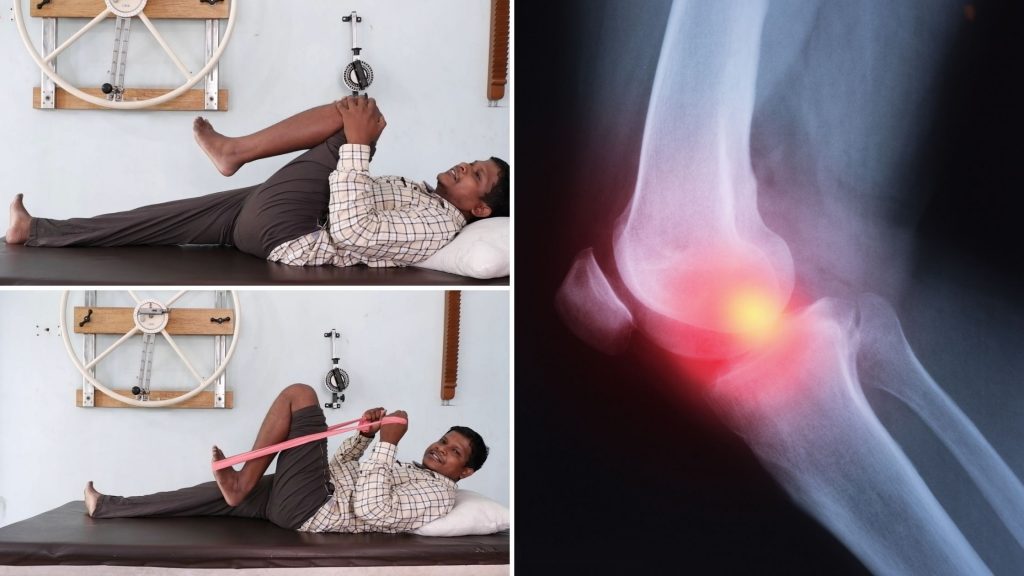
In osteoarthritis of the knee, the smooth cartilage lining over the joint surface gets eroded. Currently, there is no way to restore this erosion. Exercises for OA knee are considered effective conservative management.
In a recent research from the University of Utah, New York University, and Stanford University, researchers have found that gait training can be a promising alternative.
Scientists have found that adjusting the angle of the foot while walking was effective in pain reduction as compared to medications.
Let us find out more about this research.
Can Changing Foot Angle Reduce Knee Pain?
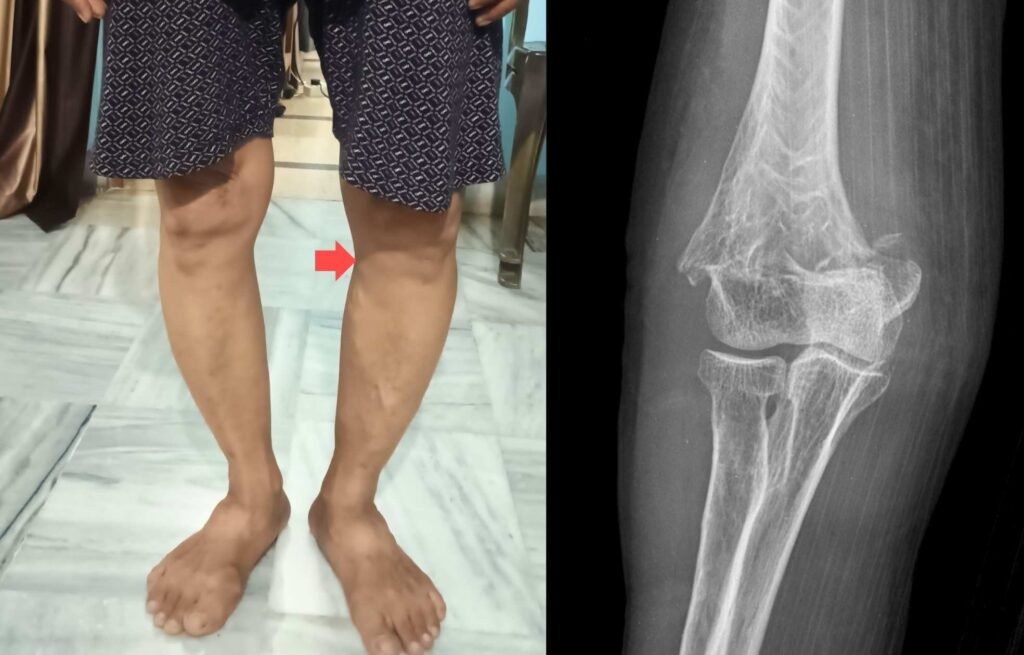
A 79-year-old OA knee sufferer who regularly visits me at my clinic for knee physiotherapy has reported to me that walking in a certain way makes walking comfortable and painless for him. He has a bow leg, making osteoarthritis symptoms more prominent on the inner side of the knee.
This research paper caught my attention as I was keen to learn why walking in a certain way was comfortable than walking normally for my patient.
The study was published in the reputable online journal The Lancet1. The researchers at University of Utah were curious whether changing the foot angle (ie, toe-in or toe-out angle) when walking can reduce the excessive weight on a particular point of the knee and make the walking pain-free.
Two Groups, Two Different Walking Approaches
For this, the researchers were looking for adult individuals who have osteoarthritis knee with pain and other symptoms on the inner side (medial) side of the knee. Out of 1582 participants, they finally recruited 68 individuals at Stanford University, USA.
They were randomly assigned to two groups. One group was the intervention group, and the other was the Sham group. They all were going to receive gait training in the lab.
So, what new gait pattern was trained to them?
The participants of the sham group were instructed to walk normally, which aligned with their normal gait pattern without any modification to the foot position.
However, the participants of the intervention group were trained to walk with a foot angle progressing from 5 degrees to 10 degrees. Each participants were assigned a personalised foot angle, the angle that has minimal load on the inner side of the knee.
How did the researchers personalise the foot angle for each participant of this group?
They made use of motion capture cameras to track the degree to which participants walked with their toes pointed inward or outward. Using this data, researchers could then calculate the loading in participants’ knees and prescribe the change in foot angle that reduced each individual’s loading.
Evaluation of the gait pattern
The participants of both groups underwent training for 6 weeks. During weekly gait training visits, participants received vibrations on their lower leg after each step, teaching them to walk precisely with their prescribed foot angle.
In the first two sessions, participants also underwent baseline MRI to study and document the current state of cartilage erosion.
After completion of the training phase, participants were instructed to continue practising their new gait for at least 20 minutes each day until it became habitual.
They were asked to attend regular follow-up visits to confirm that they were adhering closely to their assigned gait, typically within a one-degree margin.
After one year, all the participants were reevaluated. They self-reported their experience of knee pain, whether the pain increased, reduced or remained the same.
In addition to this, a second MRI was performed to check its effect on the joint cartilage on the inner side of the knee.
Which walking approach reduced knee pain?
Pain Reduction Results:
After one year of following their assigned gait patterns, the outcome was encouraging.
Participants of the intervention group who were told to practice the personalised foot angle modification experienced significantly greater reduction in medial knee pain compared to those in the sham group.
The difference between the groups was substantial – the intervention group showed a pain reduction score that was 1.2 points better than the sham group on the pain scale.
Biomechanical Improvements:
The researchers also found that the intervention group had a notable reduction in knee adduction moment peak – this is essentially the excessive loading force on the inner side of the knee that contributes to cartilage damage in OA patients.
This reduction was 0.26% of bodyweight × height compared to the sham group.
Cartilage Protection:
Perhaps the most important outcome was, the MRI scans revealed promising changes in cartilage microstructure.
The intervention group showed less deterioration in cartilage quality in the medial compartment compared to the sham group. The difference was 3.74 milliseconds, suggesting that the personalised gait training may have actually slowed down the progression of cartilage damage.
Safety Profile:
The intervention was generally safe. Only three participants dropped out due to increased knee pain – two from the intervention group (6%) and one from the sham group (3%).
No severe adverse events were reported throughout the study.
How can it benefit you as an OA knee pain sufferer?
This research demonstrates how a simple modification, like foot rotation, can offload the painful osteoarthritis knee joint.
This can significantly improve the lives of people suffering from medial compartment knee osteoarthritis.
This study explains the reason behind what I observed in my 79-year-old patient, who discovered that walking in a certain way reduced his knee pain.
While personalised gait retraining has been proven to provide benefits in off-loading and knee pain relief, in my experience, if it is integrated with osteoarthritis knee exercises, it will give the best result.
In my clinical practice, I prescribe strengthening and mobility exercises with knee traction and IFT for optimal results.
Core Exercises That Complement Gait Training:
- Quadriceps strengthening: Supports proper knee mechanics during walking
- Hip abductor exercises: Improves leg alignment and reduces knee loading
- Balance training: Essential for mastering new gait patterns
- Range of motion exercises: Maintain joint flexibility for optimal foot positioning
The beauty of combining these approaches is that stronger muscles make it easier to maintain the new walking pattern, while the improved gait mechanics reduce stress on the joint during exercise.
Keep Reading: Hydrogel Injections for Rheumatoid Arthritis Joint Pain can be a life-saving treatment -Study
FAQ

The author is a physiotherapist who has been practising for the last 17 years. He holds a Bachelor's in Physiotherapy (BPT) from SVNIRTAR (Swami Vivekananda National Institute of Rehabilitation and Research), one of the prestigious physiotherapy schools in India.
Whatever he learns dealing with his patient, he shares it with the world through blogs and e-books. He also owns a YouTube channel, "Sunit Physiotherapist" with over 8 lakh active subscribers. Here, he shares everything he gets to learn serving the patient.