
Last Updated on January 23, 2026 by Sunit. S. Ekka
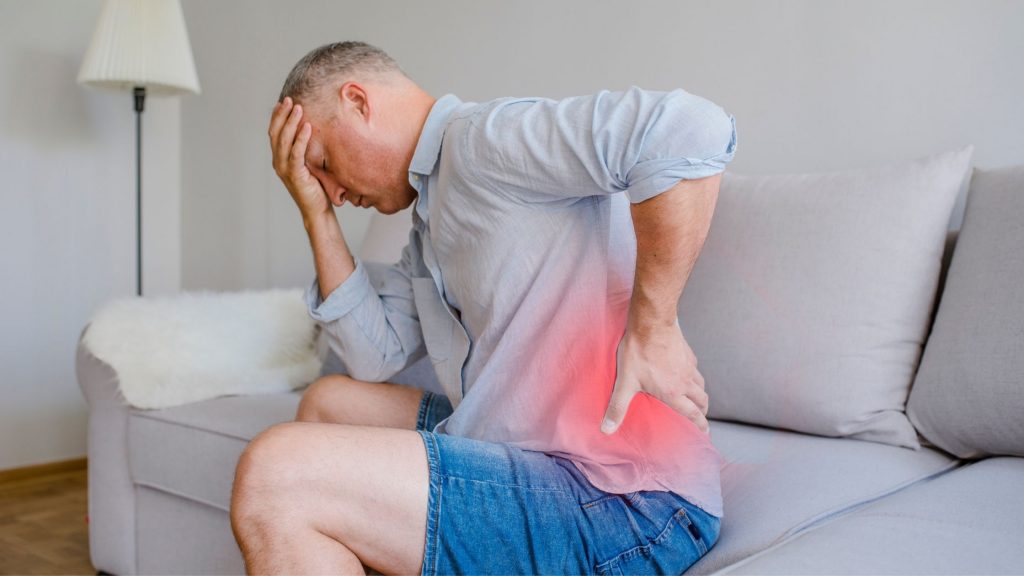
Key Takeaway: The critical difference lies in the pain location. Muscle pain is typically localized to your back, while disc-related pain often radiates into your leg. Identifying which type you have is the first step toward finding the right treatment and avoiding further injury.
How to tell if back pain is muscle or disc? To answer this question, we first need to understand the basics of back pain. It will help you in distinguishing between good exercise and bad exercise.
The Internet is flooded with information about sciatica exercises, but one should be careful that not all exercises are valid. In fact, the authenticity of the source itself is in question. Every third person, even though not a qualified health professional, claims himself /herself a guru of sciatica treatment.
Remember, the wrong exercise will do more bad to your back pain than anything else.
Quick Summary: Muscle vs Disc Pain
✅ Muscle Strain
- Pain Location: Localized to back only
- Pain Type: Achy, stiff, “knotted”
- Onset: Gradual or after overuse
- Sensations: Tenderness to touch
⚠️ Disc Problem (Sciatica)
- Pain Location: Radiates to buttocks/legs
- Pain Type: Sharp, burning, electric shock
- Onset: Often sudden, after injury
- Sensations: Numbness, tingling, leg weakness
Muscle or Disc Pain? Understanding the Two Main Types
After 11 years of professional dedication and successfully dealing with back pain, I have come up with a few simple steps to recognise the type of back pain you might be suffering from.
These steps are very simple. It can give you a broader picture of the actual problem on your back. But do keep in mind that this is not a replacement for professional medical investigation.
So, before moving ahead, let us first discuss the types of back pain.
To simplify it, back pain can be broadly classified under two subheadings.
- Localised back pain.
- Back pain with radiation to the lower leg.
Signs Your Back Pain is a Muscle Strain
In localised back pain, the pain is only felt in and around the lower back. The person complains of pain and tenderness only around the lower back region. The localised back pain could be due to muscle spasm or trigger points.
Usually, this type of pain is very old (muscle spasm is an exception, which develops instantaneously); they do not start all of a sudden, and it develops slowly with time.
If I ask for the exact day when you started this back pain, perhaps you may recollect it. This is because this type of pain is usually very old it develops slowly with time.
Common Causes of Muscle-Related Back Pain
- Sitting habitually in the wrong posture.
- Often associated with professions like a truck driver, whose profession involves long hours of driving in a single sitting position.
But the good thing is that it can easily be managed if you regularly do a few effective back pain exercises at home. And if you visit your physiotherapist, they will apply IFT treatment and Ultrasonic treatment.
Signs Your Back Pain is a Disc Problem (Sciatica)

In this type, pain in addition to the lower back is also felt (referred to) on the lower leg. It means the sufferer will have low back pain and also a complaint of pain (with burning and pulling sensation) radiating down to the legs. It could be on one single leg or both legs simultaneously.
Pain radiating to the leg is a red flag indicating possible internal neuronal involvement. You may also feel a sudden sharp pain in lower back when bending over. Most probably, it could be due to sciatica.
Once you have found symptoms of sciatica, you should become very cautious. Even you must follow the proper way of getting out of bed in back pain.
A Self-Check Guide: How to Tell if Your Back Pain is Muscle or Disc
So, how to tell if back pain is muscle or disc? First, try to observe your pain and ask yourself these questions.
- Do I feel pain only in the back?
- Is there any kind of pain other than the lower back pain?
- Am I feeling any pulling sensation or tingling sensation in my legs?
- Do I feel uncomfortable while walking or standing on my legs?
If you have come up with the answers, then again ask these questions.
- When did my pain start?
- Am I able to remember the exact day when my pain started?
- How did it start?
Did it start on its own or while lifting a heavyweight, during jumping or twisting (try to associate the incident that could have triggered your pain)?
Note down your answers on a piece of paper. Try to evaluate and compare it with the probable answers given below.
You might come across one of the two following answers.
You only have pain concentrated on your lower back and are unable to recollect the exact day or incident that triggered the pain.
The second condition is that you have pain in your back, and you also feel a pulling sensation or a painful tingling sensation in the lower legs. It could be the right leg or the left leg, and you can easily associate it with the incident. The incident could be a jerk, twisting, jumping and lifting a heavyweight or anything like this.
What to Do Next: Your Action Plan Based on the Pain Type
Before we proceed, let me once again repeat our main question: how to tell if back pain is muscle or disc?
If your answer is the first one, then you are on the safer side. This pain can easily be managed with a few effective tips. We have got some most effective pain-relieving tips and techniques in our chapter, you can apply them and see your pain vanish in no time.
But if the second point is your answer, then it’s a matter of concern. You might be suffering from a neurological problem known as sciatica.
Once again, let me remind you that this is not a replacement for professional medical investigation. You should take professional help to get fully diagnosed and pinpoint the cause of pain.
When to Seek Help and Treatment for Sciatica

- Ekka, Sunit Sanjay
- Quddus, Nishat
This article is an extract from my book “Sciatica Relieved”. You will find everything related to sciatica in this book. If you are a sciatica sufferer, I would highly recommend getting it as soon as possible.
Keep reading: Sciatica pain relief: Dummies guide that actually works
Frequently Asked Questions

The author is a physiotherapist who has been practising for the last 17 years. He holds a Bachelor's in Physiotherapy (BPT) from SVNIRTAR (Swami Vivekananda National Institute of Rehabilitation and Research), one of the prestigious physiotherapy schools in India.
Whatever he learns dealing with his patient, he shares it with the world through blogs and e-books. He also owns a YouTube channel, "Sunit Physiotherapist" with over 8 lakh active subscribers. Here, he shares everything he gets to learn serving the patient.




Pingback: How to Get Out of Bed with Sciatica Back Pain - Physiosunit
Pingback: क्या हर्निएटेड डिस्क अपने आप ठीक हो सकते हैं? : Physiosunit
Pingback: क्या हर्निएटेड डिस्क अपने आप ठीक हो सकते हैं? – Physiosunit
Pingback: एक हर्निएटेड डिस्क अपने आप ठीक कर सकते हैं? – Physiosunit
Pingback: Safe Way of Getting out of bed with back pain sciatica : Physiosunit
Pingback: 6 Best ball exercises for lower back for quick pain relief : Physiosunit