
Last Updated on January 23, 2026 by Sunit. S. Ekka
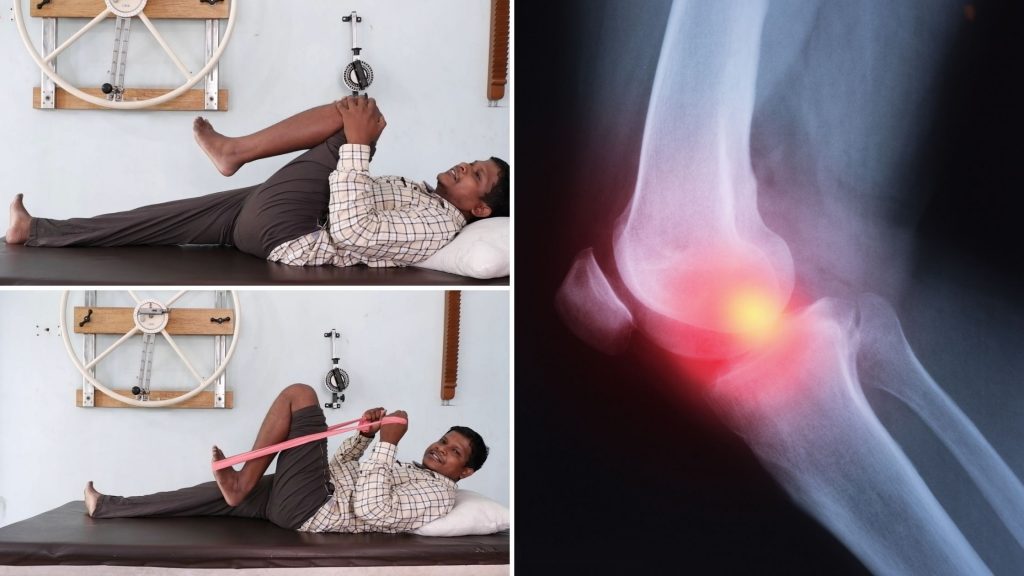
Key Takeaways
- ✅ Strengthening exercises (like straight leg raises) protect joints.
- ✅ Range-of-motion exercises (patella mobilization) reduce stiffness.
- ✅ Use resistance bands or light weights for progression.
- ✅ Heat therapy (infrared lamp) helps manage flare-ups.
It is very common for a rheumatoid arthritis sufferer to have knee pain with joint restriction and stiffness. Fortunately, we can prevent or, to be realistic, slow down these knee issues with simple knee rheumatoid arthritis exercises.
We often confuse osteoarthritis (OA) and rheumatoid arthritis; they are not the same. Although they both affect joints, there’s a difference between osteoarthritis and rheumatoid arthritis.
Contrary to OA, rheumatoid arthritis involves many joints of our body, even the small joints of our fingers; our spinal joint affects all of them. In this article, I’ll specifically focus on knee rheumatoid arthritis.
- 10 Best Knee Rheumatoid Arthritis Exercises for Pain & Stiffness Relief
- 7 Strengthening Exercises to Support Weak RA Knees (With Steps!)
- 1. Knee Press Exercise – Simple Quad Strengthening for RA Knees
- 2. Ankle & Toe Mobilization – Improve Circulation & Flexibility
- 3. Straight Leg Raises – Strengthen Thighs Without Joint Stress
- 4. Side-Lying Leg Lifts – Target Outer Thigh Muscles Safely
- 5. Inner Thigh (Adductor) Strengthening – Pillow Squeeze Technique
- 6. Prone Hamstring Curls – Protect Knees While Building Strength
- 7. Resistance Band Workout – Low-Impact Knee Flexion/Extension
- 3 Gentle Range-of-Motion Exercises to Reduce Knee Stiffness
- Pro Tip: How to Safely Progress These Exercises (Weights & Reps)
- Bonus: 3 Quick Pain-Relief Tips for RA Knee Flare-Ups
10 Best Knee Rheumatoid Arthritis Exercises for Pain & Stiffness Relief
So, whatever exercises we are going to learn, we can broadly divide them into two categories. We can divide them into strengthening exercises and range-of-motion exercises.
Strengthening exercises strengthen our muscles, and range-of-motion exercises prevent the stiffness and joint restriction of our knees. If our knees become stiff, we will have difficulty bending or straightening them.
Rheumatoid arthritis affects almost all axial joints, including the hip, shoulder, and small finger joints. However, as the article title suggests, we will focus on the knee joints in this article.
7 Strengthening Exercises to Support Weak RA Knees (With Steps!)
1. Knee Press Exercise – Simple Quad Strengthening for RA Knees
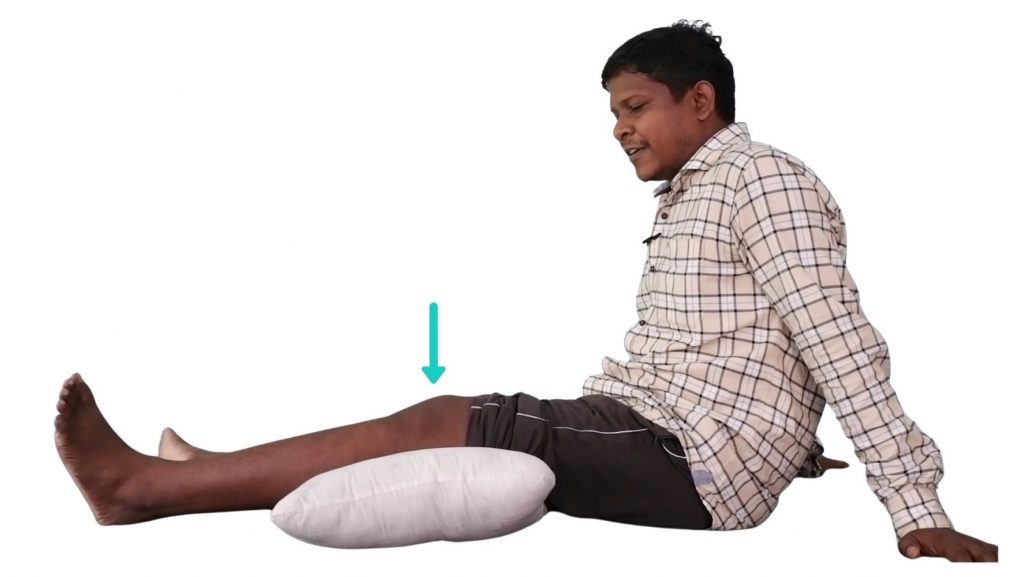
Arthritis pain is a common cause of reduced walking. In the long run, this can lead to weak muscles. The knee press exercise is a great way to strengthen the quadriceps muscle on the front of the thigh.
To perform this exercise, all you need is a pillow.
- Start by sitting on a chair or a mat with your legs extended before you. Place the pillow under your knees.
- Now, press the pillow with your knees and hold this position for five seconds. You can count to five in your mind to keep track of time.
- After five seconds, relax your knees and release the pressure on the pillow.
- Repeat this process thirty to forty times or until you feel comfortable. This exercise strengthens the muscles around the knees, which can reduce pain and improve mobility.
2. Ankle & Toe Mobilization – Improve Circulation & Flexibility
Ankle foot-toe movement exercise is a great way to improve the strength and flexibility of your ankle, calf, and knee muscles.
It can be done in the long sitting position and involves moving your ankles and feet, as shown in the figure.
- To begin this exercise, sit with your legs straight out before you and place your hands on the ground for support.
- Start by moving your toes towards your shin, then down towards the ground. Next, move your foot up towards your shin, then down towards the ground.
- Repeat this sequence of movements as much as you can while sitting.
3. Straight Leg Raises – Strengthen Thighs Without Joint Stress
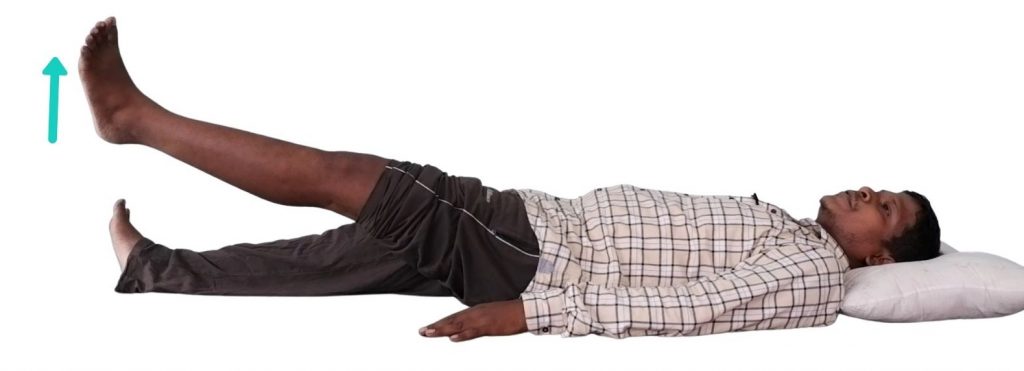
The straight-leg raise exercise is a great way to strengthen the muscles at the front of your knee. To perform this exercise, you’ll need to lie down on your back and raise one of your legs straight up without bending the knee.
It’s important to note that the leg should only be raised up to about thirty degrees, not more than that.
- To start the exercise, lift your leg and hold it up for five seconds.
- Count to five while holding the leg up, then slowly lower it back down. Be sure to keep your leg straight throughout the entire exercise.
- After you’ve lowered your leg, lift the other leg and hold it up for five seconds. Count to five, then lower it back down.
- Continue alternating between your legs, lifting one at a time, until you’ve completed 10 repetitions.
4. Side-Lying Leg Lifts – Target Outer Thigh Muscles Safely
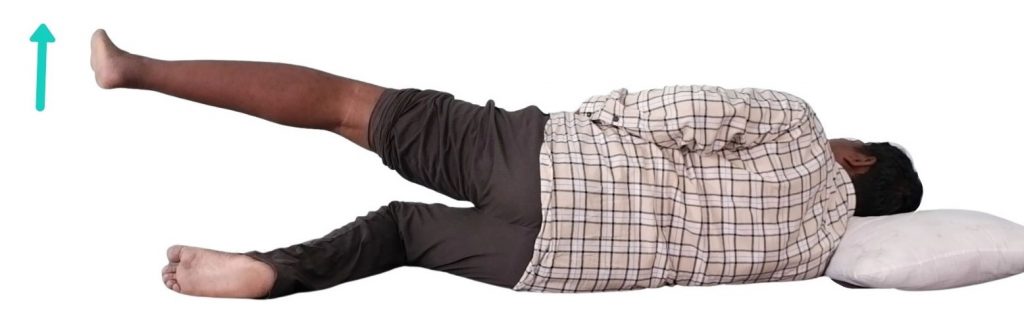
To strengthen the muscles outside your thighs, you can do a simple exercise called the straight leg raise in side-lying.
- First, lie down on your side, preferably on a comfortable surface. If you want to exercise your right leg, you should lie on your left side.
- Once you are in position, bend your bottom leg slightly and keep the top leg straight.
- Next, slowly raise your top leg while keeping it straight and without bending your knee.
- Once you have reached 30 degrees, hold the position for another five seconds before slowly lowering your leg.
- Then, lift your leg again, count to five, and relax.
5. Inner Thigh (Adductor) Strengthening – Pillow Squeeze Technique
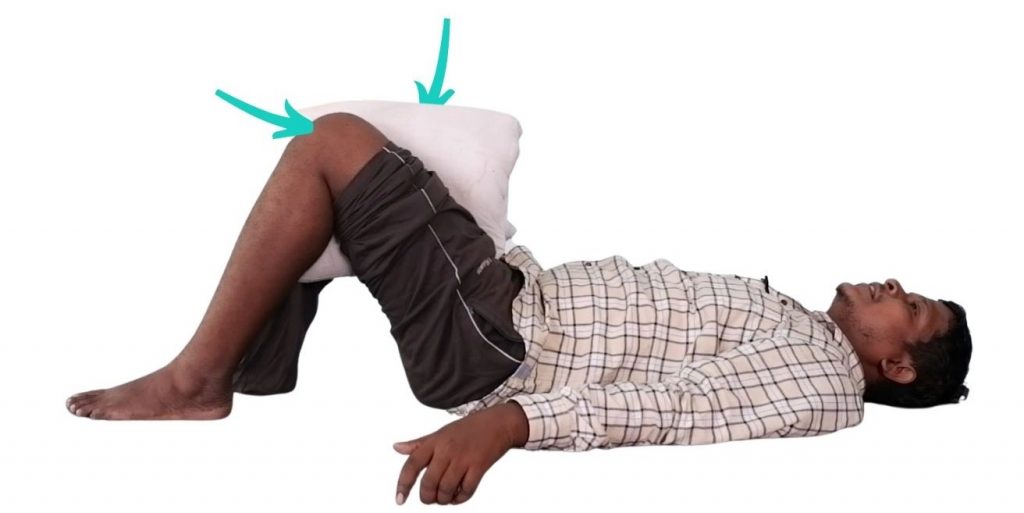
If you want to strengthen the muscles on the inside of your knees and thighs, there is a simple exercise that you can do.
- Start by lying down flat on your back. Then, bend both of your knees, as shown in the figure.
- Next, keep the pillow between both of your thighs. Make sure it’s in a comfortable position. Once you have the pillow in place, press it firmly between your thighs.
- Hold the pressure for a few seconds, and then relax your muscles.
- Repeat this process of pressing and relaxing as many times as you can.
- There’s no specific rule for how often you should do this exercise, so the more you do it, the better.
6. Prone Hamstring Curls – Protect Knees While Building Strength
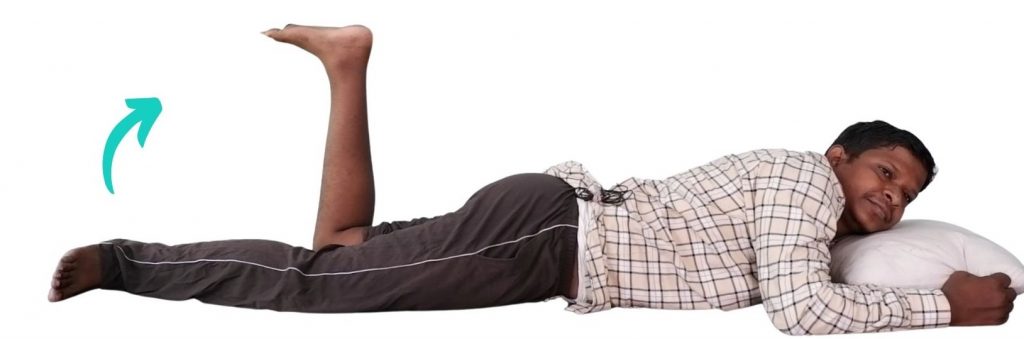
Our next strengthening exercise focuses on the hamstring muscles as part of our knee rheumatoid arthritis exercises. The hamstrings are located on the back of the thigh and are responsible for knee bending.
- We will assume a prone position, lying flat on our tummies to get started.
- Keeping both legs straight, slowly bend one knee to a 90-degree angle and lower it back to the floor.
- Repeat this movement alternately on both legs.
- It is recommended to perform this exercise for a minimum of 15-20 repetitions on each leg. However, the more you practice, the better your results will be.
Also read: 4 Exercises for Fixing Forward Head Posture Permanently
7. Resistance Band Workout – Low-Impact Knee Flexion/Extension
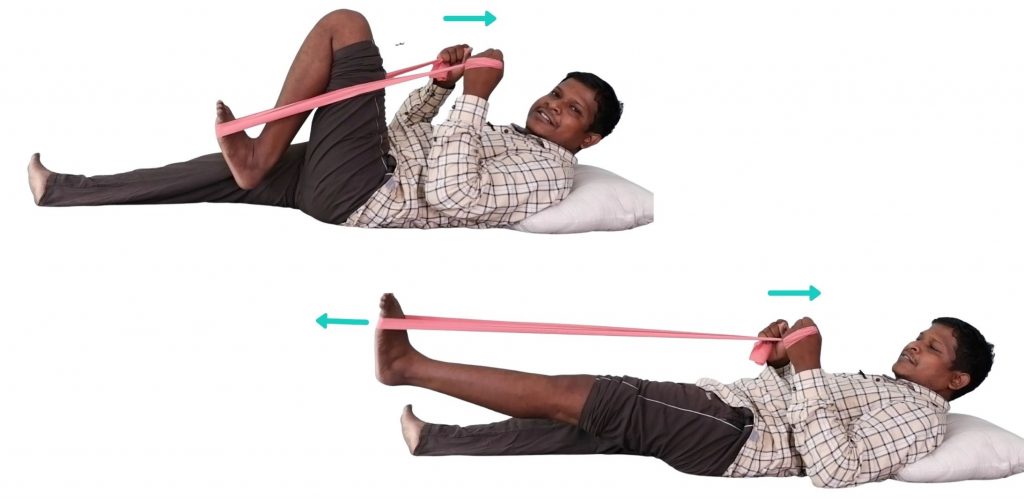
For this exercise, you will need a resistance band made of latex-free rubber.
- Start by lying down on your back and bending one of your knees. Place the band on the ball of your toes and hold both ends of the band firmly with both hands. Pull the band towards yourself to tighten it.
- Now, slowly straighten your knee against the resistance of the band. Remember to keep the band pulled as you straighten your leg against the resistance created by the band.
- Then, bend your knee and repeat the exercise by straightening it again.
- Repeat this process 10-15 times before switching to the other leg.
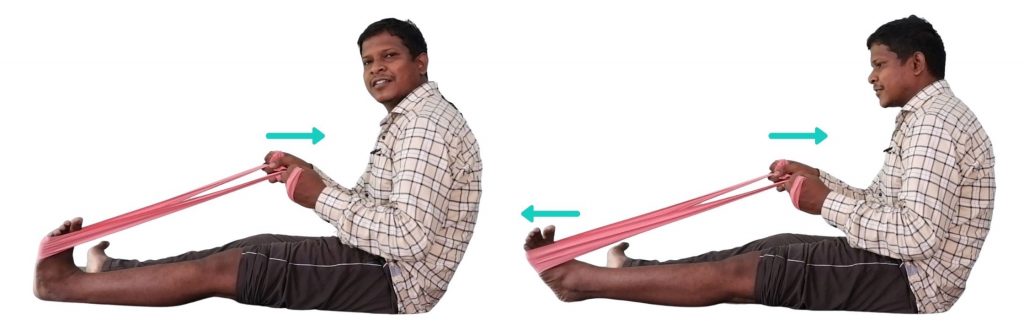
- To begin, take a long sitting position and place the band over the ball of your toes. Hold the two ends of the band with both hands and keep your knee as straight as possible throughout the exercise.
- Next, pull the band towards you and bend your ankle towards yourself. You should feel a gentle stretch in your calf muscles as you do this.
- Hold this position for a few seconds and then release.
- Now, pull the band and tighten it, and then bend your ankle away from yourself against the band’s resistance. Again, hold this position for a few seconds before releasing.
- Repeat this movement at least fifteen to twenty times, maintaining proper form and control throughout.

- Stretches, tones & conditions all major muscle groups, perfect for those with latex allergies or sensitivities
- Simple & easy to use product for upper & lower body exercises that can be performed anywhere, is ideal for conditioning …
- The Non-Latex Resistance Band increases both strength & flexibility in a subtle & natural manner

3 Gentle Range-of-Motion Exercises to Reduce Knee Stiffness
8. Patella Mobilization – Prevent Stiffness in Your Knee Cap
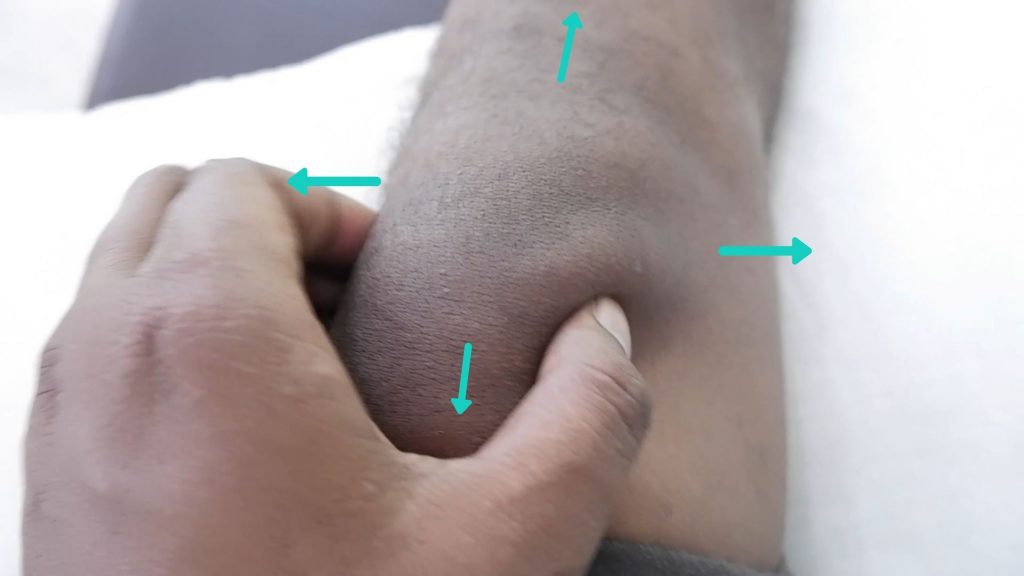
Now let’s move to Range of Motion exercises. These knee rheumatoid arthritis exercises are to prevent stiffness. So, it is straightforward. See, sometimes our patella also gradually gets stiff here.
The patella, also known as the kneecap, is present just over the front of the knee. This bone forms a joint with the anterior knee and has a high degree of freedom of movement. However, it can get stiff sometimes, so we must also prevent that.
For this, sit in a long sitting position and put a pillow under the knees to give a good support base. Sit comfortably and let your leg completely relax; there should not be any tension in it.
Now, hold the patella with your hand as shown in the figure and move it, right-left, left-right, right-left, in this way.
You may also use your thumb and move it, but do it at your convenience. You also have to move in the up-down direction. You have to do it yourself; there is no problem with this.
So, this exercise can help prevent patella stiffness.
9. Knee Bends – Restore Flexibility Gradually
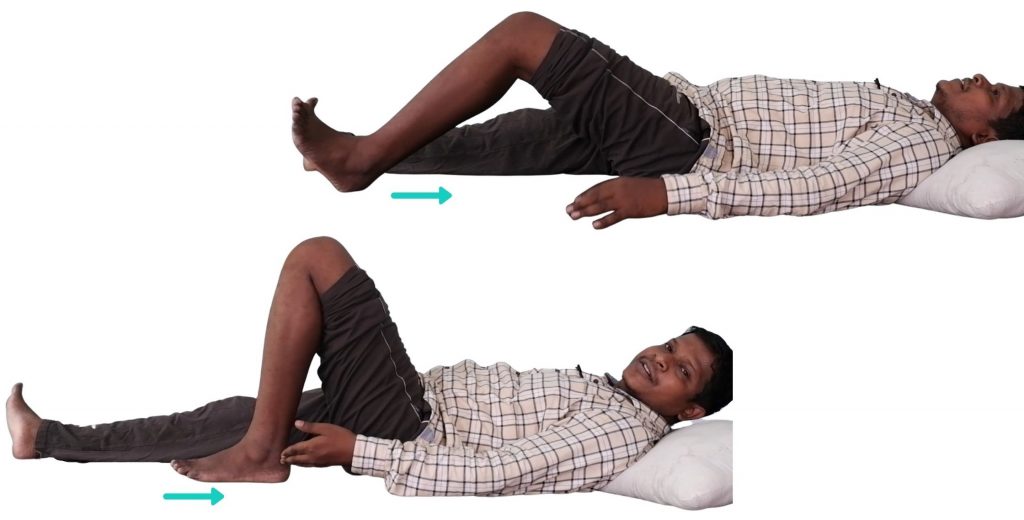
To perform this exercise, start by lying down flat on your back on a comfortable surface such as a bed or yoga mat.
- Once you are in position, slowly flex your knee by sliding your heel towards your buttocks. As you slide, you should feel a gentle stretch in your quadriceps muscles at the front of your thigh.
- Continue to slide your heel inwards until your knee is fully flexed and your heel is as close to your buttocks as possible. Hold this position for a few seconds to allow your muscles to relax and stretch.
- Next, slowly straighten your leg by sliding your heel back down the bed or mat until your leg is fully extended. As you slide, you should feel a gentle stretch in the back of your thigh and calf muscles.
- Repeat this movement as many times as possible, focusing on the slow and controlled motion of sliding your heel up and down the bed or mat.
10. Combined Hip & Knee Stretch – Ease Joint Tension
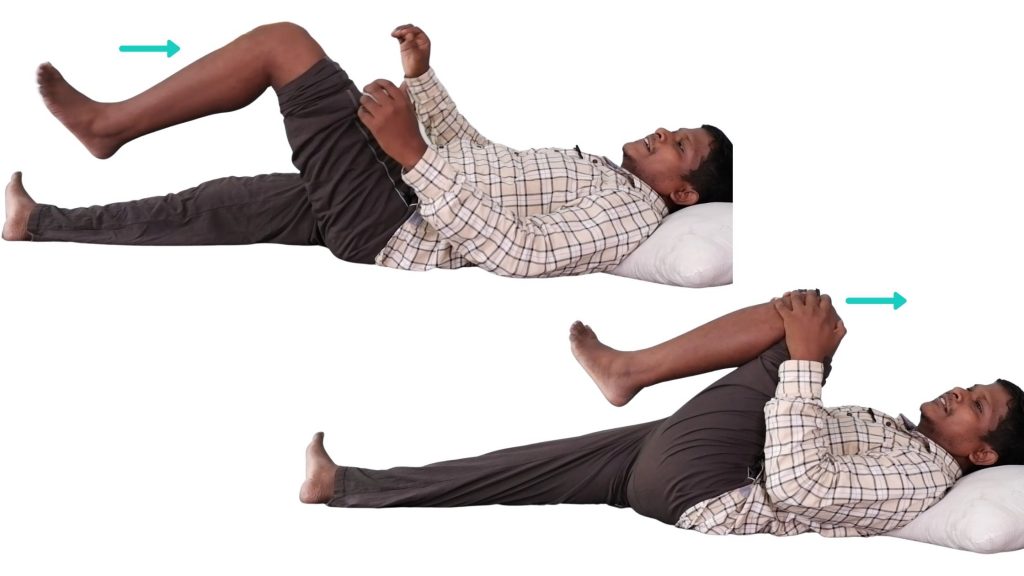
Once you have completed the first exercise, you can move on to the next one, which will focus on both your knee and hip.
- This exercise can be performed by lying flat on your back and slowly bending your knee.
- Once your knee is bent, hold it with both hands and try to pull it towards your chest.
- This will help stretch the muscles in your knee and hip area, thereby increasing flexibility and improving mobility.
Pro Tip: How to Safely Progress These Exercises (Weights & Reps)
Whatever strengthening exercises I have described you like, the straight leg raises this way, and in the side-lying position, all these exercises can be done by adding a weight of 1 KG. Take
a towel and hold a packet of one-kilo salt. You can wrap it here on the leg, and after that, you can do all these exercises, okay? This will bring effectiveness to the exercises.
Or you can simply use a weight cuff, a one-kilogram, one-and-a-half-kilogram weight cuff is available, I have it with me, but perhaps I misplaced it, otherwise, I would have demonstrated it to you, but you can buy it online.
You have to wrap it here, and then you will exercise with it. Do all this when your pain subsides a bit.
Bonus: 3 Quick Pain-Relief Tips for RA Knee Flare-Ups
Exercise is important for the long-term management of your pain and stiffness, but suppose you have pain right now. What will you do about it?
The best tip would be to apply a good pain balm or ointment over the knee where you have pain; after applying the ointment, you can apply a hot pack. You can also use TENS for knee pain relief.. You can also use TENS for instant knee pain relief.
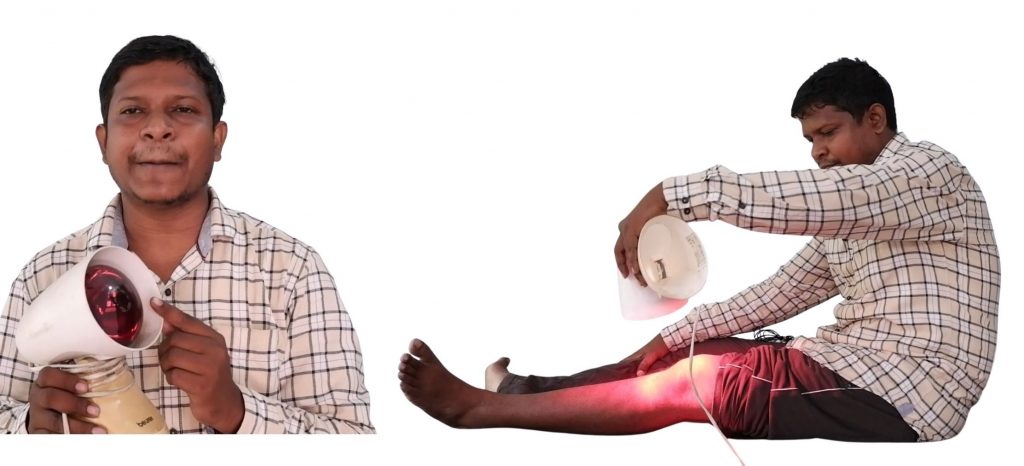
One of my favourite ways to give a hot pack, which I usually recommend to my patients, is this infrared lamp. This lamp has a red bulb that emits red light.
If you apply it over your knees, it will give comfortable heat, and almost immediately, your pain will disappear.
You can also use a hot water bag or simply heat water, dip a towel in it, squeeze it and put it on your knees. You can also adopt all these methods.
![SteadMax [2 Pack] Hot Water Bottles, 2L (68oz) Natural Rubber -BP...](https://m.media-amazon.com/images/I/51aJsmoaiYL._SL500_.jpg)

You can also use a kneecap. If you wear the knee cap regularly, it will help improve the swelling and inflammation. To some extent, it will try to control the difficulty that you have in walking.
Did these exercises help you? Share your progress in the comments below or bookmark this guide for daily use!
Keep Reading: Symptoms of arthritis in the hip & its physiotherapy
FAQs: Knee Rheumatoid Arthritis Exercises

The author is a physiotherapist who has been practising for the last 17 years. He holds a Bachelor's in Physiotherapy (BPT) from SVNIRTAR (Swami Vivekananda National Institute of Rehabilitation and Research), one of the prestigious physiotherapy schools in India.
Whatever he learns dealing with his patient, he shares it with the world through blogs and e-books. He also owns a YouTube channel, "Sunit Physiotherapist" with over 8 lakh active subscribers. Here, he shares everything he gets to learn serving the patient.





Pingback: 4 Exercises to Avoid in Knee Pain Arthritis - Physiosunit
Thanks
Nice article