
Last Updated on January 23, 2026 by Sunit. S. Ekka

Key Takeaway
Cervical radiculopathy exercises, when performed correctly, are some of the most effective home treatments for relieving a pinched nerve in the neck. This guide provides step-by-step exercise instructions, essential safety tips, and practical answers to common questions, empowering you to reduce nerve pain, safely restore neck mobility, and avoid the movements that could worsen your symptoms.
For a pinched nerve in the neck, exercises are the most preferred treatment option. However, not all cervical radiculopathy exercises/ neck exercises are effective; some may worsen the pain. This is because the cause of radiculopathy differs, as do the exercises.
Learning the correct neck exercises for pinched nerves and performing them correctly is important. In this article, we will learn the causes of cervical radiculopathy, its symptoms, and the exercises.
Please read this article to the end to get the most out of it.
- What Is a Pinched Nerve in the Neck? Causes & Risk Factors
- Best Neck Exercises for Cervical Radiculopathy (Pinched Nerve Relief)
- 1. Active Neck Rotation for Cervical Radiculopathy
- 2. Neck Extension (Backward Bending) for Pinched Nerve Relief
- 3. Neck Extension With Towel Support
- 4. Neck Side Bending Stretch
- 5. Chin Tuck Exercise for Neck Posture and Radiculopathy
- 6. Side Neck Stretch for Pinched Nerve Relief
- 7. Isometric Neck Strengthening Exercises
- Key Takeaways: Cervical Radiculopathy Exercise Results
- FAQs on Cervical Radiculopathy Exercises and Pinched Nerve in the Neck:
What Is a Pinched Nerve in the Neck? Causes & Risk Factors
The pinched nerve in the neck is a condition in which the spinal nerve originating from the cervical region is pinched and irritated due to a slipped disc in the upper back.
This gives rise to neurological symptoms in the arm and forearm. We first need to learn a little about its anatomy to understand what it is.
Our cervical spine has 7 cervical vertebrae, from C1 up to C7, and there are 8 spinal cervical nerves originating from here. These spinal nerves travel down our upper arm through the elbow and forearm to our fingers and thumb.

All the sensations and movements in our hands are the action of these spinal nerves.
So, any irritation or compression of the nerve leads to pain and a tingling sensation through the arm, forearm, and fingers.
There are various reasons, but the most common are cervical spondylosis and slipped disc problems in the neck and the upper back area.
We will not go deeper into it, but cervical spondylosis occurs at an older age, during which the cervical vertebrae bones become weak and the neck stiffens.
There could be osteophyte formation on the margins of vertebrae, leading to the narrowing of neural foramina that compresses the nerve.
In the cervical disc hernia, there is bulging/herniation of the cervical intervertebral disc. This, in turn, causes irritation/ compression of the cervical spinal nerve.
Best Neck Exercises for Cervical Radiculopathy (Pinched Nerve Relief)
So, whatever neck exercises we will learn are aimed at treating slipped discs in the upper back and neck area. Exercises help reduce the compression or irritation of the spinal nerve.
But, if you suffer from severe pain, you should reduce the acuteness and then proceed with this exercise. For this, I usually suggest following simple at-home steps.
- First, apply any good pain balm around the neck and upper back area and leave it for 10 minutes so the body can absorb it.
- After 10 minutes, apply heat treatment over it; you may choose any way that suits you, like an infrared lamp, an electric heating pad, or a hot water bottle. But I usually prefer using an infrared lamp.
Returning to the topic, in both the conditions mentioned above (cervical spondylosis and disc hernia), the basic principle of exercise remains the same. All the neck exercises are valid in both conditions, except for one or two exercises.
The one exercise you must avoid in cervical disc hernia is “forward bending of the neck”. Rest, all the exercises are equally effective in both conditions. So, let us start.
1. Active Neck Rotation for Cervical Radiculopathy
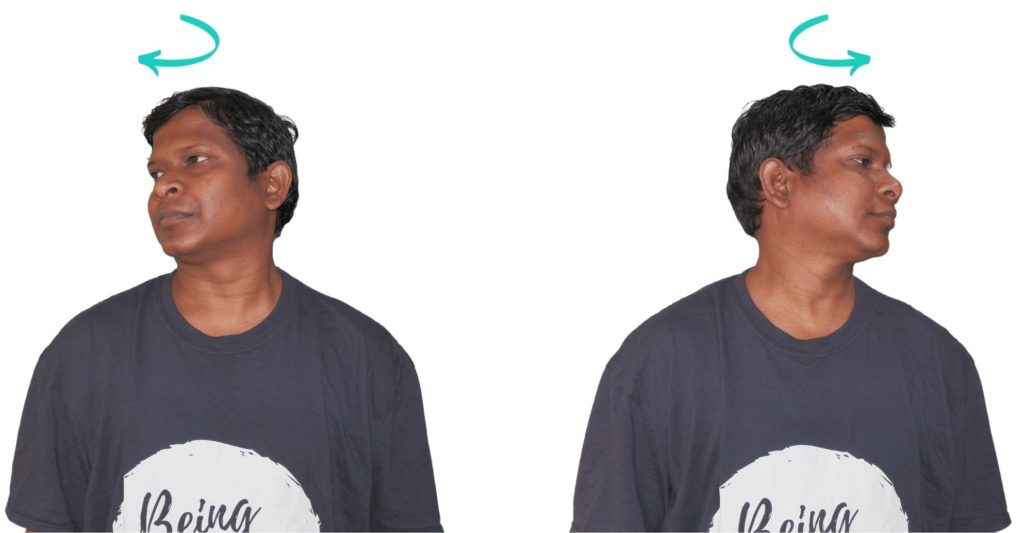
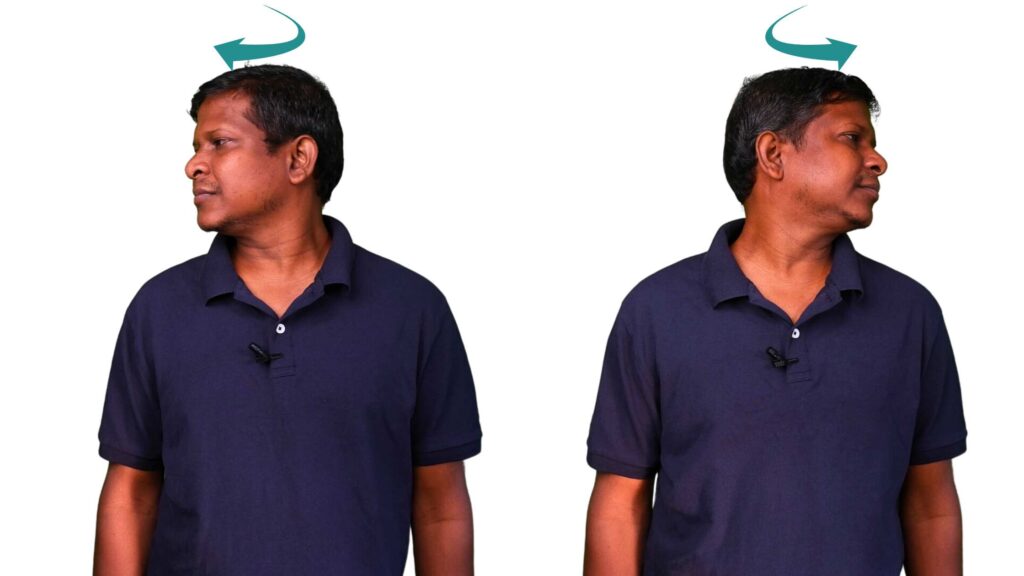
The first exercise among the list of 7 easy cervical radiculopathy exercises is the active neck rotation. To perform this exercise, we must come to a comfortable position, sitting or standing.
Let us assume that we are performing the exercise in a sitting position.
- Sit straight on the chair with your neck erect and your shoulders retracted.
- Now, to the actual exercise, rotate your neck to your left side slowly and smoothly.
- Then, slowly rotate it to the right side without any jerk.
- Repeat ten times on each side.
2. Neck Extension (Backward Bending) for Pinched Nerve Relief

Neck backwards bending, also known as neck extension exercise, is a beneficial activity for improving neck flexibility and strength.
It’s best to start this exercise in a comfortable and supportive position, such as sitting on a chair with a backrest that does not exceed the height of the mid-upper back.
- To begin, find a comfortable position on the chair and relax your shoulders.
- Slowly tilt your head backwards, aiming to feel a gentle stretch in the front of your neck. Be mindful not to push your neck too far or to the point of pain.
- Hold this position for a few seconds and then return your head to the neutral position.
- Repeat this movement at least 10 times, focusing on smooth and controlled motions.
3. Neck Extension With Towel Support

If you find that the above exercise causes significant discomfort, there is a modified version that can help alleviate the strain.
- To begin, assume the same starting position as previously described.
- Take a towel and hold both ends with your hands, then position the towel on the back of your neck.
- Use the towel to provide support to your neck as you gently lean your head backwards.
- Aim to complete at least 10 repetitions of this modified movement.
- This variation of the exercise offers additional neck support, which can help minimise any discomfort you may have felt while performing the original exercise.
4. Neck Side Bending Stretch

When managing cervical radiculopathy, neck side-bending exercises can be highly beneficial. Let’s delve into the specific steps for performing this exercise in a sitting position.
- First, sit in a chair upright with your neck erect and relaxed.
- Now, gradually tilt your neck to the left until you sense a gentle stretch in the muscles on the left side of your neck.
- It’s important to hold this position for about 5 seconds.
- Repeat the same movement on the right side by tilting your head to the right. Doing so effectively provides a moderate stretch to the muscles on both sides of your neck.
- Repeating this exercise 10 times on each side can help maximise its benefits.
- Maintain slow and controlled movements throughout the exercise.
5. Chin Tuck Exercise for Neck Posture and Radiculopathy

The chin tuck exercise is an effective way to help maintain correct neck posture and treat forward neck posture. To perform this exercise, follow these steps:
- Sit or stand in a comfortable position with your back straight.
- Gently tuck your chin in towards your neck as if you are making a double chin.
- If needed, you can use your fingers to provide light pressure to guide your chin movement.
- Hold this position for 3 to 4 seconds, ensuring that you feel a gentle stretch at the back of your neck.
- Slowly release the chin tuck and return to the starting position.
- Repeat this movement at least ten times.
- Performing the chin tuck exercise regularly can help strengthen the muscles in the neck and improve overall posture.
6. Side Neck Stretch for Pinched Nerve Relief

In this stretching exercise, we will stretch the muscles on the sides of our neck. First, we will stretch the muscles on the left side of the neck, then the right side.
- To stretch the muscles on the right side of the neck, place your left hand on the upper side of your head and gently pull it towards the left side until you feel a stretch in the right side neck muscles.
- Hold this position for at least 1 minute and then release slowly.
- Repeat the process for the left side muscles.
- This stretching exercise should be performed once or twice in a session.
7. Isometric Neck Strengthening Exercises

The final exercise in our list of 7 easy cervical radiculopathy exercises is the strengthening exercise. This is a strengthening exercise that aims to strengthen the muscles on all sides of the neck.
- To strengthen the muscles on the front of the neck, place your right hand over the forehead; you can also use your left hand. And apply pressure by hand on the forehead.
- While pushing your head forward, you have to remember that you don’t have to move your neck. You have to press it, which is why it is called an isometric exercise.
- Hold it for 2 to 3 seconds, and then release it. Repeat it ten times.
- To strengthen the muscle on the left side, repeat the same process. But by using the right hand placed over the left side of the head temple region and repeating the method described above.
- Likewise, it would be best to strengthen the right side neck muscles using your right hand and the backside neck muscles by clasping both hands on the back of the head.
Looking for Extra Relief? Alongside these home exercises, we at our clinic have observed that neck traction is helpful for easing tension and supporting recovery from cervical radiculopathy1. However, you can also use the S Cervical Neck Traction device for gentle traction at home to provide controlled stretching and reduce pressure on the nerves. Always consult your healthcare provider before trying new devices, especially if you have severe symptoms.

- ✅INFLATABLE CERVICAL NECK TRACTION DEVICE – Designed to relieve cervical pain and tension, Siwei neck traction device pr…
- ✅ADJUSTABLE & COMFORTABLE NECK TRACTION DEVICE – You can control the amount of air in this inflatable neck brace to get …
- ✅LIGHTWEIGHT NECK DECOMPRESSION COLLAR – When you go out, the neck relaxer can be easily deflated and be put into your b…

Key Takeaways: Cervical Radiculopathy Exercise Results
If you feel radiating pain in your arm, you must immediately consult a neurologist (slipped disc doctor). And your doctor will advise you on a disc herniation MRI, as not all radiating pain in arm is due to crevical radiculopathy.
Once the slipped disc is confirmed, you should take medications as advised and start following the exercises.
It would be more effective if you performed all these exercises twice daily, once in the morning and once in the evening. Follow the exercise repetition mentioned against each different exercise.
Keep Reading: 5 Easy Back Pain on Upper Right Side Exercises that Actually Work
FAQs on Cervical Radiculopathy Exercises and Pinched Nerve in the Neck:

The author is a physiotherapist who has been practising for the last 17 years. He holds a Bachelor's in Physiotherapy (BPT) from SVNIRTAR (Swami Vivekananda National Institute of Rehabilitation and Research), one of the prestigious physiotherapy schools in India.
Whatever he learns dealing with his patient, he shares it with the world through blogs and e-books. He also owns a YouTube channel, "Sunit Physiotherapist" with over 8 lakh active subscribers. Here, he shares everything he gets to learn serving the patient.





Pingback: 12 Easy Chair Exercises for Seniors for Healthy Life (with Video) - Physiosunit
Pingback: 4 Causes of Neck Pain Left Side| Best Home Remedies - Physiosunit
Pingback: What is the Best Exercises for Carpal Tunnel : Physiosunit