
Last Updated on January 23, 2026 by Sunit. S. Ekka

Patellar tendonitis, causing pain below the knee cap, is often manageable with targeted stretching and strengthening exercises you can do at home.
Pain below knee cap?
It could be due to a painful knee condition known as patellar tendonitis. Patellar tendonitis pain is very common among young athletes, where the sufferer complains of pain at the bottom of the kneecap. It is an overuse syndrome typically occurring among athletes who participate in sports requiring jumping.
But with a few simple stretching and strengthening exercises, we can manage it. This article is all about patellar tendonitis and its exercises.
So if you, too, are uncomfortable with pain below the knee cap or patella, then read this article till the end.
What is patellar tendonitis? What causes it?
Before moving on, let’s try to find out what actually is patellar tendonitis. Patellar tendonitis (PT) is characterised by well-localised anterior knee pain along the patellar tendon distribution. The pain is often exacerbated by moving from sitting to standing or walking uphill1.
- Patellar tendonitis is commonly seen in young sports personalities who engage in activities of jumping or running.
- High intensity activities, such as volleyball, basketball players, and mountaineers who engage in mountaineering, they have more risk of developing patellar tendonitis.
- That is why it is also called jumper’s knee because it is seen more in jumpers.
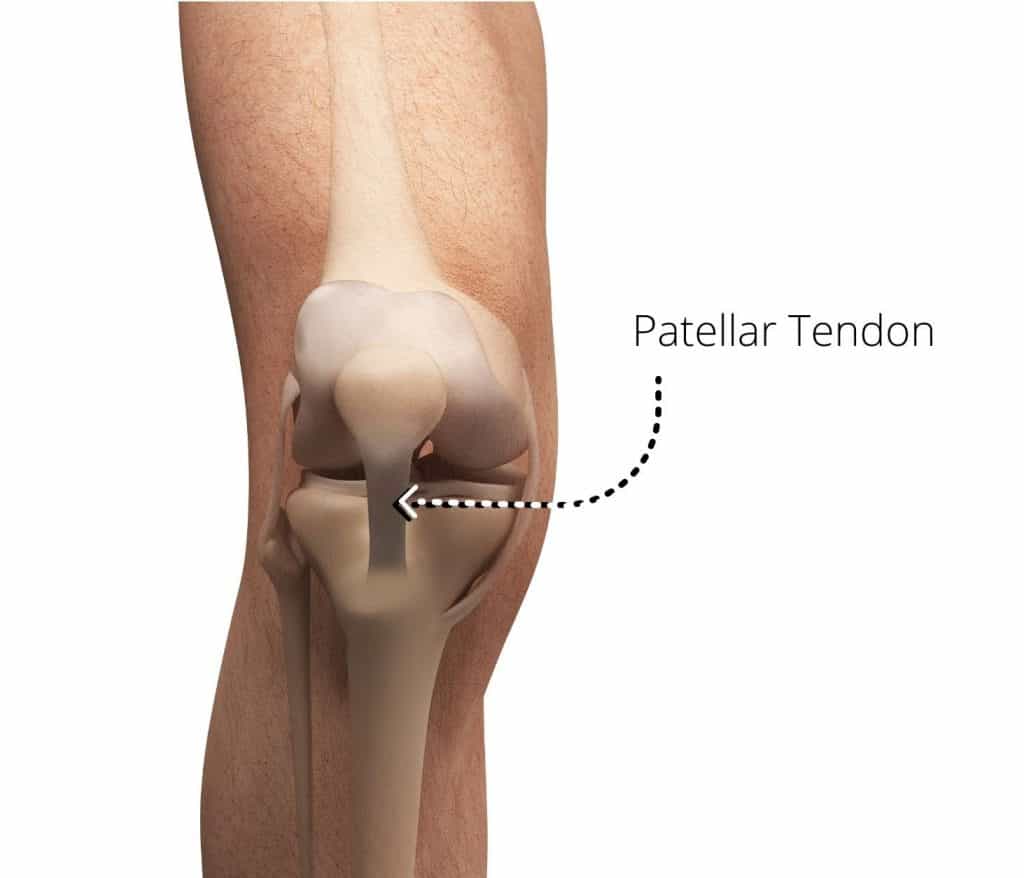
Our knee has a knee cap or patella bone on the front, a tendon that originates from the lower end of the patella and inserts into the upper part of the shin bone. This is why this tendon is called the patellar tendon.
So, whenever someone is doing regular jumping and running activities, this tendon is subjected to excessive stress.
With time, swelling and inflammation start to develop in the tendon, and it becomes painful on sitting to standing, jumping, and running. We call this condition patellar tendonitis.
The Best Stretching Exercises for Patellar Tendonitis
The first exercise we are going to learn is the stretching exercise. In addition to exercises, I also suggest you regularly use a patella support brace, about which we will learn more at the end of the post.
Patellar tendonitis cases usually have tightness of the quadriceps and hamstring muscles. Quadriceps muscles lie in front of our thigh, and hamstring muscles lie in the back of the thigh become tight. So stretching these two muscles is very important.
How to Stretch Tight Hamstrings
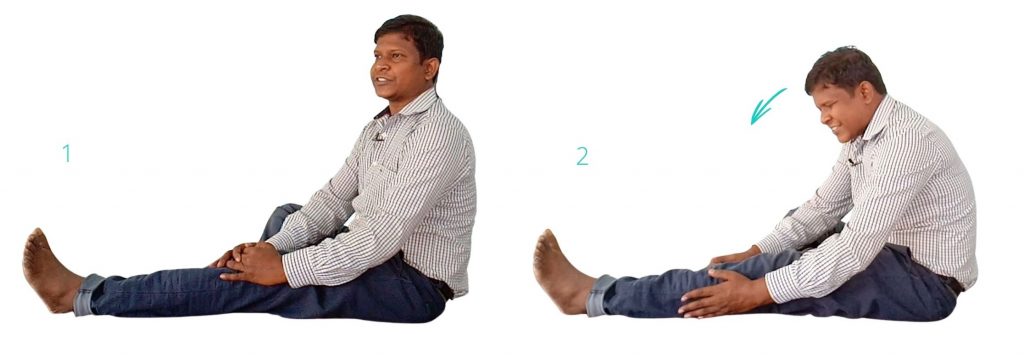
So, first, let me tell you how we can stretch our hamstring muscles.
- For this, we need to sit in a long sitting position. Suppose you have a problem with the left knee. Keep this knee straight and bend the other knee.
- In this position, try to keep your lower back as straight as possible.
- Then slowly bend yourself forward a little. Bend it to a point where you will elicit a nice stretching behind the thigh on your hamstring.
- Note that you don’t have to bend at the upper back; just keep the lumbar region straight, and then bend forward.
- Hold this position for a minimum of thirty seconds or half a minute.
- Bend as much as you can to have good stretching, and after holding this position for 30 seconds, come to relax.
- In a single session, repeat this stretching up to three times.
- To make this exercise more effective, bend the ankle a little bit towards yourself; by doing this, you will have better stretching.
Quadriceps Stretch (Lying on Your Stomach)
Next is quadriceps stretching exercises. We can do this exercise in two ways: One, we can do it in a lying position, and the second is standing. So, let me first cover the exercise in the lying position.
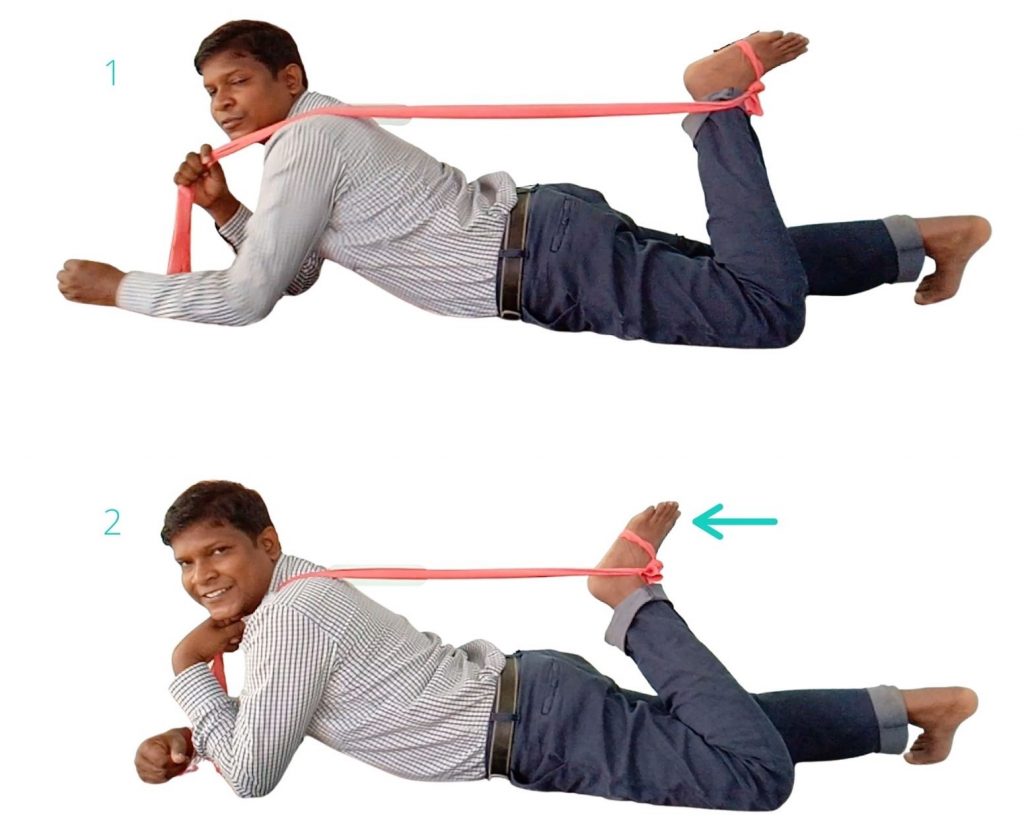
- For that, I will use a resistance band; you can use either a bed sheet or a towel.
- I find it easier to use a resistance band, and I make a loop on one side of it, wrap it around your legs and hold the other end with your hand.
- Then, lie on your tummy and bend the knees in question as in the figure.
- Now pull the band towards yourself to create a stretch on the thigh muscle.
- Keep stretching it to the point where I have a nice stretch feel on the quadriceps muscles.
- Once you have a comfortable stretch, hold that position for 30 seconds.
- Do at least 3 times in a single session. You can do two to three sessions a day.

- HEAVY RESISTANCE FOR FULL-BODY TRAINING: Designed for upper and lower body workouts; ideal for strength building, flexib…
- CUT TO ANY LENGTH FOR CUSTOM FIT: 50-yard latex roll lets you trim precise lengths for individual workouts, body sizes, …
- PORTABLE & EASY TO USE ANYWHERE: Lightweight and compact for workouts at home, gym, office, or while traveling; perfect …

Standing Quadriceps Stretch
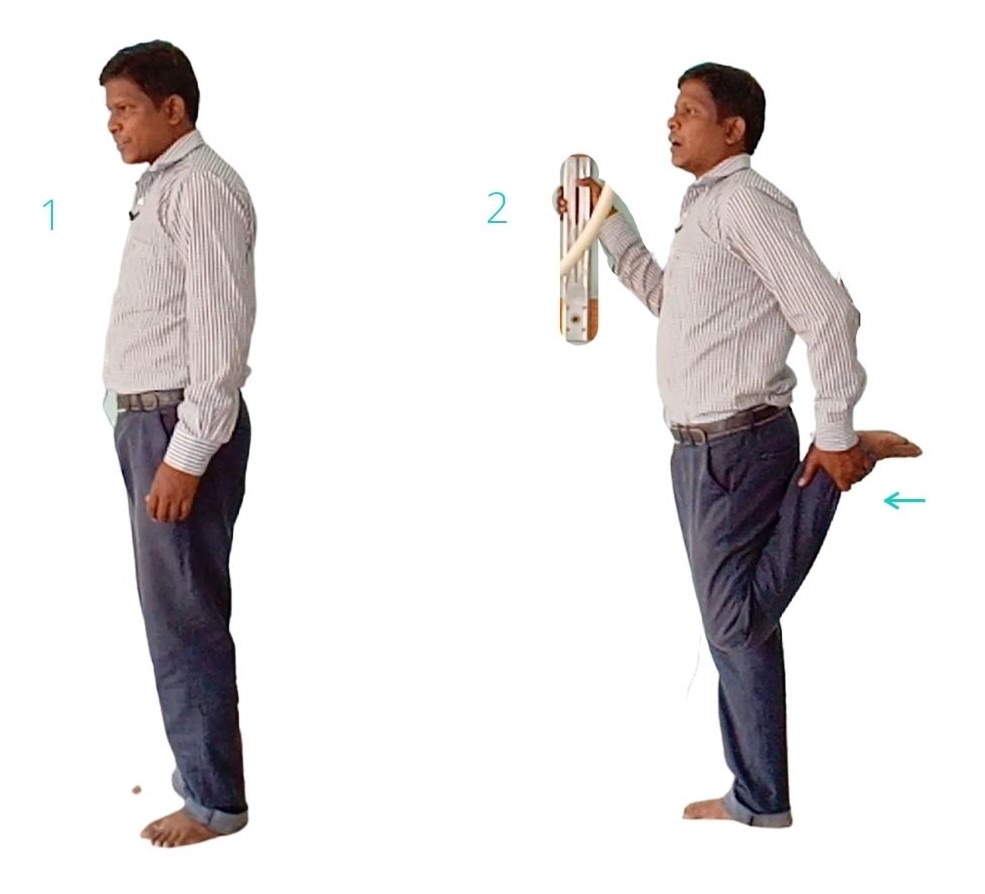
We can do quadriceps stretching in a standing position as well.
- For this, stand normally. Then bend the knee, and hold your legs behind yourself as in the figure. Make sure to stand as straight as possible. If you are stumbling, grab something firmly.
- In this starting position with this hand, bend your knees, and press towards your buttocks. Try to keep your hip full straight, and avoid any slouching or bending. Look at the image carefully. I have not bent the hip; I have a perfectly straight hip.
- Then pull your heel towards your buttocks with your hands. So you’ll get a nice stretch in front of the thigh.
- You should also hold it for a minimum of 30 seconds.
- Do it thrice in a single session, two to three times a day.
Patellar Tendonitis Strengthening Routine
Straight Leg Raises (For Quadriceps)
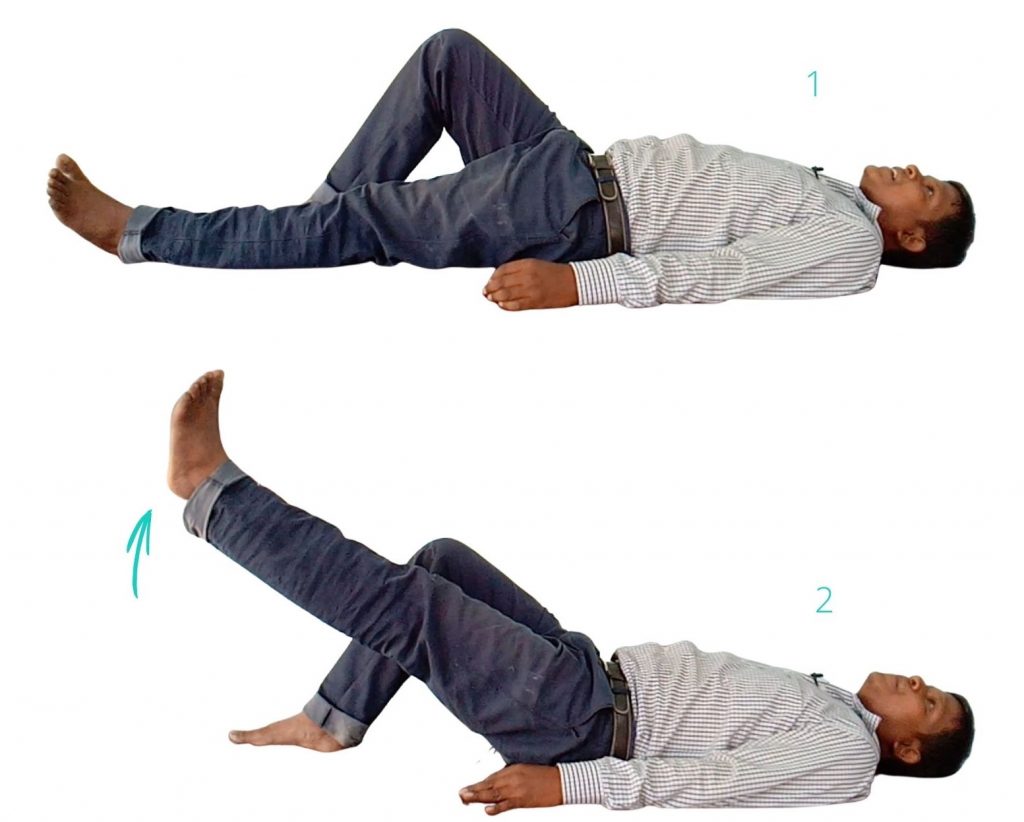
The next exercise of pain below the knee cap is the strengthening exercise. It goes like this: You have to strengthen the muscles around your leg. So first of all, let me explain the quadriceps strengthening exercise. For this:
- Lie down flat and bend the other knee as in the figure.
- Then raise the leg that has pain to bring it to a level equal to the opposite thigh.
- Hold this raised position for five seconds, then lower it. Relax…Again, raise your leg and hold it for 5 seconds after bringing it equal level.
- In this way, you do it at least 10 to 15 times in a session.
Wall Sit or Semi-Squat Hold
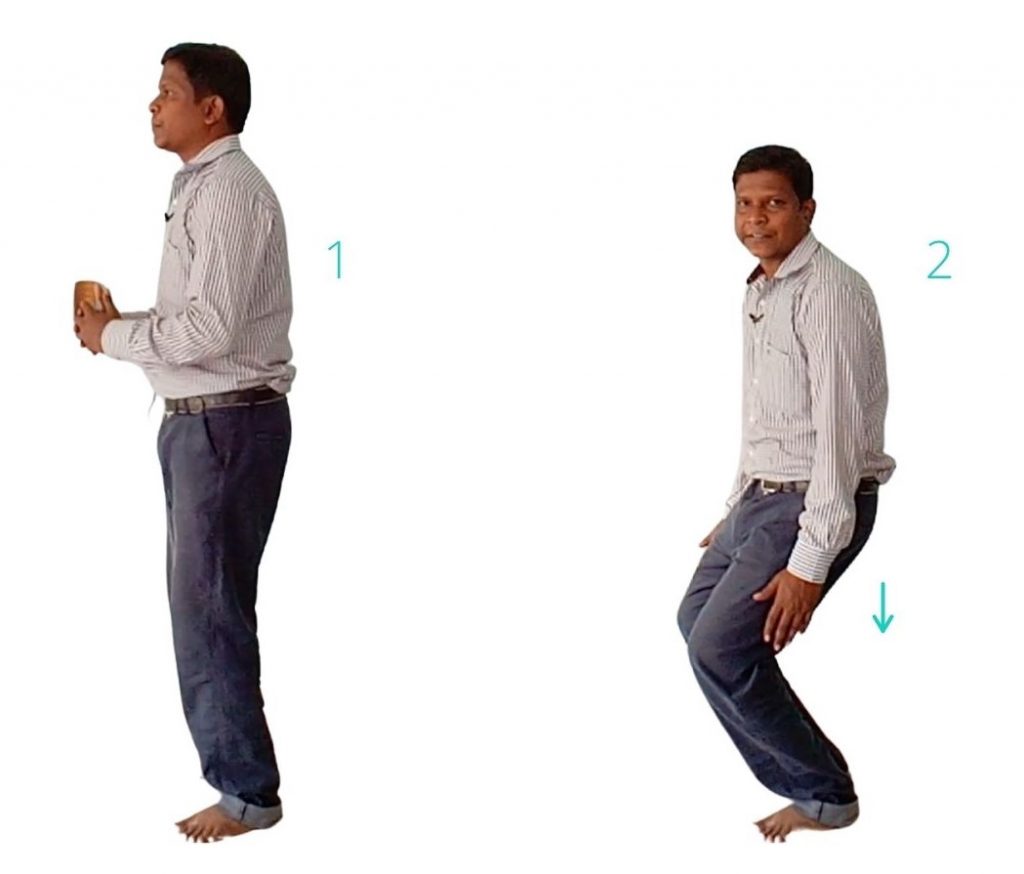
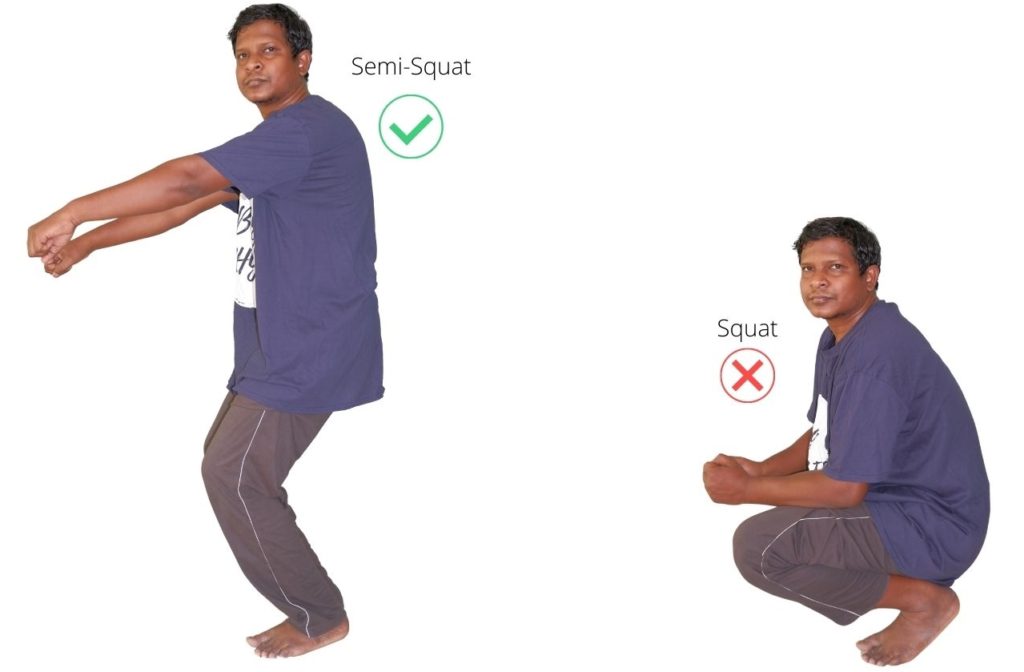
Quadriceps strengthening exercises for patellar tendonitis can also be done in a standing position. It is very effective for your patellar tendonitis pain. For this, you will stand in a normal position, and then you will be doing a semi-squat.
Follow these steps:
- First, you need to keep apart two feet at a normal distance.
- In this position, bend yourself on the affected side. In other words, we have to semi-squat, i.e midway through the full squatting. Also, notice the figure with a side view of how the subject is in a semi-squatting position.
- Now, hold this for 5 seconds, the best way is to count 1 2 3 4 5, then come to standing.
- Similarly, you have to repeat it at least 10 to 15 times in a session. You will bend your knees as much as you can and then stand up.
- You should do this two to three times a day. It’s a very effective exercise.
Also read: 9 Easy Knee cap fracture exercise & physiotherapy protocol
Side-Lying Leg Lifts (Hip Abduction)
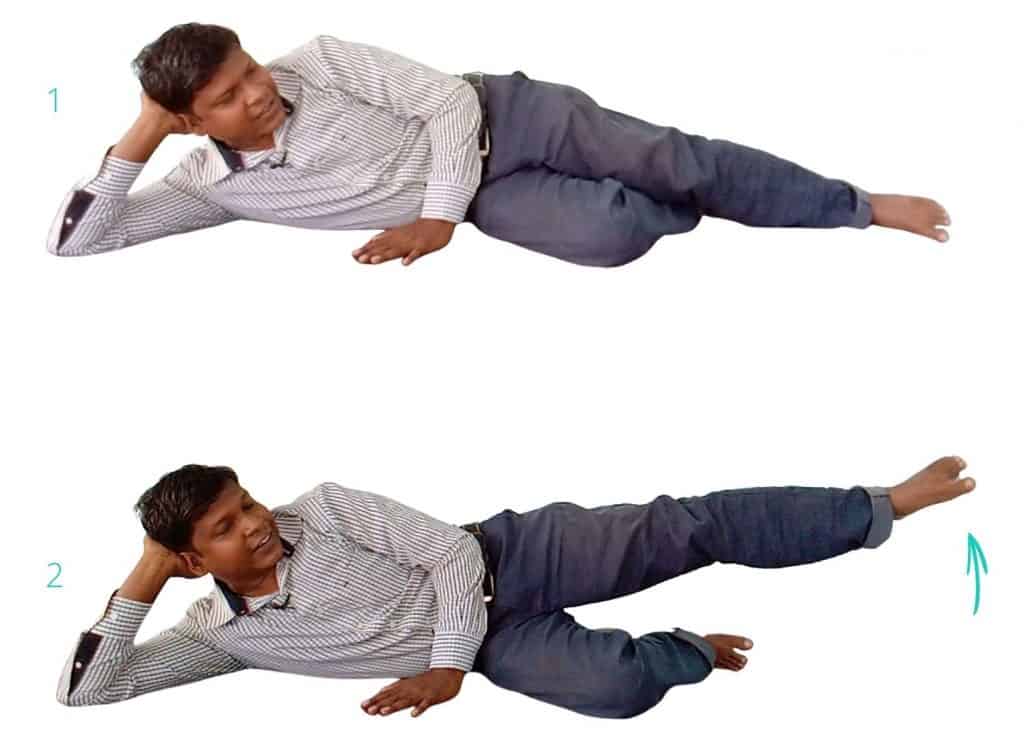
After that, to strengthen the muscles on the outer sides of the thigh, you need to come to a side-lying position.
- Lie down in the sidelying position. It will be much better if you place a pillow below the neck. Bend your bottom lying leg as shown in the figure while keeping the overlying leg straight.
- Now, lift the upper leg straight without bending the knee.
- Have to lift it up to 30 degrees.
- Hold it for 5 seconds, then drop it down.
- In a single session repeat it 10 to 15 times and do it for two to three sessions in a day for a good result.
In this position, we can now do one more exercise with a slight tweak in the posture. Here, we need to keep both legs in a bending position. Look at the hips, it is bent in a forward direction, also, the knee is bent with the feet together.
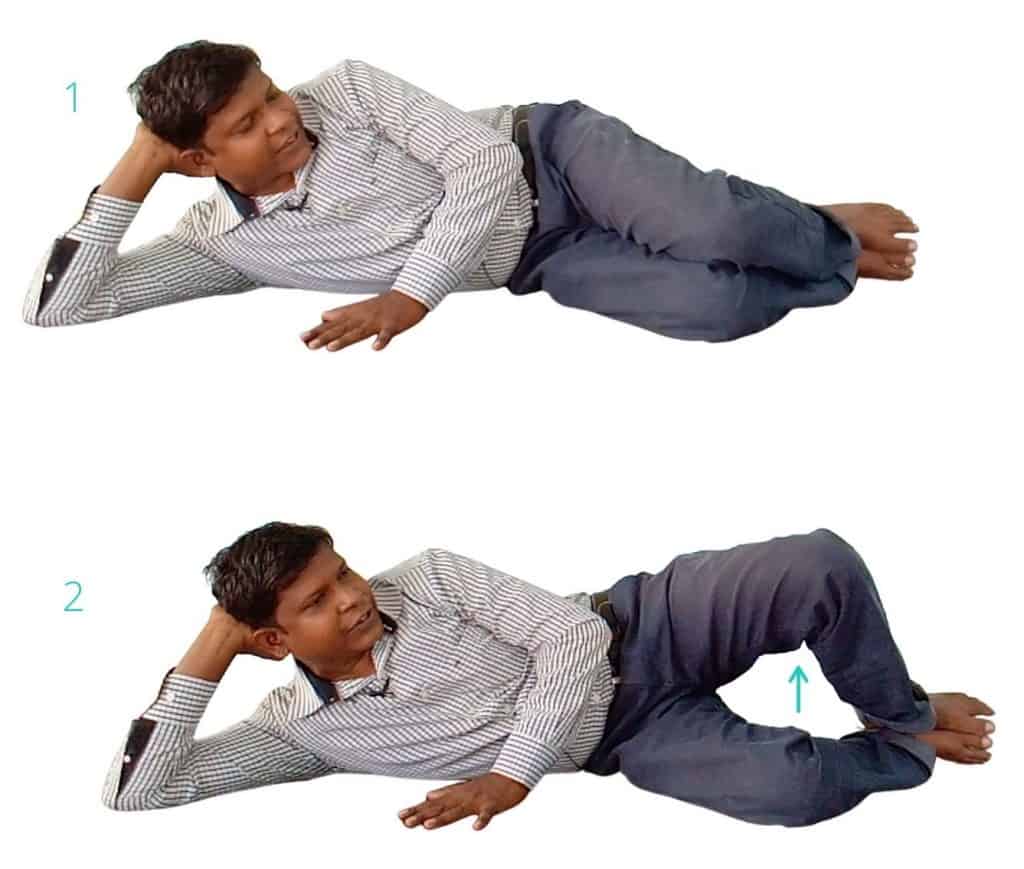
Now, in this position, raise your knee without the feet being separated. Hold it for 5 seconds, then release it. Continue with the exercises 10 to 15 times in a single session. Twice daily is recommended.
Prone Hamstring Curls
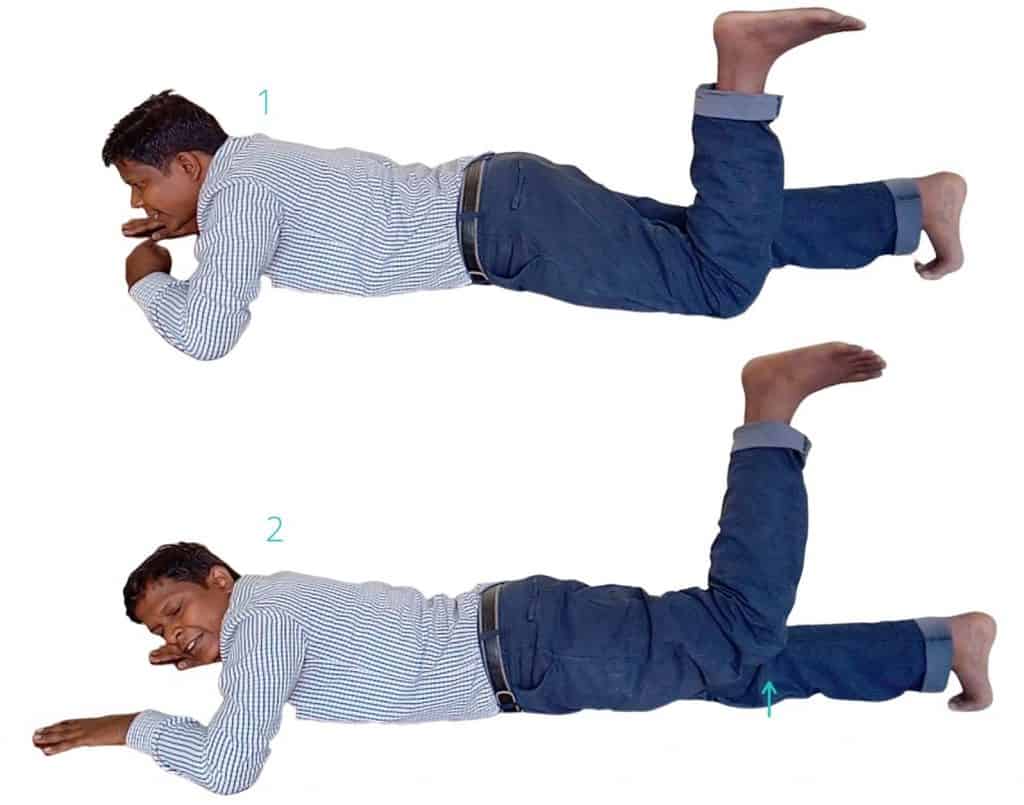
After this, we have hamstring strengthening exercise, i.e. the muscles on the back thigh. To strengthen it:
- Lie down on your tummy and bend one knee at 90 degrees,
- In this knee-bending position, lift your thigh off the floor.
- Lift it and hold it for 5 seconds, and then lower it down.
- Then again, raise it and hold it for 5 seconds, then lower it. Similarly, we have to repeat it at least 10 to 15 times in a single session.
Other useful home tips
During the initial period when you have severe pain, I would suggest you apply a good pain ointment on the painful spot twice daily. To make it more effective, you can apply a hot pack over it after ten minutes of application of the ointment.
Once the severe pain reduces (you can use ice pack), you can go with the exercises.
When you have patellar tendonitis, giving good support to the patella when walking or doing a daily routine can greatly improve the pain. This can be achieved by using a patella support brace; just wear it when you are at work.

- PAIN RELIEF SUPPORT: This knee band works as a knee strap patella tendon support
- UNIFORM COMPRESSION: The tubular non-slip buttress of this patellar stabilizing knee brace offers uniform compression, s…
- ADJUSTABLE FIT: This patella knee strap features an adjustable hook and loop closure, making it a versatile patella stab…
Young sports personality also has a higher risk of having ligament injury around the knees in which anterior cruciate ligament injury is very common. Other ligaments are also at risk of injury, like a meniscus injury. For this, I have explained the exercises in a video, please watch it here.
When to see a doctor
While these exercises are effective for managing patellar tendonitis, it’s crucial to get a proper diagnosis. If your pain is severe, doesn’t improve with rest, or is accompanied by significant swelling or locking of the knee, please consult a doctor or physical therapist.
Keep Reading: ACL reconstruction protocol: Step-by-step guide
Patellar Tendonitis FAQs

The author is a physiotherapist who has been practising for the last 17 years. He holds a Bachelor's in Physiotherapy (BPT) from SVNIRTAR (Swami Vivekananda National Institute of Rehabilitation and Research), one of the prestigious physiotherapy schools in India.
Whatever he learns dealing with his patient, he shares it with the world through blogs and e-books. He also owns a YouTube channel, "Sunit Physiotherapist" with over 8 lakh active subscribers. Here, he shares everything he gets to learn serving the patient.



Pingback: 6 Best Exercises for Arthritis in knee Pain Relief - Physiosunit
Thanks
very informative
Very good exercise for ligament injured persons..