A new Dutch clinical trial suggests that Strolll augmented reality home-based rehab is a safe, well‑accepted way for people with Parkinson’s to train gait and balance with high adherence.
For person with Parkinson’s Disease, rehabilitation exercises are important to improve and maintain the walking balance and gait pattern. However, these rehab programmes being phyisotherapy center-based, their is an issue of lower complaince and irregular attandance by them.
Home based rehabilitation is the solution and Strolll, an innovative Augmente Reality based neurorehabilitation programe is already in practice. But, can improves patients compliance? What about the risk of fall? And the important of all, is it feasable in long term?
With all these questions, the Dutch researchers conducted a study with 100 person with Parkinsonism and 28 physiotherapist1. The result of the study is encouraging. Let’s find out more about it.
Importance of exercise in parkinsonism
A parkinsons disease is progressive neurological degenerative disease which affects fine motor control of the sufferer. For example, initially the sufferer will have difficuculty in performing fine motor skill line buttoning and unbuttoning the shirt.
As the disease progresses it affects walking pattern and walking balance.
Dopamine is a hormone that controls fine motor. This hormone is secreted by a organ inside the brain known as substantia nigra. In parkisons disease this substantia nigra is damaged resulting in decreased dopamine secretion.
The small task like opening the lid of a can holding a cup of tea and sipping it may look simple but they require fine motor control. When dopamine secretion is decreased, it affects these skill. With time it also affects standing and walking balance of the sufferer.
Exercises are important to maintian the joint and muscle health. The neurorehab exercises are importatn for improving the walking balance.
Being a physiotherapist dealing with parkinsons we primarily focus on achieving standing and walking balance. We have various neurorehabilitation exercises. We progress from light challenging exercises to highly challenging exercises.
This includes, throwing ball in standing positon, walking on a zigzag path etc.
Challenge with center-based rehab in person with Parkinsonism
Currently all the rehabilitation programme for person with parkinsonism’s disease are centre-based, where exercises are performed under the supervision of physiotherapist.
According to the author of this Dutch study1, there are several challenges with center-based rehabilitation which we as a owner of rehab center also agree.
The paper says that “Individuals with Parkinson disease often face challenges attending to regular, center-based rehabilitation programs over a prolonged period”. This could be due to barriers such as:
- Mobility limitations,
- Fatigue,
- Transportation, and
- disease progression reduce compliance.
For this, the home-based rehabilitation can be a long term solution.
However, to achieved this we have to move towards digitally supported, independent, home-based care.
Here comes the role of Strolll, an Augmented Reality based neurorehabilitation system. This dutch based study aimed to evaluate feasibility and effectiveness of AR-based rehabilitation.
How typical physio exercises are recreated in AR using Strolll

Normally in our rehab center we start with teaching the person with parkinsonism the standing balance. This includes standing with the support of a Walker then progression to more challenging task like throwing ball in different direction.
Simultaneously we also train gait balance.
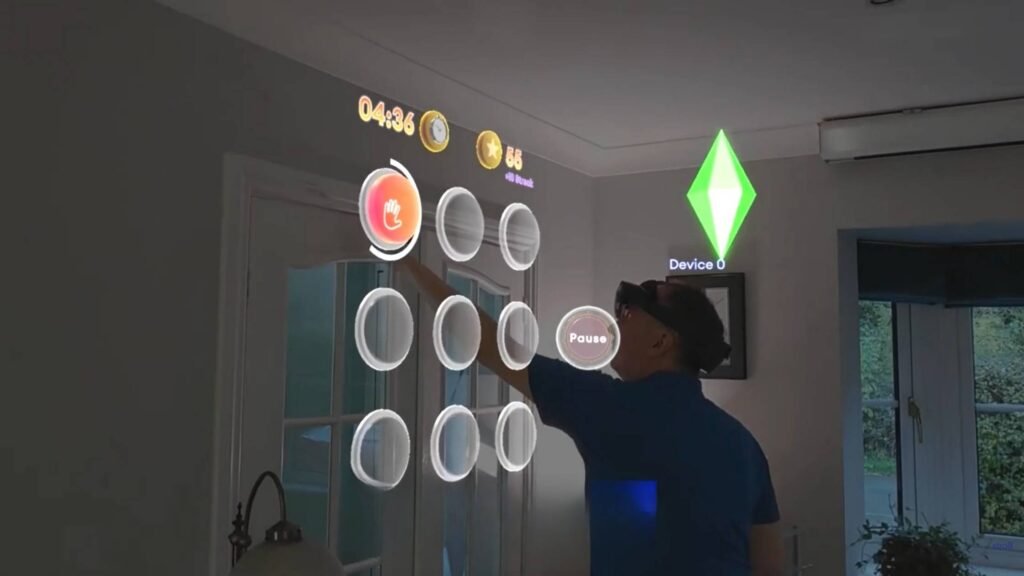
By using Strolll neurorehabilitation systems innovative technology, all these center-based exercises can be created virtually using Augmented Reality technology.
I visited and checked Strolll website and found that this can be created virtually using innovative AR technology at home. One of the gamified exercises is throwing basketball on the net. This exercise in physical is one of our favourite.

Picking and throwing ball in a different direction challenges your standing balance.
Another important exercise to develop walking balance is working through the obstacles. This is also innovatively created through this Strolll device.
According to Strolll, it seamlessly blends digital content with any physical space and adapts to any room layout. The AR glasses have transparent, see-through lenses so the real world remains visible.
It comprises 7 gamified exercises these exercises is similar to what we give at our rehab centre but in a more fun and engaging way.
The exercises include:
- Mole petrol
- Smash
- Basketball.
- Hot button
- Puzzle walk
- Wobbly waiter
- Cue challenge
Research on feasible is AR based rehab exercises for Parkinson’s
To test whether AR-based, home exercises are practicle and safe, Dutch researchers conducted study with 100 people with Parkinson’s and 28 Physiotherapists. These all person with PD were designated their therapist and was going to be under the supervision for next 8 to 9 months.
The researchers initially train them to exercise with Strolll for two week at the rehab centre under their supervision. This was to make them familiar and teach different challenges the storll offers.
Following this they followed exercises at home for 6 weeks. This innovative device can be controlled remotely giving and chance for physiotherapist to keep an eye on exercises performed by person remotely.
Result: Home based rehab for Parkinsonsim not only possible, beneficial too
You can watch the effect of AR intervention at home in the video. (Video credit: Oxford University Press, Author: Hoogendoorn, Eva M; Geerse, Daphne J, Title: Cueing-Assisted Gamified Augmented-Reality Home Rehabilitation for Gait and Balance in People With Parkinson Disease: Feasibility and Effectiveness in the Clinical Pathway)
After 6 weeks of home training, the researchers evaluated feasibility, safety, and functional outcomes. The result where positive and extremely encouraging. Here is the summary of what the author of the study found:
Augmented Reality Rehabilitation Showed High Compliance and Functional Improvement in Parkinson’s Disease
This study found that the person with PD where more adherent to exercises as compared to center-based rehabilitation. This could be attributed to haighly engaging gamified exercises.
After an initial supervised training period in the rehabilitation center, most participants were able to safely transition to independent home-based rehabilitation.
The data of the paper says that 93.9% of participants were considered suitable for independent home exercise using the AR system.
Finally, 78 participants successfully completed the full 6-week home rehabilitation program.
The Rehabilitation Program Was Safe
Safety is equally important for we physiotherapist when prescribing independent exercise programs. The results showed that the AR-based rehabilitation was safe.
- No serious adverse events reported
- Only 2 minor, non-injurious falls during more than 60,000 minutes of exercise
- Some participants reported mild symptoms such as dizziness, headache, or eye strain
- Most participants reported feeling safe while performing exercises at home
Improvements in Balance and Lower Limb Functional Strength
The study also reported improvements in balance and lower limb function.
Participants showed improvement in:
- Five Times Sit-to-Stand Test
- 10-Meter Walk Test at comfortable walking speed
- Mini Balance Evaluation Systems Test
Progressive Improvement in Exercise Performance
Participants demonstrated continuous improvement throughout the rehabilitation program.
Over time, participants were able to:
- Achieve higher exercise levels
- Walk faster
- Perform more repetitions
- Improve functional performance during exercises
Positive Patient and Therapist Feedback
Both participants and physiotherapists reported positive experiences with the AR rehabilitation system.
Participants appreciated:
- The ability to exercise at home
- Increased motivation and engagement
- Enjoyable and interactive exercise experience
Physiotherapists reported benefits such as:
- Ability to monitor patient progress remotely
- Improved patient compliance
- Effective progression of rehabilitation programs
Personalized Augmented Reality Cueing Was Beneficial
Augmented reality cues were found beneficial in 53 out of 92 participants.
These cues helped improve:
- Step length
- Walking stability
- Foot clearance
- Walking performance in some patients with freezing of gait
However, the benefits varied between individuals, highlighting the importance of personalized rehabilitation approaches.
Overall Summary of Results
The study demonstrated that augmented reality-based rehabilitation for Parkinson’s disease is:
- Safe
- Highly feasible
- Associated with excellent exercise compliance
- Effective in improving mobility and balance
- Well accepted by both patients and physiotherapists
These findings suggest that augmented reality rehabilitation may be a valuable tool to improve exercise adherence and functional outcomes in individuals with Parkinson’s disease.
Conclusion: How to get Strolll AR for yourself
As of now when writing this article, the info on Strolll website says you can not get Strolll gadget for individiual. It is only distributed through their physiotherapist and healthcare parctioner through rehab center. You can visit their page to find list of rehab center from where you can contact and get for yourself.
Till this reaches your locality, you should visit your nearest physiotherapy centre for exercises. In addition, you can also practice chair seated exercises for seniors which will atlease keep your joint and muscle health intact.
FAQ

The author is a physiotherapist who has been practising for the last 17 years. He holds a Bachelor's in Physiotherapy (BPT) from SVNIRTAR (Swami Vivekananda National Institute of Rehabilitation and Research), one of the prestigious physiotherapy schools in India.
Whatever he learns dealing with his patient, he shares it with the world through blogs and e-books. He also owns a YouTube channel, "Sunit Physiotherapist" with over 8 lakh active subscribers. Here, he shares everything he gets to learn serving the patient.