
Last Updated on January 23, 2026 by Sunit. S. Ekka
Persistent heel pain often stems from plantar fasciitis, but it can be effectively managed without surgery. This guide provides easy, at-home exercises to stretch the tight fascia and strengthen foot muscles for lasting relief. Consistency with these methods is the key to walking pain-free again.
If you have sharp heel pains when walking, and the very first step in the morning is extremely painful, then chances are you have a plantar fasciitis issue in your heel. We also call plantar fasciitis a heel spur.
It is a condition in which there’s a sharp bony outgrowth on the heel, so when we walk, this bony outgrowth creates sharp heel pain and makes walking painful. Fortunately, with proper exercises, we can get rid of such heel and foot pain.
In this article, we are going to discuss 5 easy exercises for heel pain relief and other tips to fix it permanently. These exercises are very simple and anyone can learn and perform them at home. So, let’s get started.
What Causes Sharp Heel Pains? Understanding Plantar Fasciitis
But, before we proceed, it would be good to learn the common reasons for sharp heel pain. As I just mentioned in the introduction, the cause of sharp heel pains is plantar fasciitis. Plantar fasciitis affects both young active patients and older, more sedentary individuals 1.
In plantar fasciitis, there is inflammation of the plantar fascia (A thick, flat fibrous band on the sole of the foot). And as the pain becomes chronic, there also occurs extra bone formation at the heel at the point where the plantar fascia is attached to the heel bone.

When we stand, walk, and run, this plantar fascia bears weight and maintains the foot arch. Plantar fasciitis results from chronic overload of the plantar fascia, which can be due to overuse, as seen in runners and military personnel.
It can also be due to excessive loading, as seen in obese sedentary individuals and those who stand for prolonged periods of time. Another reason is the structural foot deformity, such as flat feet, pes cavus, tightness of the tendo-Achilles, and limb length discrepancy.
8 Best Exercises for Heel Pain and Plantar Fasciitis
The exercises we are going to learn are aimed at stretching the tight plantar fascia and strengthening the muscles around the foot and heel. There are numerous small muscle in our sole that maintains the foot arch. We need to strengthen these muscles.
So, let us start with stretching exercises.
#1 Plantar Fascia and Foot Stretch

So first we start with stretching exercises. When we have foot pain, it almost starts from the heel and then spreads from the heel to reach the sole of the foot. So around our soles, there are a number of small muscles of our feet, in which stiffness develops.
So, stretching these stiff muscles is very important. It is simple to stretch it:
- Sit in the position as shown in the figure. If I want to stretch the foot of the left leg, then I will put it on the right thigh.
- Then hold the foot with your hand (observe the position, my wrist will almost be around my toes).
- After having a proper grip, pull the foot towards yourself and allow the ankle to bend to the maximum so as to stretch the muscles of the sole.
- Stretch it, and you will feel stretched on your feet.
- Now you have to hold this position for at least 30 seconds or a minute, then let it relax.
- So in this way, if you do it three to four times, five times at a time, then you will get a lot of relief from it.
#2 Towel Scrunches: Toe Strengthening Exercise

After this comes strengthening exercises for sharp heel pains. As we know, there are numerous small muscles in and around our feet. Because of pain and other reasons, these muscles become weak, which is a cause of foot pain.
So, strengthening these muscles is very important for long-term effects. So, the first exercise in the list of strengthening exercises for foot pain relief is toe movement.
- The starting position for this exercise is sitting straight on a chair or stool with the foot flat on the floor. Keep your two feet side by side.
- Now, in this starting position, simply bend and straighten the toes of both legs while trying to maintain contact of the toes with the floor.
- To make it more subjective and effective, we will spread a towel in front, and then I will try to collect it by moving my toes. Do it till you collect the whole towel. This will also strengthen your foot muscles.
- Do it for a minimum of 5 minutes in a single session.
#3 Foot Scooping for Arch Activation

Our starting position for this exercise would be the same as the previous one, with the only difference being the position of the foot.
- Keep both of your heels together and toes apart so as to make an angle of 15 degrees between the feet.
- In this position, scoop both feet against each other as shown in the figure. This will also help all the small muscles in the heel to strengthen them.
- Do it for 3 to 5 minutes in a single session
#4 Seated Heel Raises

Our next exercise for foot pain relief is heel off in sitting.
- Sit on a chair with both feet flat on the ground.
- Then lift the heel off the ground as shown in the figure.
- After lifting the heel lower it slowly to the original position.
- Do it as much as you can; there’s no specific count.
Every exercise that we discussed has to be done at least 20 to 25 times, but as much as the more you do, the better.
#5 Seated Toe Raises
In this exercise, instead of the heel, we have to raise our toes off the ground so that our leg comes to the heel. After taking the toes off the ground, bring it foot back to its normal flat position. As in the previous exercise, repeat this for 20 to 25 times in a session.
#6 Standing Calf Raises

To make the heel-off exercise effective, we can do the same exercise in the standing position. For this:
- You stand in front of the table and hold it. This is to make sure you do not get an imbalance and fall.
- So, in this starting position, you will stand on your toes by taking your heel off the ground. Then lower yourself slowly to the original position, and then again stand on your toes.
- Do it a minimum of 15 to 20 times in a session.
#7 Tennis Ball Roll for Plantar Fascia Release

The next exercise for foot pain relief is a type of self-massage exercise in which you have to use a tennis ball.
- Simply keep the tennis ball under your foot and roll it back and forth.
- You would feel a nice massage effect on the sole of the foot, do it for as much as you can. Rub it all around the painful region.
- With this, your stiffness will also be removed, and in a way, there will also be self-massage if you have pain in both legs.
- Do it in this way on both legs. Do this as much as you can; there is no limit to this.
- You will definitely do it for at least 2 to 5 minutes in a session.
Upgrade Your Self-Massage: While a tennis ball works, I often recommend a specialized foot massage ball with textured surfaces. The firm rubber and ridges provide deeper myofascial release than a tennis ball, helping to break up adhesions in the plantar fascia more effectively.
#8 Barefoot Sand Walking for Sensory Stimulation
Next, I will recommend that if you have sand accumulated around the house somewhere, in the morning walk barefoot in the sand there as much as 10 minutes, 15 minutes half an hour walk barefoot in the sand.
This will also help correct the flat feet as well, and you will get rid of foot pain gradually.
Additional Tips for Lasting Heel Pain Relief
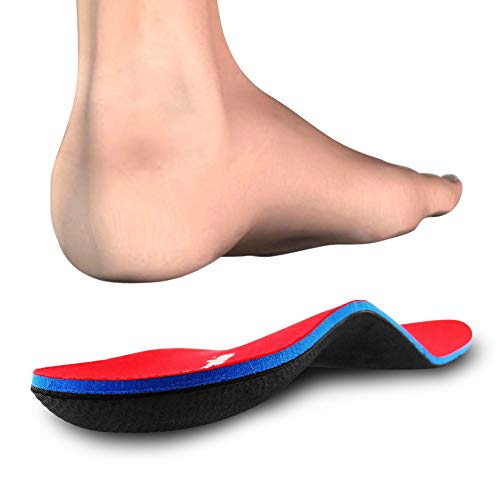
#9 Use Orthotics or Shoe Inserts for Arch Support
If you have a flat foot, then you can use a shoe insert. Actually, see here in our foot there is an arch, there is a medial arch, which in the flat foot this arch collapses and the foot goes flat. So whenever you wear a shoe, you can put medial longitudinal arch support inside it.
If you keep that medial longitudinal arch support in your shoes and if you wear it regularly in your duty or if you do your profession, then gradually that pain will subside, along with this, the problem of the flat foot will also get corrected.
#10 Try Warm Water Foot Soaks to Reduce Stiffness
Along with this, when you come home after doing a whole day’s work, then after reaching home, dip both your feet in warm water and leave it to relax.
The pain will reduce with the hot water bath, and if you add a little salt to it, then its effect will increase even more. Therapeutic ultrasound is found to be effective in relieving pain to some extent.
#11 Consider a TENS Unit for Pain Management
Along with this, you can also use a TENS machine, Transcutaneous Electrical Nerve Stimulation. You will get a lot of relief from that too, but the exercises are very important; whatever the tips I have told you will be effective in combination with exercises.
Only by following those tips, a hot water bath will not work; you should focus on the exercises.


Medical Treatments for Persistent Heel Pain
There may be a condition for which nothing works to relieve sharp heel pain. Such a person who remains symptomatic despite a 6-month of exercise and other tips may have to go for minimally invasive treatment or surgery. Like the injection of platelet-rich plasma that stimulates the body’s healing response.
Corticosteroid injections are commonly prescribed, which may temporarily relieve pain but may increase the risk of plantar fascia rupture and fat pad atrophy. Another option is botulinum toxin injections, which relax the calf muscles that in turn decrease the stress in the plantar fascia 1.
Surgical management includes gastrocnemius recession and medial head of gastrocnemius release, which decreases the stress on the plantar fascia and partial plantar fasciotomy, which stimulates a healing response 1.
Frequently Asked Questions About Heel Pain

The author is a physiotherapist who has been practising for the last 17 years. He holds a Bachelor's in Physiotherapy (BPT) from SVNIRTAR (Swami Vivekananda National Institute of Rehabilitation and Research), one of the prestigious physiotherapy schools in India.
Whatever he learns dealing with his patient, he shares it with the world through blogs and e-books. He also owns a YouTube channel, "Sunit Physiotherapist" with over 8 lakh active subscribers. Here, he shares everything he gets to learn serving the patient.




Pingback: Feiss Line: Test Process for Flat Foot Measurement, Analysis - Physiosunit