Last Updated on January 23, 2026 by Sunit. S. Ekka

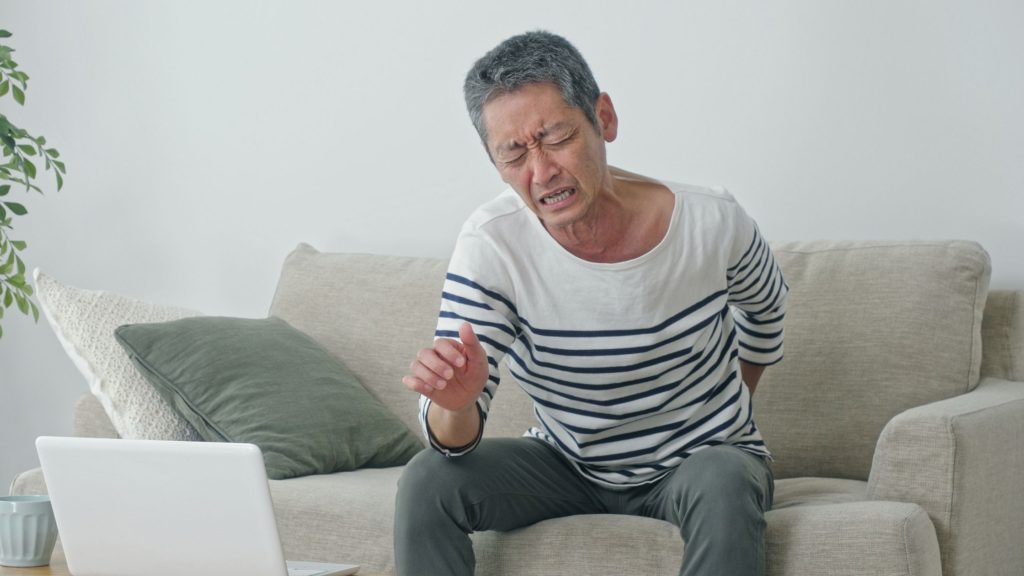
If you have pain on the outer side of your elbow that hampers your daily routine, like pain when writing or holding a glass/ bottle of water, then there’s a high chance of pain due to Tennis Elbow.
However, you need not worry, as exercises have been found to effectively cure tennis elbow pain. In this article, we will learn easy but very effective exercises that, if you follow them regularly, will relieve you. I will also discuss a few effective tips to help you eliminate this pain as early as possible.
- What is Tennis Elbow (Lateral Epicondylitis)? Symptoms & Causes
- Top Tennis Elbow Exercises for Fast Pain Relief at Home
- 1) Stretching Exercises: Relieving Tennis Elbow Stiffness
- Eccentric Strengthening: Best Physiotherapy for Tennis Elbow
- 2) Wrist Flexion-Extension: Restore Elbow Function
- 3) Wrist Ulnar-Radial Deviation: Improve Mobility and Strength
- 4) Advanced Wrist Flexion-Extension Using Weights
- 5) Weighted Wrist Deviation: Enhanced Strength Training
- 6) Elbow Flexion-Extension with Resistance Band/Dumbbell
- 7) Tennis Elbow Rehab: Resistance Band Exercise Routine
- Additional Tips for Tennis Elbow Home Treatment
- Tennis elbow pain FAQ
What is Tennis Elbow (Lateral Epicondylitis)? Symptoms & Causes
Tennis elbow, also known as lateral epicondylitis. Tennis elbow pain sufferer complains of pain on the outer side of the elbow. It affects roughly 1-3% of the adult population each year and is commonly seen in the dominant arm2.

From the outer side of the elbow, a group of muscles originates called Extensor carpi radialis brevis. At the origin point ot the muscle, it goes into repetitive stress due to various task that involves wrist flexion and extension.
Extension and flexion of the wrist are important for various activities, including typing, gripping objects, and playing musical instruments.
This causes microtears and inflammation at the common extensor origin of the elbow, leading to tennis elbow pain.
Risk Factors and Prognosis for Tennis Elbow Recovery
Professionals like mechanics or electricians, or when using an accelerator while driving motorbikes, tennis and badminton players, all have one thing is common in them.
All of them engage in activities that require repetitive wrist flexion and extension.
So if we keep doing such activity repeatedly, there comes a point where due to overuse a slow wear, tear, and micro-injury start to develop at point of muslce origin at outer elbow (we just discussed above). This results in swelling, inflammation and pain at this point2. If this stays long, stiffness develops and the muscles weaken.
Symptoms include pain when picking up something. You have severe pain here while bathing, you have pain while picking up the mug, and you have problems while driving.
Top Tennis Elbow Exercises for Fast Pain Relief at Home
Exercise is a very important conservative intervention for curing tennis elbow pain. However, it works best with physiotherapy treatment, which primarily includes ultrasonic therapy and interferential therapy.
Exercises are aimed at strengthening the weak muscles (strengthening exercises) and stretching the stiff muscles (stretching exercises) around the elbow.
They help to strengthen the muscles and tendons in the forearm and elbow, which in turn helps reduce the stress on the affected area. Stretching exercises help improve flexibility and range of motion, which can help prevent future injury.
Exercises also help reduce pain and inflammation associated with tennis elbow by increasing blood flow to the affected area, speeding up the healing process.
1) Stretching Exercises: Relieving Tennis Elbow Stiffness

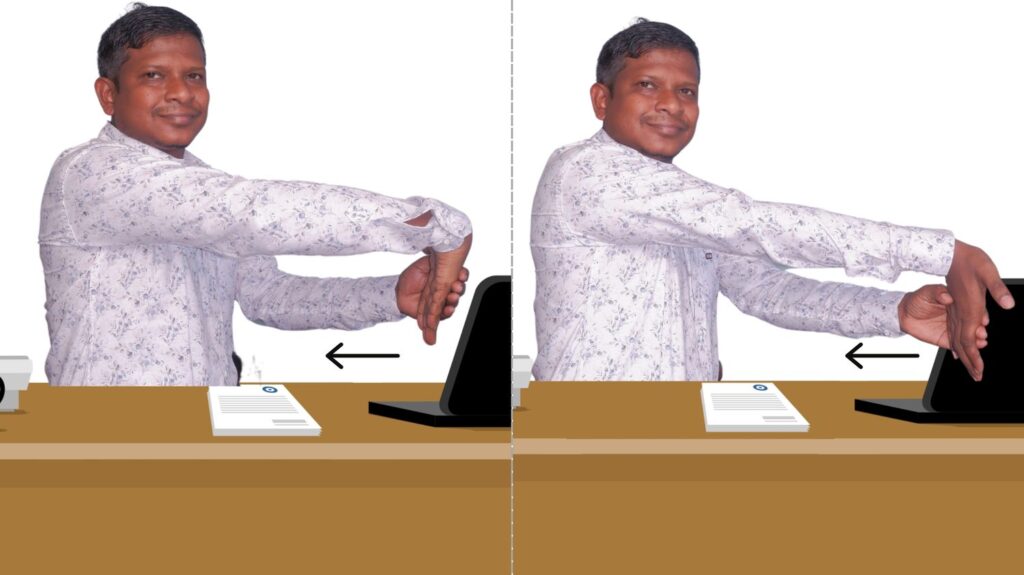
So, the first exercise is the tennis elbow stretching exercise. To perform the stretching exercise for tennis elbow:
- Start by standing or sitting with your arm extended in front of you at shoulder level. Ensure that your forearm is positioned so your palm faces down towards the floor.
- Next, take your other hand and hold the fingers of the extended arm.
- Gently pull your fingers back towards your wrist, careful not to overstretch. You should feel a gentle stretch in the top of your forearm.
- Hold this position for 15-30 seconds.
- Repeat this stretch 4-5 times on each arm.
As you continue to perform this exercise, you will gradually stretch the stiff muscles and soft tissue structures, which can help to alleviate pain and improve mobility in your elbow.
Eccentric Strengthening: Best Physiotherapy for Tennis Elbow
Research suggests that strengthening exercise, specifically eccentric exercise, is more beneficial for lateral elbow tendinopathy3. Increasing the resistance/load of the eccentric exercise progressively is recommended.
So, we will first perform the free exercise without any resistance and then progress with adding load/resistance. So, let us first start with wrist flexion and extension.
2) Wrist Flexion-Extension: Restore Elbow Function

Wrist flexion-extension motion is a simple exercise that focuses on the range of motion of your wrist. To perform this exercise:
- You can start by sitting or standing straight with your feet shoulder-width apart.
- Begin by lifting your hand at shoulder level in front of yourself with your elbow entirely straight and both palms facing downwards towards the floor. Keep your fingers relaxed and straight.
- Now, slowly bend your wrist towards your forearm until you feel a gentle stretch in your wrist and forearm muscles.
- Hold this position for 2-3 seconds, then slowly straighten your wrist to the starting position.
- Next, slowly bend your wrist backwards until you feel a gentle stretch in your wrist and forearm muscles.
- Hold this position for 2-3 seconds, then slowly straighten your wrist to the starting position.
- While performing this exercise, it’s essential to transition from wrist flexion to extension smoothly and slowly.
- You can perform this exercise for at least 15 to 20 repetitions, but the more you do, the better it is.
3) Wrist Ulnar-Radial Deviation: Improve Mobility and Strength

To perform the wrist ulnar and radial deviation exercise,
- You should start by sitting or standing straight with your arm extended in front of you.
- Hold your hand out with both palms facing inward, and then make a fist.
- Slowly bend your wrist towards your little finger in a sideways motion until you feel a stretch in your wrist and forearm muscles.
- Hold this position for a few seconds, then slowly straighten your wrist to the starting position.
- Next, bend your wrist towards your thumb in a similar sideways motion and hold this position for a few seconds before slowly returning your wrist to the starting position.
- Repeat this movement slowly and smoothly 15 to 20 times in a session.
4) Advanced Wrist Flexion-Extension Using Weights

This exercise is designed to strengthen your wrist muscles by adding some resistance. To perform this exercise, you will need a weight of approximately 1 kg, and a one-litre water bottle can be used for this purpose.
- Hold the water bottle with your affected hand, ensuring a firm grip.
- Stand or sit comfortably with your forearm resting on a flat surface, such as a table or armrest.
- Next, slowly lift the water bottle towards your body by flexing your wrist upwards.
- Hold the position for a few seconds before slowly lowering the bottle back down to the starting position.
- Repeat this movement 15 to 20 times in a session, taking a break as needed.
5) Weighted Wrist Deviation: Enhanced Strength Training

This is the same ulnar-radial deviation motion of the wrist we discussed. This time, we have to perform this exercise by adding weight. As we just discussed, hold one litre of a water bottle and do wrist ulnar-radial deviation. Repeat this 15 to 20 times in a session.
6) Elbow Flexion-Extension with Resistance Band/Dumbbell

You will need a 1.5 kg dumbbell and a resistance band to perform the elbow flexion-extension exercise. The exercise targets the muscles in your upper arm and strengthens your elbow joint.
- To start with, stand straight with your feet shoulder-width apart and keep your forearm in the mid-prone position, which means your forearm should be in a position where your palm is facing inward.
- Hold the dumbbell in your hand, keeping your elbow close to your body. Your upper arm should be parallel to the floor.
- Next, slowly lift the dumbbell towards your shoulder by flexing your elbow joint. Make sure to keep your upper arm stationary and only move your forearm.
- Hold the dumbbell at the top of the movement for a second, then slowly lower it to the starting position by extending your elbow joint.
- Repeat this movement for 15 to 20 repetitions in a session.
To use the resistance band, loop the band around your forearm and hold onto the other end of the band with your hand. Perform the same movement, lifting the band towards your shoulder and lowering it back down.
The resistance provided by the band will make the exercise more challenging and effective.
7) Tennis Elbow Rehab: Resistance Band Exercise Routine

To perform the exercise using the resistance band, follow the steps below:
- Start by holding both ends of the resistance band in your hand.
- Place one end of the band under your foot and stand on it, ensuring it is securely in place.
- Hold the other end of the band with your hand, keeping your arm straight and your elbow close to your side.
- Slowly flex your wrist by moving your hand upwards towards your body.
- Hold the position for a few seconds, then slowly release and lower your hand to the starting position.
- Repeat the same movement for wrist extension by moving your hand downwards, away from your body.
- Next, perform wrist ulnar-radial deviation by moving your hand to the left and right while keeping your arm stationary.
- Finally, perform elbow flexion and extension by bending your elbow and straightening it back out while keeping your wrist and forearm stationary.

- MEDIUM RESISTANCE FOR FULL-BODY TRAINING: Designed for upper and lower body workouts; ideal for strength building, flexi…
- CUT TO ANY LENGTH FOR CUSTOM FIT: 50-yard latex-free roll lets you trim precise lengths for individual workouts, body si…
- PORTABLE & EASY TO USE ANYWHERE: Lightweight and compact for workouts at home, gym, office, or while traveling; perfect …

Additional Tips for Tennis Elbow Home Treatment
Immediate Relief Strategies for Acute Tennis Elbow Pain
The acute stage is severe pain; even the slightest movement in the elbow can trigger sharp pain. Pain that triggers at the elbow can spread upward to the shoulder and below up to the wrist or even the fingers.
In my clinical practice, my patients usually complain of pain during activities like squeezing clothes during washing, controlling the motorbike accelerator, serving a meal, etc.
During the severe pain of the acute stage, giving rest to the elbow is very important; you need to prevent any movement at the elbow. You need to take care and follow some home tips.
- Take rest from aggravating activities.
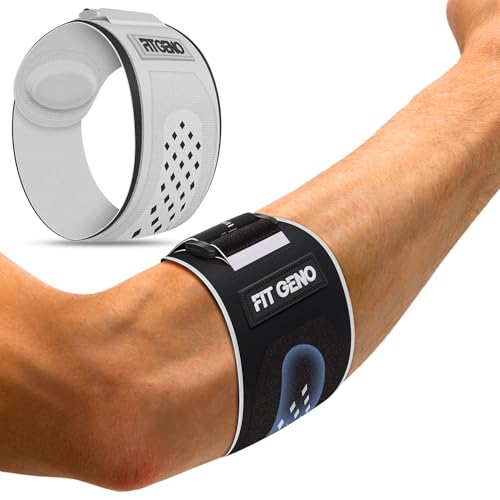
- Rest to the elbow by using a tennis elbow brace/ tennis elbow band.
- At home, apply any good pain balm over the painful region and then apply a cold pack.
- Physiotherapy treatment: Physiotherapy will speed up the recovery time so do visit your local physiotherapist. They will give you ultrasonic therapy and interferential therapy.

Chronic Tennis Elbow Recovery: Long-Term Management Tips
As severe pain reduces, the pain that is spread over the upper arm and forearm decreases. They now remain concentrated on the outer side of the elbow.
Because of the inactivity of the elbow during the acute stage, the muscles around the elbow become comparatively weak. Due to the disease process, there is stiffness and tightness of the tendons and muscles of the elbow.
So, we need to continue what we discussed above; in addition to it, we have to start exercises. Following is how we need to proceed.
- Continue to avoid aggravating activities.
- Use the tennis elbow band.
- Physiotherapy: a. Ultrasound Therapy b. DTFM (Deep Transverse Friction Massage) c. Gradual stretching.
Keep Reading: What Is Frozen Shoulder: 3 Stage & Physiotherapy To Ease Pain
Tennis elbow pain FAQ

The author is a physiotherapist who has been practising for the last 17 years. He holds a Bachelor's in Physiotherapy (BPT) from SVNIRTAR (Swami Vivekananda National Institute of Rehabilitation and Research), one of the prestigious physiotherapy schools in India.
Whatever he learns dealing with his patient, he shares it with the world through blogs and e-books. He also owns a YouTube channel, "Sunit Physiotherapist" with over 8 lakh active subscribers. Here, he shares everything he gets to learn serving the patient.