Last Updated on January 23, 2026 by Sunit. S. Ekka
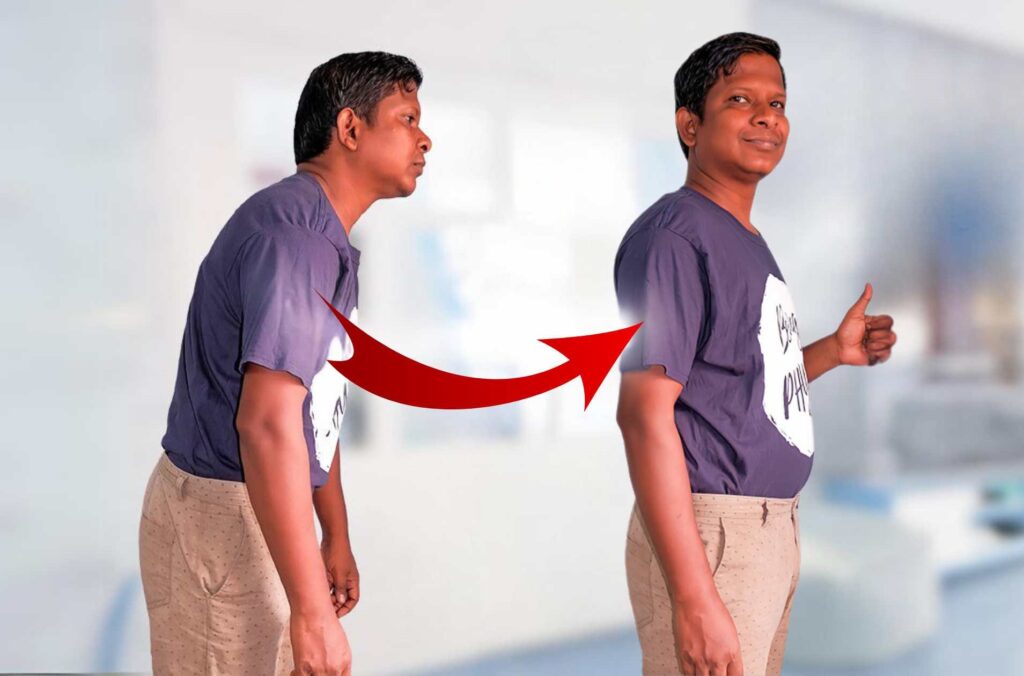
We know how easy it is to slip into poor posture while sitting on a computer or at work. This may develop into a permanent poor posture, commonly referred to as forward head posture. This issue is common among the younger generation, who often have their necks bent forward while using their phones.
But by some simple exercises which can easily be done at home, we can correct our bad posture. In this article, I’ll discuss about these exercises.
| Exercise | Target Area | How To Do It | Reps/Duration | Benefits |
|---|---|---|---|---|
| Chin Tuck | Neck (Cervical Spine) | Tuck chin straight back without tilting head | 10 reps, 5-sec hold | Fixes forward head posture, reduces tech neck |
| Shoulder Squeeze | Upper Back (Scapular) | Roll shoulders back and squeeze shoulder blades | 15 reps, 3-sec hold | Corrects rounded shoulders, opens chest |
| Wall Angle | Upper Back & Shoulders | Slide arms from W to Y position against wall | 15 reps | Strengthens postural muscles |
| Bridging | Lower Back & Core | Lift hips until body forms straight line | 12 reps, 5-sec hold | Stabilizes lumbar spine, prevents slouching |
| Cat-Camel | Entire Spine | Alternate arching and rounding back on hands/knees | 10 reps each | Improves spinal flexibility, relieves stiffness |
Do these exercises daily for best posture correction results. Combine with proper ergonomics.
- 1. Chin Tuck Exercise to Fix Forward Head Posture (Step-by-Step Guide)
- 2. Shoulder Squeeze Exercise for Upper Back Pain & Posture Correction
- 3. Wall Angle Exercise: Strengthen Upper Back Muscles (W/Y Technique)
- 4. Bridging Exercise for Lower Back Strength & Spinal Alignment
- 5. Cat-Camel Exercise to Relieve Stiffness & Improve Spine Flexibility
- Why Ergonomics Matters for Posture (Bonus Desk Setup Tips)
- FAQ
1. Chin Tuck Exercise to Fix Forward Head Posture (Step-by-Step Guide)

So, the first exercise is the chin-tuck exercise. You can do it either sitting or standing straight. So, follow these steps to perform this exercise:
- Stand up straight and keep your body relaxed.
- Gently tuck your chin towards your chest without tilting or bending your head forward. You can use your hands as shown in the figure to guide the movement.
- Hold the position for 5 seconds, aiming to feel a stretch at the back of your neck.
- Remember to keep your shoulders down and avoid hunching them towards your ears.
- Relax and return to the starting position. Repeat this movement several times, ensuring to perform it slowly and gently.
- This will strengthen the muscles at the back of the neck, and the forward-leaning neck posture will gradually straighten.
2. Shoulder Squeeze Exercise for Upper Back Pain & Posture Correction

Let’s move on to the next exercise, the shoulder squeeze exercise.
- Your starting position should be the same, i.e. stand or sit up straight with your shoulders relaxed and your arms by your sides.
- Now, lift your shoulders towards your ears, and then slowly roll your shoulders back and down, squeezing your shoulder blades together.
- Squeeze it as if you need to hold a pen between the shoulder blades.
- Hold the squeezed position for a few seconds to feel the stretch across your chest and upper back.
- Relax your shoulders and repeat the exercise for 10 – 15 repetitions.
This exercise will strengthen your shoulder blade muscles, which will help to straighten your upper back.

- 【RESTORE CONFIDENT POSTURE】Back support brace is based on ergonomic and biomechanical principles, it helps you open your…
- 【INVISIBLE & BREATHABLE】Velvet and PU material, comprehensive mesh design, will not increase the sense of weight, while …
- 【ADAPTIVE WEARING】The correction process is painful. We recommend starting from 15-30 minutes a day and gradually increa…
3. Wall Angle Exercise: Strengthen Upper Back Muscles (W/Y Technique)

The next exercise is known as the wall angle exercise. For this:
- You’ve got to stand against the wall. Your back should be flat against the wall, and your heels should be a few inches away from the wall – about 3-4 inches away.
- Your hips, your upper back, and your head should be in contact with the wall.
- While staying in this position, lift your arm and form a ‘W’ shape like this. My forearm is resting against the wall. They’re not sticking out, but resting against the wall like this.
- From this ‘W’ shape position, raise your arms to make a ‘Y’ shape.
- Now, you’ve to slide your arms back in the ‘W’ shape and then again raise and slide up to make a ‘Y’ shape.
- Repeat the process at least 15-20 times.
This will also strengthen the upper back muscles or shoulder blade muscles, which will help to correct your posture.
4. Bridging Exercise for Lower Back Strength & Spinal Alignment

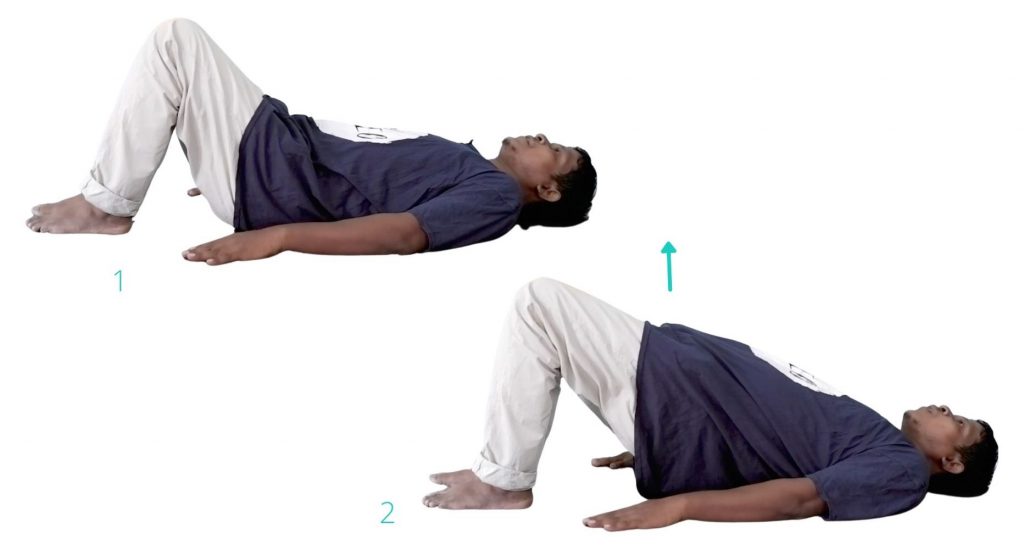
The next exercises are for our lower back. It’s important to strengthen the lower back and core, as they are essential for overall spine alignment. The first exercise for that is the bridging exercise. To do the bridging exercise:
- First, you must lie down flat on your back and bend both your knees with your feet flat on the floor. Keep your hands at your sides.
- Then slowly lift your waist, lift it to a point where your spine is aligned in a straight line.
- Hold this position for 5 seconds, and then release and relax.
- You must do 10-15 reps of this exercise, though the more you do, the better.
5. Cat-Camel Exercise to Relieve Stiffness & Improve Spine Flexibility

The next exercise is called the cat-camel exercise, also known as the cat-cow exercise. For this, you need to be in a quadruped position.
- First, come to a quadruped position as displayed in the figure.
- Then, start by making a curve of your spine upward. This upward curve position of the spine in a quadruped is known as the camel pose.
- Then, slowly, it is curved downwards; this pose is called the cat position.
- So, you’ve to alternate between the cat and camel position slowly and smoothly like this.
- Repeat this for 10 to 15 repetitions.
This is a very good exercise to strengthen and make the core muscles flexible. Because when we sit in the same position for long hours at work, stiffness can develop in the lower back area.
This exercise relaxes your lower back muscles, aligns the spine, and removes the stiffness.
Why Ergonomics Matters for Posture (Bonus Desk Setup Tips)
So, follow the exercises regularly. Do them once in the morning and once in the evening, and you’ll see a drastic improvement in your posture, which is important for your overall musculoskeletal health.
In addition to exercises, it is also essential to consider how you sit in front of the computer at work. Since you spend 8 to 10 hours in the office, incorrect posture can slow down or delay the effects of the exercises.
I suggest reading my article on the perfect sitting position for the computer where I discuss how to sit at a desk ergonomically the right way.
FAQ

The author is a physiotherapist who has been practising for the last 17 years. He holds a Bachelor's in Physiotherapy (BPT) from SVNIRTAR (Swami Vivekananda National Institute of Rehabilitation and Research), one of the prestigious physiotherapy schools in India.
Whatever he learns dealing with his patient, he shares it with the world through blogs and e-books. He also owns a YouTube channel, "Sunit Physiotherapist" with over 8 lakh active subscribers. Here, he shares everything he gets to learn serving the patient.