
Last Updated on November 27, 2025 by Sunit. S. Ekka
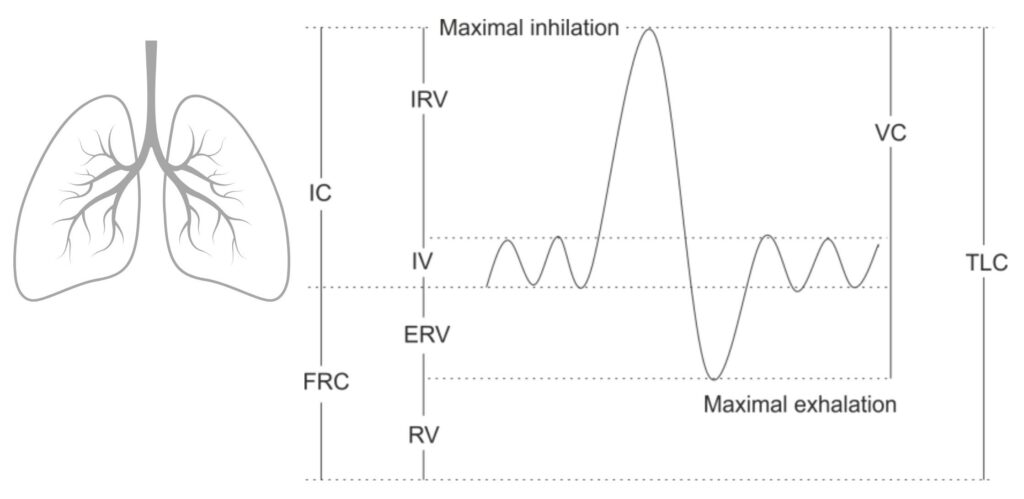
Lung volume and capacity are important metrics for differentiating a normal lung from a diseased one. But we often get confused between lung volume and lung capacity.
If you are the one who gets all volumes and capacities mixed up, this article will help you clear the concept. In this article, we will discuss the following:
- The normal range of volume and capacities.
- Lung volume and capacities in obstructive pulmonary disease.
- Lung volume and capacities in restrictive pulmonary disease.
- How is lung volume a part of lung capacity?
By the end of this article, you will be somewhat better than you were before.
- What Are Lung Volumes and Capacities?
- 4 Key Lung Volumes Explained (With Examples)
- Lung Capacities: Definitions and Normal Ranges
- Lung volume and capacity graph
- Lung Volume Chart: Normal Values & Disease Patterns
- Obstructive vs. Restrictive Lung Disease: Key Differences
- Healthy Lungs
- COPD (Chronic Obstructive Pulmonary Disease)
- Pulmonary Fibrosis
- How Age, Height & Lifestyle Affect Lung Capacity
- Final word
- FAQ
What Are Lung Volumes and Capacities?
Lung volume and capacities measure the amount of air in the lungs when we breathe normally and forcefully. During respiration, air moves in and out of the pulmonary system.
When respiration is normal, less air moves in and out, which increases when our rate of respiration increases during running, etc.
So, lung volume is the measure of the volume of gas/air that moves in and out during
4 Key Lung Volumes Explained (With Examples)
What is lung volume? It’s the amount of air your lungs move during breathing—measured for normal breaths (tidal volume) or max effort (inspiratory reserve volume). It is measured in Litres. So, let us discuss how inspiration and expiration are measured in their different forms.
The four lung volumes are:
- Tidal volume.
- Inspiratory reserve volume.
- Expiratory reserve volume.
- Residual volume.
#1 Tidal volume (TV): To understand tidal volume, just sit relaxed on a chair and close your eyes. Now, try to feel your inspiration and expiration (air expelled) with closed eyes.
The volume of air inhaled or exhaled during this resting breathing is the tidal volume. So, tidal volume is defined as “The volume of gas inhaled or exhaled during the resting breath is called the tidal volume”.
#2 Inspiratory Reserve Volume (IRV): Inspiratory reserve volume is the maximum volume of air that can be inhaled during a forceful inspiration. Actually, it is the additional air to the tidal volume that can be inspired during forceful inspiration.
To understand it, again sit relaxed on a chair with your eyes closed. Now, take a deep breath to your maximum capacity and expel it. This additional air you inhale in addition to the tidal volume mentioned above is the IRV.
#3 Expiratory Reserve Volume (ERV): Expiratory Reserve Volume is defined as the amount of air that can be expelled during forceful expiration.
Now, close your eyes and, after taking normal inspiration, try to exhale the maximum amount of air possible. This extra amount of air, in addition to normal expiration, is ERV.
#4 Residual Volume (RV): Even after forceful expiration, there is some volume of air still left inside the lung. That is, the lung doesn’t get fully emptied even after forceful expiration.
The amount of air that remains in the lungs after maximum exhalation is the residual volume.
So, it can be defined as the volume of air remaining in the lung after ERV has been done.
Lung Capacities: Definitions and Normal Ranges
The four lung capacities are:
- Inspiratory capacity.
- Vital capacity.
- Functional residual capacity.
- Total lung capacity.
#1 Inspiratory capacity (IC): Inspiratory capacity is how much extra air you can breathe in after a normal breath. Think of it like this – after you exhale normally, take the deepest inhale possible.
That total amount of air you can pull in is your inspiratory capacity.So, it is the sum of Tidal Volume (TV) + Inspiratory Reserve Volume (IRV).
#2 Vital Capacity (VC): How Much Can You Forcefully Exhale? Vital capacity is the total amount of air you can forcefully breathe out after taking the biggest breath possible. Imagine filling your lungs completely, then blowing out as hard as you can—that’s your vital capacity.
It is the sum of tidal volume, inspiratory reserve volume and expiratory reserve volume. The vital capacity of normal adults ranges between 3 to 5 litres.
It is the total volume of air within the lung that is under volitional control. It is the sum of IRV + TV + ERV.
VC is actually Forced Vital Capacity. To measure it, first, achieve maximum inspiration, then forcibly expel all the air as fast as possible into a measuring device.
#3 Functional residual capacity (FRC): Functional residual capacity (FRC) is the amount of air left in your lungs after you breathe out normally. It’s like the ‘leftover air’ that keeps your lungs slightly inflated between breaths. So, it is the combination of RV + ERV.
#4 Total Lung Capacity (TLC): Your Lungs’ Maximum Air Storage: Total lung capacity is all the air your lungs can possibly hold when you take the deepest breath possible. It’s like filling your lungs completely full – every bit of space they have.
It is the sum of IRV + TV + ERV.
Lung volume and capacity graph
We can represent all four lung volumes and four capacities in a graph. Once again, carefully read the descriptions on volume and capacities and then try to interpret it through this graph.
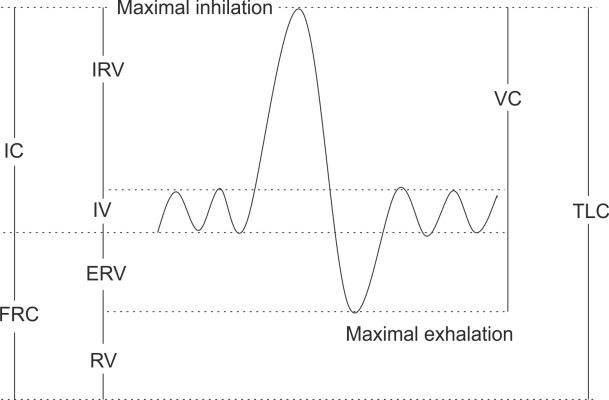
Lung Volume Chart: Normal Values & Disease Patterns
| VOLUME | CAPACITY | ||
| TV | 500 | IC | 3000 |
| IRV | 2500 | VC | 4000 |
| ERV | 1000 | FRC | 2500 |
| RV | 1500 | TLC | 5500 |
| All numbers in: ml (mili leter) |
Obstructive vs. Restrictive Lung Disease: Key Differences
Obstructive and Restrictive pulmonary disease show different lung volumes and capacities. In restrictive pulmonary disease, all the capacities of the lung are reduced, and in obstructive pulmonary disease, they all increase.
Let us try to understand it through this graph.
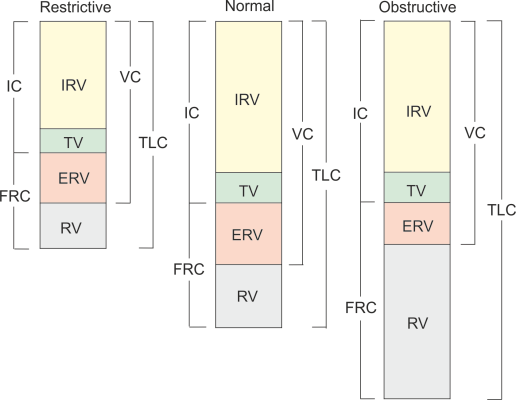
Interactive card displaying breathing pattern for various lung conditions
Lung Volume and Capacity Analysis
Healthy Lungs
Normal lung function with optimal air exchange and breathing capacity.
COPD (Chronic Obstructive Pulmonary Disease)
Airway obstruction leading to air trapping and reduced airflow, particularly during expiration.
Pulmonary Fibrosis
Lung scarring that reduces lung compliance and total capacity, leading to restrictive breathing patterns.
How Age, Height & Lifestyle Affect Lung Capacity
There are many factors that affect static lung volumes/capacities. The factors like age, gender, weight, height and ethnicity are the main physiological determinants of static lung volumes/capacities.
However, there are other factors that should be considered. Like, the level of physical activity, regular exercise, especially swimming and endurance training.
Alternatively, ascending to a high altitude may decrease lung volumes, probably due to increased pulmonary blood flow, pulmonary oedema or premature small airway closure 1.
Let’s try to find out how age affects lung volume and capacities.
Does Age Reduce Lung Function? The Science Explained
The respiratory system undergoes various anatomical, physiological and immunological changes with age. The structural changes include chest wall and thoracic spine deformities, which impair the total respiratory system compliance, leading to increased work of breathing.
Respiratory muscle strength decreases with age and can impair effective cough, which is important for airway clearance 2.
All these factors affect the lung volume and capacities; this is why we recommend breathing exercises, which are important for the health of the respiratory system.
If the excess sputum is collected inside the lungs, it also affects breathing. We can get rid of this naturally by following the postural drainage position technique at home.
The lung matures by age 20–25 years, and thereafter, ageing is associated with progressive decline in lung function. The alveolar dead space increases with age, affecting arterial oxygen without impairing carbon dioxide elimination.
The airway receptors undergo functional changes with age and are less likely to respond to drugs used in younger counterparts to treat the same disorders.
Older adults have decreased sensation of dyspnea and diminished ventilatory response to hypoxia and hypercapnia, making them more vulnerable to ventilatory failure during high-demand states (ie, heart failure, pneumonia, etc) and possible poor outcomes 2.
Test your knowledge
Final word
There are a number of factors that
Still confused? Watch the video above or ask your question in the comments!
Further reading: What is Bucket Handle Movement of Ribs, it’s Anatomy
FAQ

The author is a physiotherapist who has been practising for the last 17 years. He holds a Bachelor's in Physiotherapy (BPT) from SVNIRTAR (Swami Vivekananda National Institute of Rehabilitation and Research), one of the prestigious physiotherapy schools in India.
Whatever he learns dealing with his patient, he shares it with the world through blogs and e-books. He also owns a YouTube channel, "Sunit Physiotherapist" with over 8 lakh active subscribers. Here, he shares everything he gets to learn serving the patient.

Pingback: What is Bucket Handle Movement of Ribs, it's Anatomy - Physiosunit