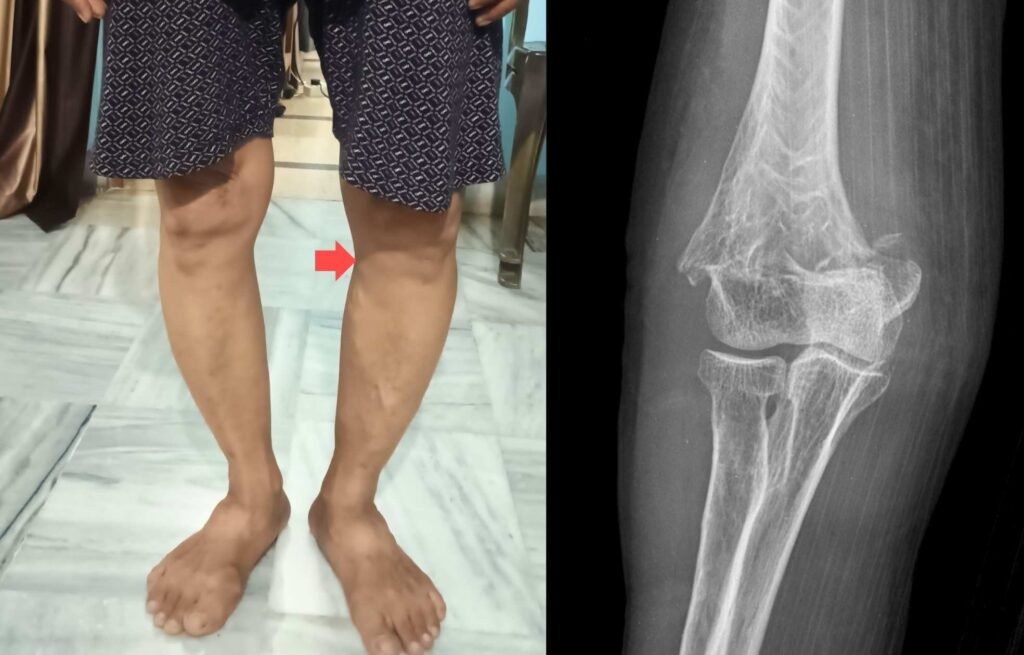
After the age of 50, the incidence of developing knee osteoarthritis becomes very common. Age is the primary risk factor for knee osteoarthritis. However, there are other factors that collectively contribute to how severe one’s knee arthritis can be. Some of these factors are modifiable, and some are not.
By working on the modifiable factors, we can significantly reduce the risk. In this article, we will learn about all these risk factors, which are all research-based. Additionally, you can also take a free test to find your risk of knee OA at the bottom of this article.
The Risk Factors That Predict Knee OA
I am basing this article and the risk calculator on three landmark systematic reviews:
- Published in Arthritis Care & Research (Appleyard et al., 2023) identified 31 separate multivariable prediction models for knee OA incidence.
- A separate study published in The Lancet Rheumatology (Liu et al., 2022) developed and externally validated two robust models for predicting total knee replacement risk.
- The Osteoarthritis Initiative (OAI) is a landmark US cohort study that has followed nearly 4,800 adults for up to 16 years. It is powering most of the validated prediction models available today.
So what are the risk factors these models consistently identify?
1. Age
We all have noticed seniors around us with knee pain. Age is the major contributor to the risk of knee OA. The risk rises steadily from your mid-50s onward. In the Liu et al. 3 prediction model for knee replacement, they compared adults under 55 with those aged 65–69, and what they found was concerning.
The seniors aged 65-69 had nearly three times the risk, even after accounting for other factors.
A research study 4 examining knee joint structure in adults aged 26–61 years found that ageing is associated with increased cartilage defects and their thinning. These changes are closely related to the development of knee osteoarthritis.
2. Body Mass Index (BMI) / Excess Body Weight
BMI, or Body Mass Index, calculates whether your body weight is ideal or excessive, taking your height into consideration. You can use free online BMI calculator to find where your body weight falls.
A high BMI means you are overweight or obese, which increases the mechanical load on knee joints. Research from the OAI and Multicenter Osteoarthritis Study (MOST) 1 confirms that BMI independently predicts both knee OA onset and the need for total knee replacement.
The Liu et al. study3 found that each unit increase in BMI raised the chances of knee replacement by about 5%.
Clinical trial data cited in the research show that intensive diet and exercise reduce joint loads, inflammation, and symptoms in overweight adults with knee OA. This is one area where action taken today can genuinely change your trajectory.
3. Sex
Watch around yourself, and you will find women are more affected by knee pain. They are consistently at a higher risk of developing knee OA than men, particularly after menopause.
This can be attributed to the woman’s body anatomy, which increases the chances of knee OA.
In the Liu et al. study, women with knee pain had a higher risk of total knee replacement than men, even after controlling for age, BMI, and pain severity.
4. Knee Pain Severity (WOMAC Score)
The severity of your current knee pain is one of the strongest predictors of future knee OA progression. In Liu et al., WOMAC (Western Ontario and McMaster Universities Osteoarthritis) index, pain score was one of the three most predictive factors (alongside age and race).
According to the index, if you have “frequent knee pain” – defined as pain, aching, or stiffness on more than half of the days in the past month, it dramatically increases the risk of needing surgery. Compared to those without frequent knee pain, those who reported it were over five times more likely to undergo knee replacement in unadjusted analyses.
5. Previous Knee Injury
If you have a history of knee injury, including ligament tears, meniscal injuries, or fractures, it substantially raises the risk of developing knee OA.
In Appleyard et al. systematic review, knee injury appears as a predictor in models across the, and prior knee arthroscopy (often performed for degenerative meniscal tears) was independently associated with a higher risk of total knee replacement in Liu et al., with nearly double the hazard compared to those without such a history.
This finding has real-world implications: clinical guidelines now recommend against knee arthroscopy for degenerative knee conditions, in part because of evidence linking the procedure to accelerated OA progression.
6. Occupational and Physical Exposures
As a physiotherapist, we at our clinic recommend that the knee arthritis patient avoid postures or activities that require the knee to bend more than 90 degrees. The common activities are squatting, the crossed leg sitting position, the use of the Indian mode of toilet, etc.
This is because when the knee is flexed, it undergoes tremendous pressure on its joint line. A biomechanical study observed that stress produced on knee during deep knee flexion beyond 120°, the stresses increased by more than 80% than normal walking peak knee stresses. Reaching levels close to the threshold known to cause cartilage damage5.
These findings suggest that repetitive activities involving deep knee bending may place excessive stress on the joint cartilage and could potentially contribute to the development of degenerative conditions such as knee osteoarthritis.
According to Appleyard et al. Physical activity is a double-edged sword: regular moderate exercise is protective and can slow OA progression, while high-impact, repetitive occupational loading accelerates joint wear.
7. Comorbidities and General Health
Comorbidities and general health factors also contribute to knee OA risk. Osteoporosis, diabetes, depression, and the presence of pain at multiple joints all appear in various models.
The OAI dataset has enabled research linking systemic inflammation, vitamin D levels, blood biomarkers, and even genetic factors to OA outcomes. While no single biomarker has yet transformed clinical prediction, the picture that emerges is clear: knee OA does not exist in isolation from the rest of your health.
Putting It All Together: Your Personalised Risk Score
So, there is no single factor that affects the knee osteoarthritis risk in isolation; it is the combination.
Our Knee OA Risk Calculator brings this science directly to you. By entering a few straightforward pieces of information — the same variables these validated models rely on — you can get a personalised, evidence-based estimate of your knee OA and knee replacement risk.
The Bottom Line
Knee osteoarthritis is not something that just happens to you randomly at a certain age. It is a condition with identifiable, measurable risk factors many of which are modifiable. Decades of research, hundreds of thousands of participants across international cohort studies, and over a thousand published papers have converged on a consistent picture of who is at risk and why.
The risk factors are: age, BMI, sex, knee pain severity, radiographic changes, prior knee injury, analgesic use, occupational loading, comorbidities, and race/ethnicity.
You do not have to wait for symptoms to become disabling before you act. The best time to understand your risk is now — while there is still time to make changes that matter.
Try our Knee OA Risk Calculator today and take the first step toward protecting your joint health.

The author is a physiotherapist who has been practising for the last 17 years. He holds a Bachelor's in Physiotherapy (BPT) from SVNIRTAR (Swami Vivekananda National Institute of Rehabilitation and Research), one of the prestigious physiotherapy schools in India.
Whatever he learns dealing with his patient, he shares it with the world through blogs and e-books. He also owns a YouTube channel, "Sunit Physiotherapist" with over 8 lakh active subscribers. Here, he shares everything he gets to learn serving the patient.