In this chapter, we’ll discuss rotator cuff injuries. The rotator cuff is located around our shoulder joint. This injury is more common in older people but can also occur in young people. We will learn everything about rotator cuff injuries, but let us start with the anatomy of the rotator cuff.
Anatomy of the rotator cuff
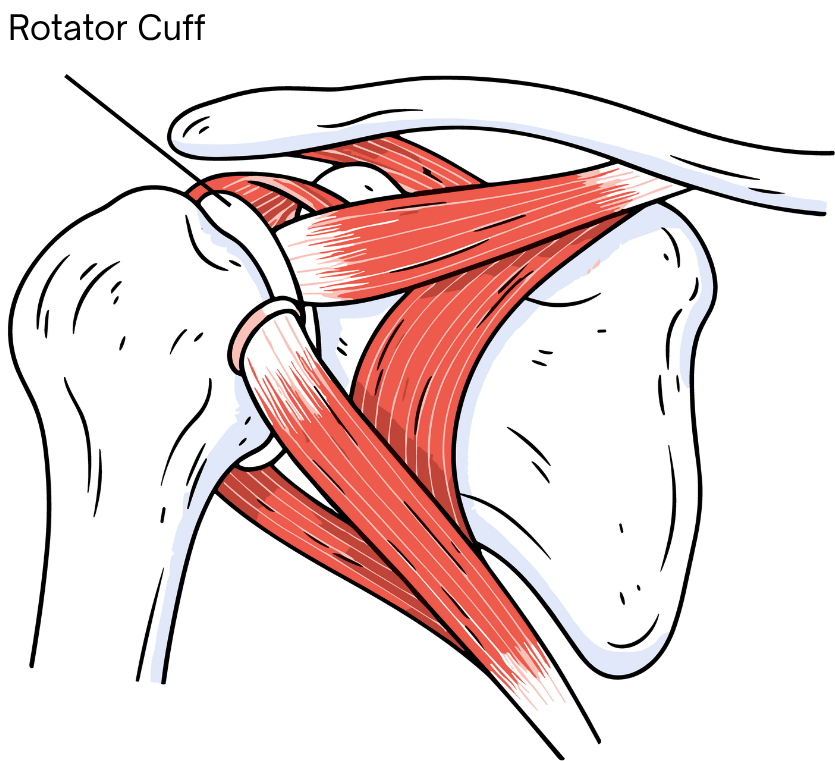
First, let’s understand what the rotator cuff is. The rotator cuff is a fibrous sheath formed by four flattened tendons that blend with the capsule of the shoulder joint and strengthen it. Our joints have a capsule around them, and the shoulder joint also has a capsule around it.
The tendons fuse with that capsule and strengthen it, which we call the rotator cuff. So, if there’s any kind of injury, we call it a rotator cuff injury.
So, what are these four muscles whose tendons fuse with the capsule?
These four muscles are the teres minor, infraspinatus, supraspinatus, and subscapularis. When we were studying for BPT, we used to remember it this way: TISS. TISS is a famous institute in Mumbai. Where:
- The T is for teres minor,
- I is for infraspinatus,
- S for supraspinatus, and
- S for subscapularis.
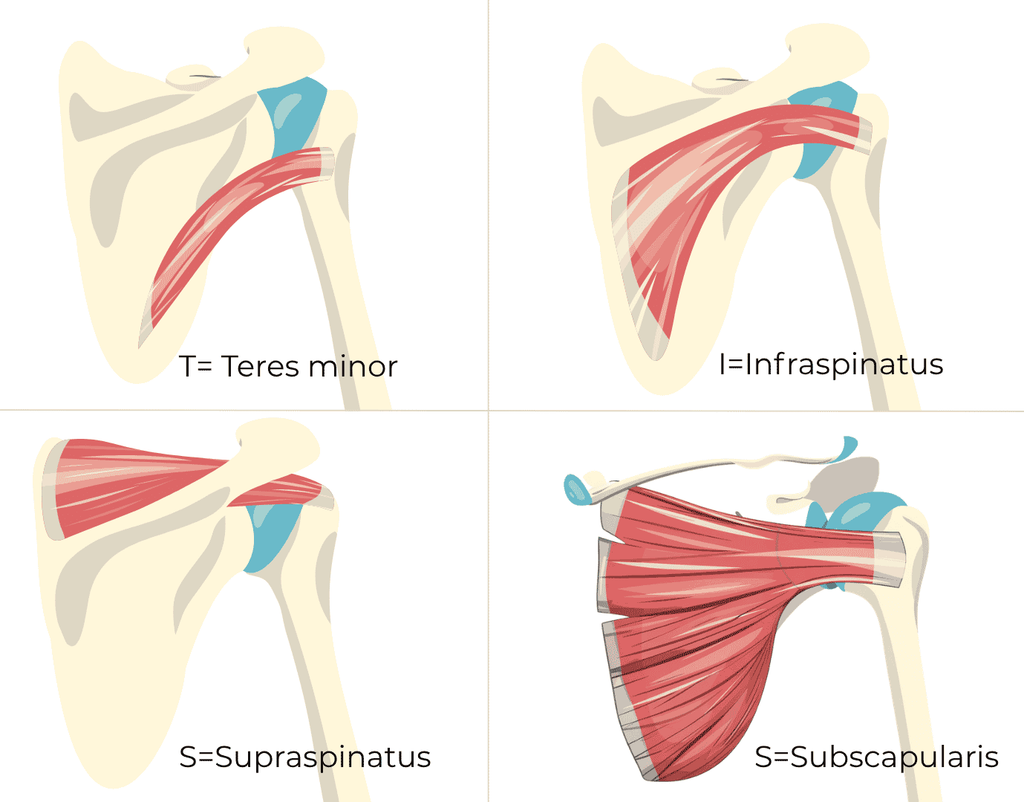
As you can see in the diagram, the posterior scapula has a spine. So, just above the spine, a muscle originates and inserts into the head of the humerus. This muscle is called the supraspinatus muscle. That’s because it’s above the spine, superior to the spine.
The muscle that originates below this spine and inserts into the head of the humerus. We call this muscle the infraspinatus muscle because it’s inferior to the spine.
The next muscle is the teres minor. Just below the infraspinatus muscle originates the teres minor. This muscle inserts into the head of the humerus. Now, finally, the subscapularis.
So, when we take an anterior view of this scapula, a muscle originates; we call this muscle the subscapularis. That means, below the scapula. It inserts into the head of the humerus.
The supraspinatus forms the major component of the rotator cuff and is sometimes called the musculotendinous cuff. It acts as a dynamic stabiliser during shoulder abduction.
Clinical feature
Usually seen in the elderly, but in some cases, it can also occur in younger individuals. In younger individuals, it is always associated with a history of trauma. Depending on the severity, the rotator cuff injury can be minor or major.
Minor tear
So, first, let’s understand the clinical features of a minor tear.
- Pain at the tip of the shoulder and in the upper arm.
- Difficulty lifting the upper limb outward. That is, when we ask the patient to perform abduction, it will be very painful and difficult for them to perform.
- Tenderness just lateral to the acromion.
- Abduction is painful and restricted.
The initiation of abduction will be difficult. Supraspinatus muscles play a very important role in initiating abduction. So if there is any injury in the tendon of the supraspinatus muscle, then initiation of abduction becomes a problem. When we ask him to actively abduct, he will not be able to do it.
But when we passively, that is, with someone’s support, ask them to perform adduction, they’ll be able to do that adduction and sustain it.
Let’s say, as a therapist, I’m passively abducting their arm, and then the adduction will occur. In a 90° abduction position, when I ask them to hold it, saying, “Hold this position,” then I remove my hand or the support, and they’ll be able to hold it.
Painful arc syndrome
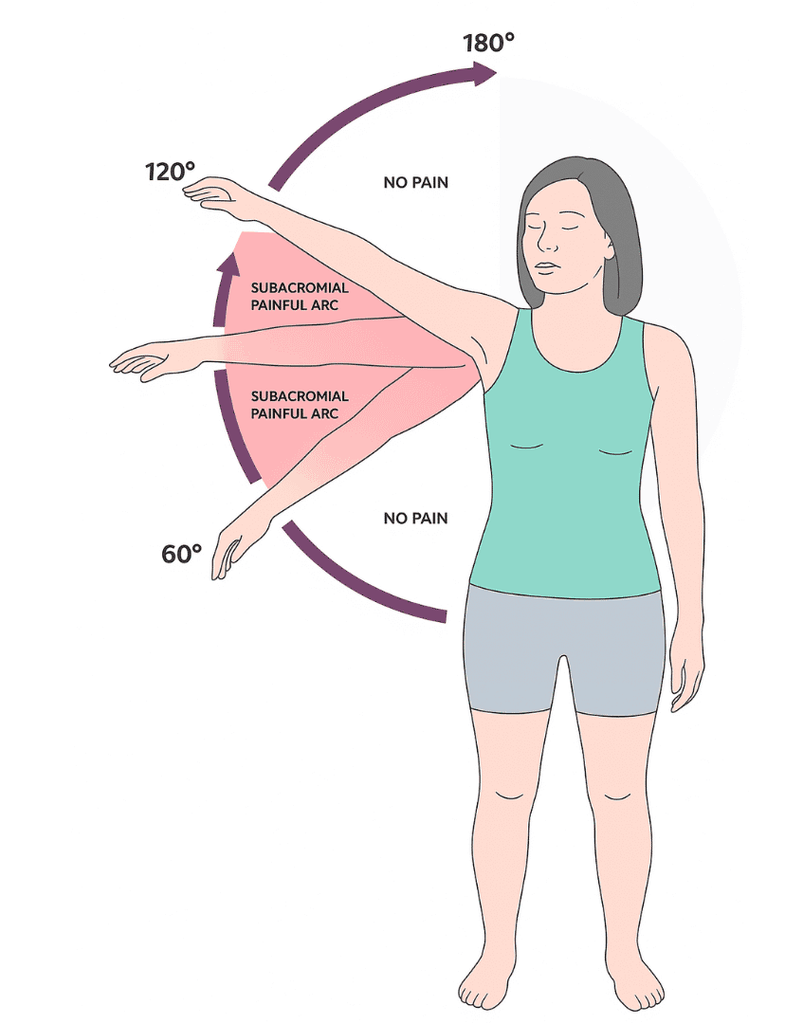
One sign of a minor tear is that it could lead to painful arc syndrome. So, look, this is painful arc syndrome. When we perform an abduction, we start at 0° and go up to 180°. So, in painful arc syndrome the abduction the mid part of the arc is quite painful. That is, when you are starting the abduction from 0° until 60°, there’s no pain at all.
But from 60° to 120°, this area is quite painful. This is the portion we call the painful arc. And after 120°, there’s no pain until 180° of abduction2.
Major tear
Now let’s move on to a major tear. In a major rotator cuff tear, there will be a history of trauma. The patient will complain of pain over the shoulder and restrictions on lifting the upper arm outward. The same complaints that occur in a minor tear will also occur in a major tear.
There will be pain in the tip of the shoulder. There will be pain throughout the entire shoulder area, and when we ask for shoulder abduction or lifting the shoulder outward, the patient will be unable to do it.
When we examine the major tear, what will we find?
- There will be tenderness just lateral to the acromion process.
- A gap will be felt just lateral to the acromion process. When we palpate, we’ll feel a gap there.
- Abduction will be restricted. If abduction is done passively, the patient can maintain abduction by the deltoid muscle. Same thing as I just explained. When we ask for a passive abduction, they will do it by the action of the deltoid muscle. The deltoid muscle is the bulk of the muscle here, which we call the deltoid muscle.
Positive drop arm test
In the drop sign, we passively ask the person to perform shoulder abduction. Then we’ll ask him to hold this abduction in this 90° position. But he won’t be able to hold it. The arm will drop. This is what we call the drop sign3.
Investigation
- First, an X-ray is prescribed. X-rays don’t typically detect tendon injuries or soft tissue injuries. But it is essential to rule out any associated fracture like fracture in the greater tuberosity.
- Arthrography may be required.
- Ultrasound may be required.
- MRI may be required.
- Arthroscopy may be required.
Treatment
For a minor tear, no major intervention is required. The shoulder joint is immobilised by using an arm sling or shoulder sling. After a month of immobilisation, minor tears gradually heal on their own. Then, gradual mobilisation exercises, including shoulder mobilisation exercises and range of motion exercises, are advised.
If the patient is referred to a physiotherapist, the physiotherapist will administer ultrasound and IFT. Ultrasound and IFT speed up the tendon’s healing process. They increase blood circulation, which speeds up the healing process. It also provides pain relief.
Major tear
In a major tear, the treatment varies with age. For younger patients, surgical repair is the choice of treatment. Arthroscopic repair is preferable. Nowadays, all surgeries are performed arthroscopically. But the point is that the results are not always better1.
After repair, shoulder mobilisation exercises should be started after four weeks of repair. This is what we physiotherapists do.
You can see the figure of repair of a minor tear of the rotator cuff using an absorbable screw. This means that the bone absorbs it over time. And this suture has been inserted into it. And it has been repaired here.
After repairing it this way, mobilisation exercises are started after four weeks.
For older patients, operative repair is contraindicated because of degenerative tendon. This is due to age. In the early stages, rest is recommended. Then, gradual mobilisation is advised.
Physiotherapists will provide ultrasound and IFT. If they are athletes or young people, operative repair may be necessary. Because the healing process is faster in young patients and athletes, and the chances of healing are higher, that’s why surgery is performed.
So, what rehabilitation exercises should be done after a rotator cuff injury? I’ve written an excellent article on exercises after a rotator cuff injury.
FAQ
A rotator cuff injury is damage to the tendons of the four muscles (supraspinatus, infraspinatus, teres minor, and subscapularis) that form a fibrous sheath around the shoulder joint capsule. The injury can range from a minor partial tear to a major full-thickness tear.

The author is a physiotherapist who has been practising for the last 17 years. He holds a Bachelor's in Physiotherapy (BPT) from SVNIRTAR (Swami Vivekananda National Institute of Rehabilitation and Research), one of the prestigious physiotherapy schools in India.
Whatever he learns dealing with his patient, he shares it with the world through blogs and e-books. He also owns a YouTube channel, "Sunit Physiotherapist" with over 8 lakh active subscribers. Here, he shares everything he gets to learn serving the patient.