What is the role of heat transmission and electrical physics in physiotherapy?
In this post, we will learn the foundational concepts of conductors and insulators, the three states of matter, and how latent heat impacts thermal energy. We will also cover the differences between conduction, convection, and radiation in physical therapy, alongside trickier exam topics like potential difference and thermionic emission.
Key Concepts Covered in This Guide:
- Conductors vs. Insulators: How electrical currents flow through therapeutic mediums.
- Methods of Heat Transmission: A direct comparison of conduction, convection, and radiation in clinical applications.
- Advanced Electrotherapy Physics: A simplified look at potential difference and thermionic emission.
What is the Difference Between Conductors and Insulators?
There are two types of electricity materials: conductors and non-conductors.
Conductors, like metal rods or wires, allow electricity to pass through them. For example, a writing pen is made of plastic, which does not conduct electricity, so we call it a non-conductor. But if we have a metal object, such as a rod or wire, current can pass through it, making it a conductor.
Conductors are elements that have a few loosely held electrons in their outer layer. They have some electrons in the outer layer which are free, which is why they work as conductors. For instance, copper wire is a good conductor because it has loosely held electrons in its outer layer. These electrons can move freely, allowing electricity to pass through the material.
On the other hand, non-conductors, or insulators, have tightly held electrons in their outer layer, meaning they are not free to move. Examples of non-conductors include plastic, rubber, and wood. These materials cannot conduct electricity because their electrons are not free to move.
The three state of matter
The state of matter refers to the physical forms in which an element can exist: solid, liquid, or gas. This concept is fundamental in understanding how different materials interact in various environments.
For instance, water can exist in three states: solid (ice), liquid (water), or gas (steam). Each state has distinct characteristics that affect how the substance interacts with external forces, including electricity.
Understaning latent heat in physiotherapy
Now, let’s discuss the concept of latent heat and the various ways heat is transmitted. These concepts are crucial in understanding how energy changes state and moves through different materials.
Latent heat refers to the internal energy required to change a substance from one state to another, such as from solid to liquid or liquid to gas. This energy is “hidden” within the molecules and is not observed as a temperature change.
For example, a specific amount of energy is required to convert ice at 0°C into water at the same temperature. This energy, known as latent heat, is necessary to overcome the bonds holding the molecules in a solid state and allow them to move more freely as a liquid.
The same principle applies when a liquid is transformed into a gas. The molecules require additional energy to break free from their liquid bonds and disperse into a gaseous state.
Understanding latent heat is essential in various therapeutic applications, especially when dealing with the effects of heat on the human body.
The 3 methods of transmission of heat
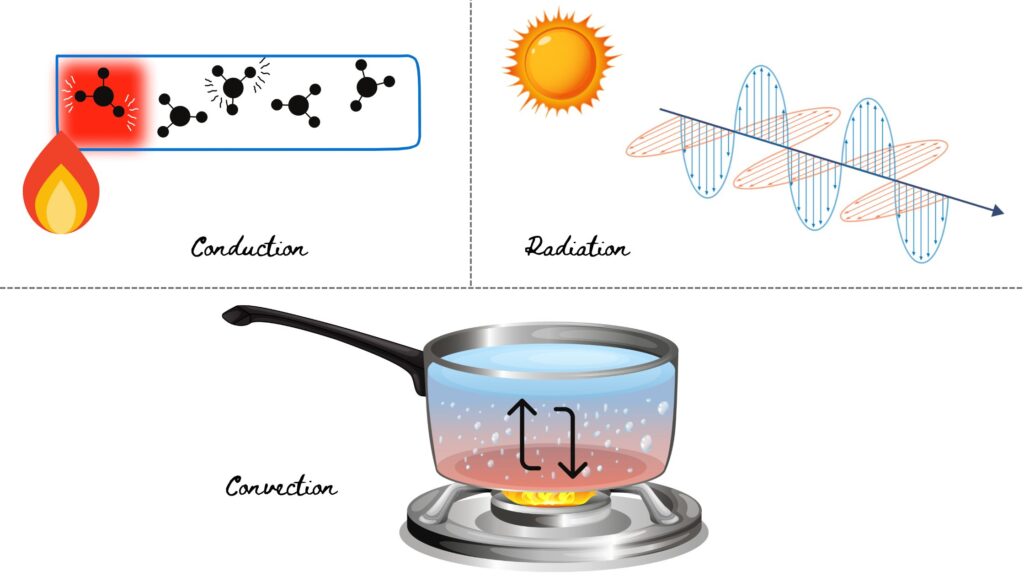
Heat transmission occurs in three primary ways: conduction, convection, and radiation.
1. Conduction: theral transfer via direct contact
This is the process by which heat is transferred through a solid material. For instance, when a metal rod is heated at one end, the energy causes the molecules to vibrate more intensely.
This increased vibration is then passed along to neighbouring molecules, transferring heat from the warmer end of the rod to the cooler end. Metals are particularly good conductors of heat, while materials like certain plastics are not.
2. Convection: thermal transfer via fluid movement
Convection occurs when heat is transferred through a fluid (liquid or gas) by the movement of the fluid itself. As the fluid heats up, it becomes less dense and rises, while cooler fluid takes its place, creating a circulation pattern that transfers heat.
3. Radiation: thermal transfer via electromagnetic wave
Radiation is the transfer of heat through electromagnetic waves without needing a medium. This is how the sun’s energy reaches the Earth, and it plays a significant role in various therapeutic techniques that involve heat application.
Understanding these methods of heat transmission is vital for effectively applying electrotherapy techniques. Each method has different implications for how heat interacts with the body and how it can be used therapeutically.
Understanding potential differences and radiation
In this final section, we will discuss the impact of radiation, the physical effects of heat on materials, and the concept of potential difference, all of which are integral to understanding and applying electrotherapy.
Radiation occurs when specific atoms are heated, causing their electrons to move to higher energy levels. When these electrons return to their normal state, the excess energy is released through electromagnetic radiation, such as infrared radiation. (For a clear introduction to atomic structure and how electron transitions produce electromagnetic radiation used in electrotherapy, see Atom and Atomic Structure, Electromagnetic Wave Simplified.)
This type of radiation is crucial in various therapeutic techniques where heat is used to achieve specific physiological effects.
For example, when we apply energy to an atom, the electrons absorb this energy and jump to a higher orbit. Returning to their original orbit, they release the absorbed energy through infrared radiation.
This radiation is what conducts heat and is a fundamental concept in the application of heat in therapy.
What are the physical fffects of heat?
Heat has several physical effects on materials, two of which are expansion and the acceleration of chemical reactions.
1. Expansion
When heat is applied to a material, the molecules within gain kinetic energy, leading to increased vibration. This increased movement causes the molecules to move further apart, resulting in the expansion of the material. This is why most materials expand when heated.
2. Acceleration of Chemical Reactions
According to the laws of thermodynamics, increasing temperature accelerates the rate of chemical reactions. The added energy causes molecules to vibrate faster, leading to quicker reactions. Conversely, cooling slows the rate of chemical reactions by reducing the power available to the molecules.
How is potential difference produced?
The concept of potential difference is vital in electrotherapy. It occurs when two dissimilar metals, such as bismuth and antimony, are joined and heated at the junction.
This heating creates a potential difference between the two metals, which can be harnessed to generate an electrical current. This principle is the basis for many therapeutic devices that use electricity to stimulate healing and relieve pain.
Understanding these principles is crucial for effectively applying electrotherapy techniques. Whether you’re using heat to relax muscles or electrical currents to stimulate healing, these fundamental concepts will guide your approach and enhance the outcomes of your treatments.
What is thermionic emission and space charge?
In thermionic emission, the electrons are released from the molecule when a material like tungsten is heated. The material becomes rich with electrons, forming a cloud known as space charge. This process, called thermionic emission, is fundamental to the functioning of electricity.
Thermionic emission occurs, for example, when tungsten metal is heated. As energy increases, the material heats up, and with more energy, it emits light. As the energy level rises, electrons in the material start to form a cloud, creating what we call a space charge, which is an area that becomes charged. This process is known as thermionic emission.
Friends, this chapter is getting a bit long so I will divide it into two parts. In the next episode, I will teach you about static electricity, current electricity, and the electromagnetic spectrum. This will help you understand and digest the information better.
I will conclude this lecture here. I hope you enjoyed it. If you have any doubts, please comment in the comment box, and I will try to clear them. I would also appreciate your feedback on this video.
Thank you all so much for reading. Thank you!
FAQ

The author is a physiotherapist who has been practising for the last 17 years. He holds a Bachelor's in Physiotherapy (BPT) from SVNIRTAR (Swami Vivekananda National Institute of Rehabilitation and Research), one of the prestigious physiotherapy schools in India.
Whatever he learns dealing with his patient, he shares it with the world through blogs and e-books. He also owns a YouTube channel, "Sunit Physiotherapist" with over 8 lakh active subscribers. Here, he shares everything he gets to learn serving the patient.