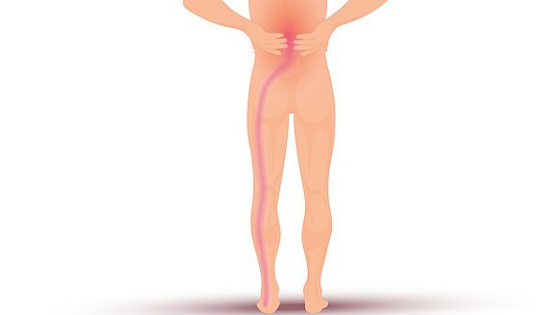
There are many causes of low back pain. Among them, one of the causes is structural in nature and is called anterior pelvic tilt. In anterior pelvic tilt, the alignment of our pelvic bone is disturbed and deviates from normal, tilting slightly anteriorly. We will discuss about its causes, but it can lead to discomfort and lower-back pain.
Fortunately, a few simple yet effective anterior pelvic tilt exercises can help correct the tilt, strengthen your core, and improve posture. This guide walks you through the key exercises step by step.
Understanding Anterior Pelvic Tilt

Anterior pelvic tilt1 is an abnormal postural pattern in which the pelvic bone rotates forward, as in the figure. As a result of this, the arch in the lower back (lumbar lordosis) increases, making the abdomen appear more prominent.
For a side-by-side comparison with the opposite pattern, see our guide on anterior vs posterior pelvic tilt—how they differ in causes, muscle imbalance, and effect on the lumbar curve.
For a deeper look at hip joint structure and how the pelvis is oriented in normal standing, see our guide on hip kinematics and joint anatomy.
This anterior pelvic tilt could result from an imbalance in muscle strength and muscle pull. There is weakness of the abdominal muscles and gluteus maximus and tightness in the iliopsoas (hip flexor) and erector spinae. This imbalance is often referred to as lower crossed syndrome.
All this results in lower back pain.
Easy exercises to fix anterior pelvic tilt
The key to correcting anterior pelvic tilt is to strengthen the core and gluteal muscles while stretching tight hip flexors. This combination helps restore balance around the pelvis and supports better posture. These anterior pelvic tilt exercises form a practical starting routine. For more posture work, see our guide on improving posture with exercises.
There are studies that support the effect of exercises in correcting anterior pelvic tilt. A 2020 systematic review on excessive anterior pelvic tilt found that exercises are effective but lacks solid evidence2.
However, a more recent 2025 study conducted on people with non-specific low back pain found that core stabilisation exercises produced reductions in anterior pelvic tilt (approximately 2–6°) along with improvements in pain and function.
In clinical practice, the combination of hip-flexor stretching plus core and glute strengthening remains the most commonly recommended approach and is the foundation of the exercises below.
Here are the essential exercises to include:
# 1. Dead bug exercises for anterior pelvic tilt

Strengthening the deep core is one of the most important parts of any plan for anterior pelvic tilt. The Dead Bug is highly effective for this because it trains the abdominals while teaching you to keep the lower back stable and neutral.
- Lie on your back with your arms extended straight up toward the ceiling. Bend your hips and knees to about 90 degrees so your shins are parallel to the floor (tabletop position). Keep your lower back gently pressed toward the floor.
- Engage your core by drawing your belly button gently toward your spine. Maintain this light tension throughout the movement so your lower back does not arch.
- Slowly lower your right arm overhead while extending your left leg toward the floor. Only go as far as you can while keeping the lower back in contact with the floor. Return to the starting position with control.
- Repeat on the opposite side: lower the left arm and extend the right leg.
- Perform 8–12 controlled repetitions on each side. Focus on quality and a stable lower back rather than speed.
# 2. Glute bridge anterior pelvic tilt exercise

The Glute Bridge strengthens the gluteal muscles, which are often underactive when the pelvis tilts forward. Stronger glutes help support a more neutral pelvic position.
- Lie on your back with knees bent and feet flat on the floor, hip-width apart. Place your arms by your sides, palms down.
- Engage your core and squeeze your glutes as you lift your hips until your body forms a straight line from knees to shoulders. Avoid overarching the lower back.
- Hold the top position for 3–5 seconds while keeping the glutes firmly contracted.
- Lower your hips slowly with control and repeat.
- Aim for 12–15 repetitions. As you get stronger you can increase the hold time, add repetitions, or progress to a single-leg variation.
# 3. Plank exercise to correct anterior pelvic tilt

The plank builds full-core endurance. For people with anterior pelvic tilt it is especially useful when performed with a neutral or slightly posterior pelvic position so the lower back does not sag into excessive extension.
- Start in a high plank (or forearm plank) with hands or elbows under the shoulders and body in a straight line from head to heels.
- Gently draw the lower ribs toward the pelvis and lightly tuck the tailbone (posterior pelvic tilt cue) so the lower back stays neutral rather than arched. Squeeze the glutes and brace the core.
- Hold for 20–45 seconds (or longer as strength improves) while maintaining the neutral position. Stop if the lower back begins to sag.
- Beginners can start on the forearms or with knees down. Progress by increasing hold time or adding side-plank variations.
#4: Stretching Tight Hip Flexors
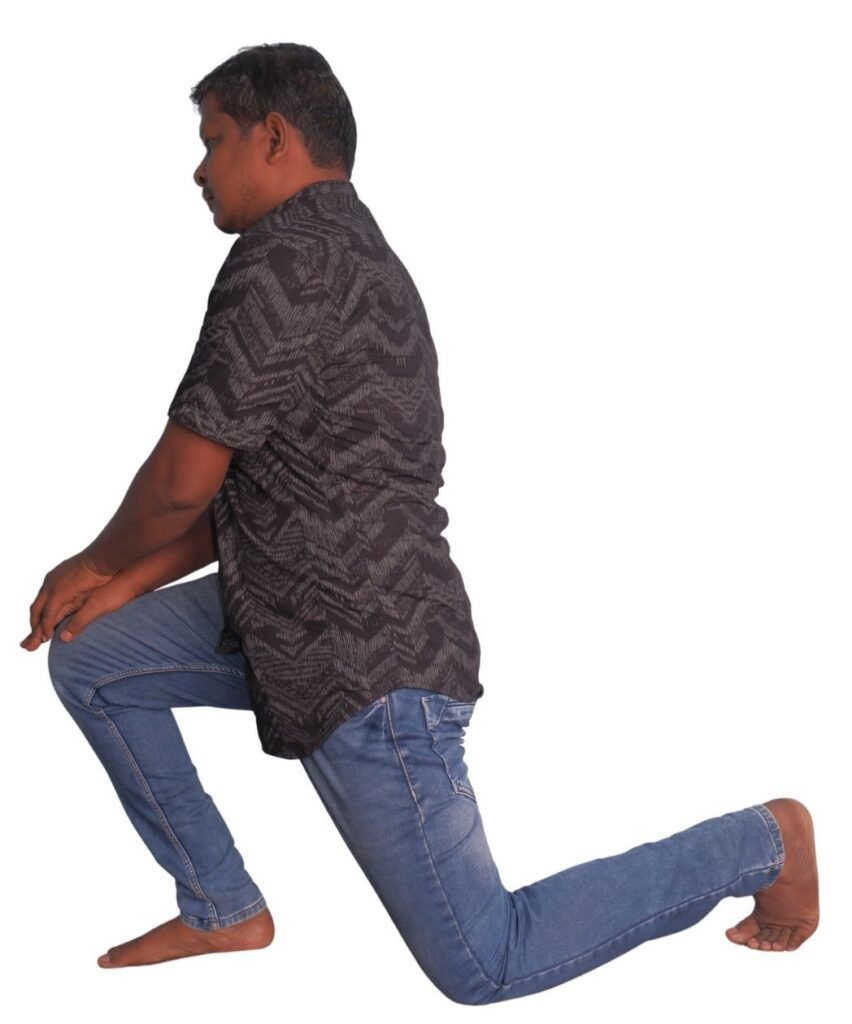
Tight hip flexors commonly contribute to anterior pelvic tilt. The kneeling hip flexor stretch is a simple and effective way to address this tightness.
- Kneel on a soft surface (yoga mat or cushion). Place one knee on the ground and step the other foot forward so the front knee is bent at about 90 degrees.
- Keep your torso upright and gently engage your core. Optionally tuck the pelvis slightly (posterior tilt) to deepen the stretch on the front of the rear hip.
- Shift your weight forward until you feel a comfortable stretch in the front of the hip of the kneeling leg. Avoid arching the lower back.
- Hold for 20–30 seconds while breathing normally, then switch sides.
- Repeat 2–3 times on each side.
#5: Correcting Posture
Exercises alone are not enough. Make a conscious effort to maintain better posture during the day.
Keep your shoulders relaxed and gently drawn back, chest open, and pelvis in a neutral position (neither strongly tipped forward nor tucked under). Frequent short posture checks throughout the day reinforce the changes you make with the exercises.
The Effects of Anterior Pelvic Tilt on the Body
When the pelvis tilts forward, the whole musculoskeletal system can be affected. Common consequences include:
- Increased stress on the lower back: The exaggerated lumbar arch places extra load on the lumbar spine and can contribute to pain and discomfort.
- Weak abdominal muscles: The deep core muscles that help hold the pelvis in a neutral position often become underactive, allowing the tilt to persist.
- Tight hip flexors: Prolonged sitting and limited stretching commonly tighten the hip flexors, which further encourages the pelvis to tip forward.
- Underactive gluteal muscles: Weak or inhibited glutes reduce the ability to stabilize the pelvis and can worsen the imbalance.
Over time these changes can increase stress on the lumbar spine, hips, and knees. The increased lumbar curve can also make the abdomen appear more prominent even when body fat is low.
Assessing your posture and identifying anterior pelvic tilt
A simple home check can give you a rough idea whether anterior pelvic tilt is present:
- Stand with your back against a wall and heels roughly six inches from the wall.
- Slide one hand into the space between your lower back and the wall. A large gap that easily fits more than a couple of fingers suggests an increased lumbar curve that often accompanies anterior pelvic tilt.
- Also notice other common postural patterns such as rounded shoulders or a forward head posture.
For a more quantitative estimate, try our Anterior Pelvic Tilt Angle Calculator. It estimates the sagittal pelvic tilt angle using the classic clinical ASIS–PSIS method (the angle between the horizontal and the line joining the anterior and posterior superior iliac spines).
This is only a quick screening approach. Persistent pain, significant asymmetry, or uncertainty about the cause of your symptoms should be assessed by a qualified physiotherapist or medical professional.
Conclusion
Correcting anterior pelvic tilt works best with a combined approach: stretch tight hip flexors, strengthen the core and glutes, practice better daily posture, and include general strength training.
Perform the exercises above consistently (for most people, 3–5 days per week is a realistic starting point). Focus on good form and gradual progression rather than high volume. If you have significant pain, recent injury, or other medical conditions, consult a physiotherapist before beginning a new exercise program.
Note that some people have the opposite problem—a reduced or flattened lumbar curve (loss of lumbar lordosis). If that describes you, see our related guide: Fix Straightening of Lumbar Lordosis – 5 Top Exercises. You can also compare both patterns in our anterior vs posterior pelvic tilt overview.

The author is a physiotherapist who has been practising for the last 17 years. He holds a Bachelor's in Physiotherapy (BPT) from SVNIRTAR (Swami Vivekananda National Institute of Rehabilitation and Research), one of the prestigious physiotherapy schools in India.
Whatever he learns dealing with his patient, he shares it with the world through blogs and e-books. He also owns a YouTube channel, "Sunit Physiotherapist" with over 8 lakh active subscribers. Here, he shares everything he gets to learn serving the patient.