The hip joint is a ball-and-socket synovial joint known for its stability,
The angle of inclination measured in the frontal plane is 150 degrees in infants and decreases to 125 degrees in adults. The angle of declination, measured in the transverse plane, normally ranges from 10 to 15 degrees,
In this post we’ll discuss hip joint kinematics. I’ll simplify this topic so your entire concept becomes clear. Today we’ll study hip joint dynamics.
Hip joint Anatomy: structure and classification
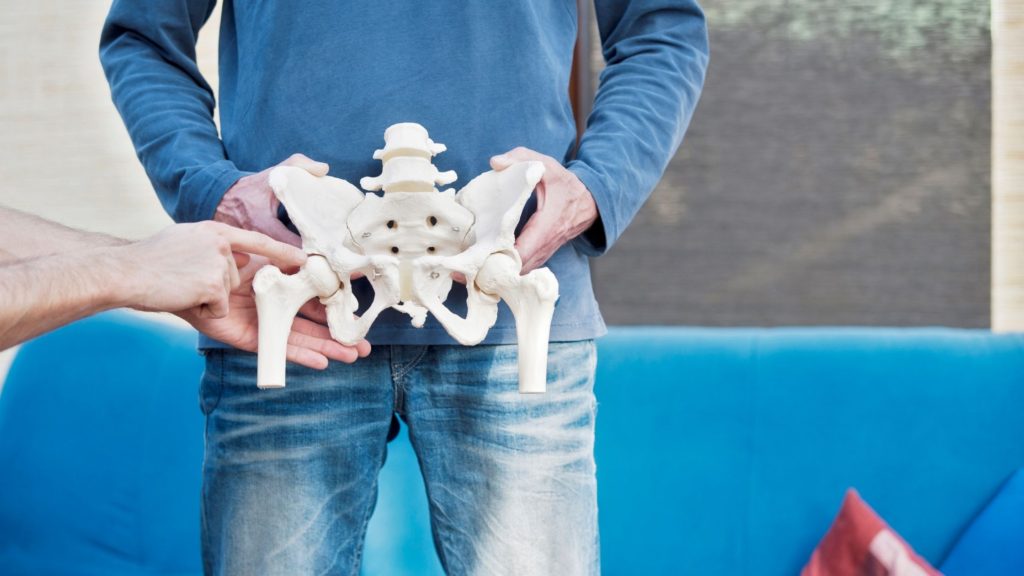
The hip joint is a ball-and-socket variety of synovial joint. We know a synovial joint is a joint that contains synovial fluid. The most freely movable joint in our body is a synovial joint. And this is a ball-and-socket variety of joint in which the ball fits into the socket.
The hip joint is a type of ball-and-socket joint, and it’s a very stable joint. If I compare it to the shoulder joint, which is also a ball-and-socket joint in which the socket is quite shallow and the ball is also quite shallow, it’s a very unstable joint.

The hip joint is stable because its socket is quite deep, and its ball which is a spherical shape. The socket, which we call it as the acetabulum, is almost a hemisphere, and its head makes up three-quarters of the sphere.
You can see in the image that the acetabulum is almost half of the sphere. And the ball that forms the head of the femur and is almost 3/4 of a hemisphere. So imagine how stable this joint is.
Hip joint position in normal standing posture
So, in normal standing, the acetabulum faces forward, outward and directed a little downward. Now, the head of the femur will face forward, upward, and inward. Because of this position of the head of femur, the anterior part of the head isn’t covered by the acetabulum. So anteriorly, it becomes a little weaker.
Neck shaft angle (angle of inclination): coxa valga and vara
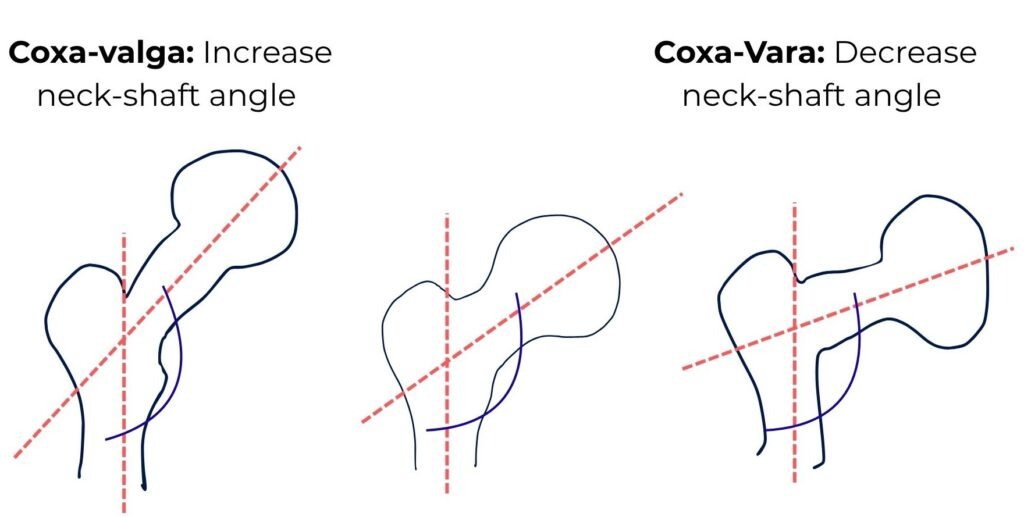
Now, let’s move on to the neck and shaft angle. The head of the femur is connected to the shaft of the femur by a neck. This neck forms an angle with the shaft. A transverse line passes through the neck, and if we draw a transverse line through the shaft, the angle it forms is called the neck and shaft angle.
In an infant, this angle is 150 degrees. But as they grow older, because of the body weight, it gradually reduces to 125°, meaning that in an adult, the angle is 125 degrees.
- Children: Neck and shaft angle = 150°
- Adults: Neck and shaft angle = 125°
When this angle increases, we call it coxa valga. When this angle decreases, we call this a condition coxa vara. These changes can occur due to a fracture or a congenital issue. Related lower-limb alignment conditions at the knee include bow legs (genu varum), which can also alter joint loading.
Angle of declination: anteversion and retroversion
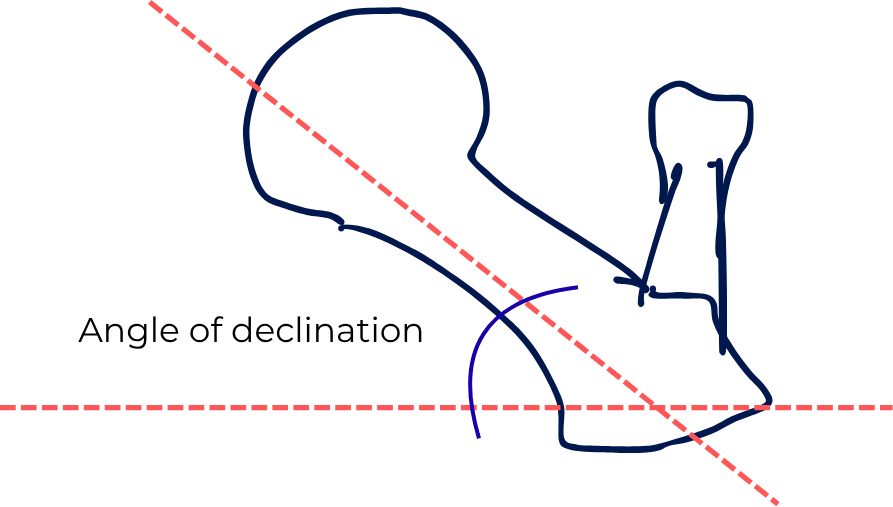
Now let’s study the angle of declination. What we studied before was the angle of inclination. The angle of declination occurs in the transverse plane. If we place the femur bone flat on a table, then the neck of the femur makes an angle with the table’s surface. We call this angle the angle of declination.
Normally, the angle of declination is 10 to 15 degrees in a normal individual. But this angle can increase or decrease under certain conditions:
- When this angle increases, we call this condition anteversion. It is more common in children. As children grow, this condition becomes normal.
- When this angle decreases, we call this condition retroversion. This often occurs over time.
Key takeaways: hip joint angles
The angle of inclination is formed in the frontal plane. When the angle of inclination increases, we call it coxa valga. When it decreases, we call it coxa vara. Similarly, the angle of declination is formed in the transverse plane. When it increases, we call it anteversion. When it decreases, we call it retroversion. If you have any questions, please leave a comment in the comment section. In the next chapter, I’ll discuss the biomechanics of the hip joint itself.

The author is a physiotherapist who has been practising for the last 17 years. He holds a Bachelor's in Physiotherapy (BPT) from SVNIRTAR (Swami Vivekananda National Institute of Rehabilitation and Research), one of the prestigious physiotherapy schools in India.
Whatever he learns dealing with his patient, he shares it with the world through blogs and e-books. He also owns a YouTube channel, "Sunit Physiotherapist" with over 8 lakh active subscribers. Here, he shares everything he gets to learn serving the patient.