This lesson is part of our full Exercise Therapy Video Lessons course for BPT 1st year, which covers mechanical principles, exercise therapy and massage, muscle strength, and joint movement in sequence with quizzes.
Welcome back to our ongoing series on the mechanical principles of exercise therapy. In this post, we will discuss:
- Force: The mechanical influence that alters a body’s state of rest or uniform motion, including its composition (direction and magnitude) and the effects of multiple concurrent forces.
- Gravity: The continuous downward force acting on the human body and how muscular contractions counteract it to produce stability or movement.
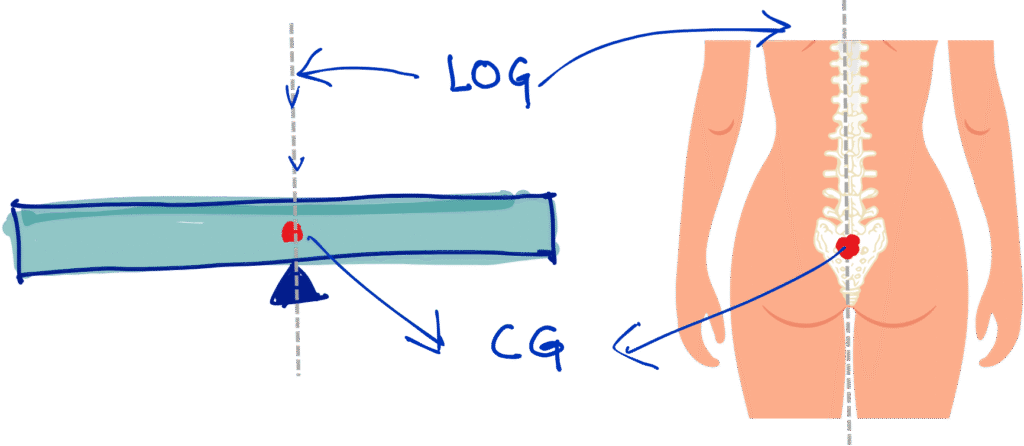
- Center of Gravity (CoG): The specific point where gravity acts effectively on an object or body—located approximately at the second sacral (S2) level in humans.
- Line of Gravity (LoG): The vertical line extending downward from the center of gravity to the base of support.
So, first, let’s start with force.
Force in Biomechanics: Definition, Components and Types
What is force? Force is something that alters the state of rest of a body and its uniform motion in a straight line.
That means, if a body is at rest, like a ball, if we push it slightly and it starts in motion, its state of rest changes to motion. So, for that, force is needed.
And if a body is in motion, like this ball in motion, if we stop it, it also comes from a state of motion to a state of rest. So, for that, too, a force is needed. Got it?
Let’s understand what the composition of forces is. There are two compositions of force:
- one is direction, and the other is
- magnitude.
The direction of the arrow represents the direction of the force. And magnitude means how much force is applied. That is represented by the length of the arrow.

Let me explain it to you clearly.
Consider an object. So I applied force in the right-to-left direction, and it is moving from right to left. So the arrow here describes the direction of force.
Now, the length of the arrow is the magnitude. If, suppose, I apply greater force, its length will increase. So magnitude is represented by the length, and the direction of the arrow represents direction.
Now, there are two situations here.
- In one situation, a single force is acting.
- And the second situation is in which two forces are acting.
In a single force, there is only one force, in which the body will move in the direction in which the force is acting, and the body will move as far as the magnitude of the applied force is.
So, what happens when two forces act simultaneously on a body at a single point? Let’s understand.
Types of Force Combinations (BPT Exam Notes)
Case 1: Two Forces Acting in the Same Direction at One Point

The first situation is in which two forces are acting in the same direction and at a common point. So, what will this result in?
The resultant force will be the sum of the magnitudes of both forces. That means, if we add the magnitudes of both forces together, that’s the resultant magnitude, and its direction will remain the same.
Let me explain this diagrammatically. A force is acting on a point, let’s consider this force to be A; another force to be B (dotted line) is acting on the same point. They together become one force. So, the resultant magnitude becomes one magnitude. It will be a + b, and its direction will remain the same because they are acting in the same direction. So, this is one condition.
Case 2: Two Equal Forces in Opposite Directions (Equilibrium)

Now let’s move on to the second condition, where two equal forces are acting on at the same point and opposite directions. So, it reaches a state of equilibrium. That is, it won’t even move from its place.
I made a video for this, in which you can see that this is a box that I’m pulling with a rope from both sides, and the forces on both sides are exactly equal and acting on the same point. So, you see, if I pull both of them simultaneously, it goes into a state of equilibrium. That is, it doesn’t move from its place.
If I show this diagrammatically, there are two forces acting on the same point: one force in the direction from left to right and the other in the opposite direction. That means the magnitude of both is equal. So now it won’t move from its place. It won’t move anywhere. It reaches a state of equilibrium.
Now we move on to the third condition.
Case 3: Two Unequal Forces in Opposite Directions (Resultant Movement)

There are two unequal forces here. One is greater, and one is less. Both are acting on a common point and working in opposite directions. So, what happens in this situation is that the force with the greater magnitude will move in that direction.
So, let me show you this diagrammatically. One has a greater force, and another is slightly lesser. Now, both are acting on the same common point.
So, the resultant force will move in the same direction, and its magnitude will be, for example, a and b, so the magnitude will be b – a.
Case 4: Two Forces Acting at an Angle (Resultant Vector)

Now, the fourth situation is where two forces are acting on the same point but at an angle to each other. So, what happens here is that the direction of both forces will compound, and the magnitude of both forces will compound, and they will move in the resultant direction.
Let me show you diagrammatically. One force is acting in this direction and another force is acting in this direction. This one has a lower magnitude and this one has a higher magnitude. So its resultant direction will be slightly greater on this side, and its magnitude will be a + b. This means that with the same amount of force, it will move in this direction.
Is that clear?
Case 5: Two Forces at Different Points (Rotation / Torque)

Now, there’s one last condition: there are two opposite forces, and they’re not acting at the same point; they’re acting at different points. In opposite directions, the direction is also its opposite. So, this rotation will rotate the body.
As you can see in this video. I’ve done it on this pen. So, it’s rotating. Let me explain it diagrammatically. One force is acting in this direction. It’s acting on this point in this direction. And a force is acting on another point, a different point. This is acting on this point. So the result will be that it will start rotating. This object will start rotating. Let’s now study the mechanics of position.
Gravity: Definition and Effect on the Human Body
So what is gravity?
Gravity is the force that we must have studied in physics, which attracts all objects on Earth towards the Earth. We call it gravity.
So how does it impact our human body?
The force of gravity continuously acts on our body. If we don’t oppose it, like if we are standing. If we don’t oppose gravity, we will fall to the ground.
So, to oppose it, our leg muscles, our spine, and our trunk muscles work continuously to keep us standing. If those muscles can’t resist it, we’ll fall.
Next, when another force counterbalances the force of gravity with an equal force, the body becomes stable.
So, to explain this, I’ll use examples like the support of a plinth. This plinth is a base. Let’s say there’s a statue on top of it. This plinth is able to support it because it’s resisting it with an equal force. If it didn’t resist with an equal force, it would sink into it.
So, another example is the buoyancy of water and isometric contraction of muscles. This ball is floating in water because it’s receiving buoyancy. The Earth’s gravity is pulling the ball downward, but the buoyancy of water is pushing it upward, and the two become equal. That’s why it’s floating here.
Now the third example is isometric muscle contraction. Look at this, this is a dumbbell. Gravity is pulling this dumbbell downward. But our biceps muscle is continuously contracting. By contracting, it is kept stable in this position. That means the force of contraction of the biceps is equal to the force of contraction of gravity. Only then can we hold it. Otherwise, it will not be able to balance it. With the force with which it is pulling, we will not be able to hold it. It will fall down.
Now, there is one last condition. If we oppose gravity with a force greater than gravity, then movement occurs. Let me explain with an example of our calf muscles. It is the contraction of these muscles that allows us to stand on our toes. See, gravity is pulling our body downward. But when its force becomes greater than the force of gravity.

It becomes greater, only then are we able to stand on our toes. Now, to maintain this position, we have stood on our toes. To maintain this position, its force must now be equal to the force of gravity. Only then will it maintain this position. Now, it has become equal here. Then it is maintaining this standing position.
Finally, when the force of these gluteal muscles becomes less than the force of gravity, we go down lower. Look, we have gone down lower again.
So, is this concept clear?
Center of Gravity (CoG): Definition and Location in the Human Body
Now let’s move on to the centre of gravity.
The center of gravity is the point where the Earth’s attraction works effectively, no matter what the body’s position is.
Let me explain this to you diagrammatically. Let’s take a solid bar and want to balance it on a point. It will only balance when we keep it at its centre of gravity. So the centre of gravity of any object is the point where gravity acts effectively.
Where is the centre of gravity in our body? It is approximately at S2 level, sacrum to level. So whatever the gravity of our body is, there. It acts at this point.
Frequently asked question

The author is a physiotherapist who has been practising for the last 17 years. He holds a Bachelor's in Physiotherapy (BPT) from SVNIRTAR (Swami Vivekananda National Institute of Rehabilitation and Research), one of the prestigious physiotherapy schools in India.
Whatever he learns dealing with his patient, he shares it with the world through blogs and e-books. He also owns a YouTube channel, "Sunit Physiotherapist" with over 8 lakh active subscribers. Here, he shares everything he gets to learn serving the patient.