
The lumbar traction technique can help relieve back pain without medication and may be useful in selected cases of sciatica or disc-related problems. It is not a cure-all and should never replace a proper clinical assessment.
It remains a common part of physiotherapy treatment for certain low-back conditions. In this post we explain the basic principle of traction, how to calculate the force, and important safety considerations, using lumbar traction as the example. For a broader overview of when and why traction is used, see our guide on what traction therapy is used for.
What is lumbar traction physiotherapy?
Traction is a broad term that involves applying a distraction force to a body part using weight or mechanical pull. When traction is applied to the lumbar area with a traction machine, it is called lumbar traction.
Traction is commonly used for neck pain, knee pain, and low back pain. It is also used for the leg after a leg-bone fracture and for the hip after a femoral-neck fracture. In this article we focus only on lumbar traction for the lower back.
Definition of spinal traction:
Traction is the application of a distraction force across the vertebrae to separate two vertebral bodies from each other. In lumbar spinal traction the pull is applied to the lower back.
How lumbar traction is applied
Over time the methods of applying traction have improved. Modern practice has moved toward automated mechanical systems in which both the force and the duration of the pull can be precisely controlled.
Force and hold/release times can be adjusted with simple controls.
Manual lumbar traction
In the past a different method was used. Weights such as sandbags or bricks were hung from a rope attached to a lumbar belt, using gravity to create a continuous pulling force for 20–30 minutes.
This continuous pull could sometimes increase muscle soreness and pain. For that reason I do not use prolonged manual continuous traction in my own practice.
Mechanical traction
Mechanical traction units consist of a motorised machine attached to a treatment table. The force is controlled electronically and both continuous and intermittent (interrupted) modes are available.
In clinical practice I prefer intermittent traction because the brief rest periods reduce muscle guarding and improve patient comfort.
When using lumbar traction it is essential to choose the force according to the patient’s body weight. The calculation is straightforward once the basic principles are understood.

- NATURAL DISCOMFORT RELIEF. Try natural discomfort relief for a host of back problems such as herniated discs, spondylosi…
- EASY TO ADJUST. This patented product comes with contouring adjustable upper and lower belts for a custom fit that secur…
- FASTER RESULTS. ComforTrac provides simple lumbar decompression for those who have compression of the spine. This tool p…
Lumbar traction parameters: How to calculate traction weight/force
The key question is: how much force is both safe and effective?
Every patient differs in body weight, build and tissue tolerance. A force that is effective for one person may be too high or too low for another. The force must therefore be calculated individually.
On a standard (non-split) treatment table, a significant portion of the applied force is lost to friction. Classic work by Judovich demonstrated that approximately 26% of body weight is required simply to overcome surface friction before any distractive force reaches the lumbar spine1.
Modern clinics almost universally use split or friction-free tables, which largely eliminate this friction component, so the force displayed on the machine is much closer to the actual force acting on the spine.
A widely used clinical rule of thumb is that the traction force for the lumbar spine is approximately one-third of body weight. Research has shown that forces of 30% and 60% of body weight can produce measurable improvements in the straight-leg-raise test in selected patients with low-back pain or radicular symptoms.
Meszaros et al. (2000) found that 30% and 60% body-weight traction significantly improved lower-extremity mobility during the SLR (Straight Leg Raise) test in a small group of subjects with low-back pain or radicular symptoms and a positive unilateral SLR below 45°.2
Practical example: For a patient who weighs 65 kg, one-third of body weight is approximately 22 kg. In clinical practice many therapists start around 20–25 kg (roughly 30–40%) and progress according to tolerance and response. Forces up to 50–60% of body weight may be used when the treatment goal is vertebral separation, provided the patient tolerates it and there are no contraindications.
Note: For cervical (neck) traction the usual starting force is roughly one-seventh of body weight.
Additional clinical parameters commonly used:
- Total treatment time: often 8–15 minutes (shorter for irritable conditions).
- Intermittent mode (preferred by many clinicians): hold 30–60 seconds, rest 10–20 seconds.
- Patient position: usually supine with hips and knees flexed; the degree of hip flexion can influence the segmental level targeted.
- Angle of pull: generally parallel to the table for mid-lumbar segments; a slight caudal angulation may be used for L5–S1.
- Progression: begin at a lower percentage of body weight and increase gradually over successive sessions according to symptom response.
Indications and contraindications
Lumbar traction is most often considered for patients with radicular symptoms, positive neural tension signs, or disc-related problems that respond to unloading. It is not indicated for every case of low-back pain.
Relative indications (examples):
- Low-back pain with radiating leg symptoms (often called sciatica)
- Positive straight-leg-raise test that improves with traction
- Selected disc herniations or degenerative disc conditions where unloading is helpful
Absolute or strong relative contraindications (examples):
- Spinal instability, fracture, or acute trauma
- Severe osteoporosis or other bone-weakening conditions
- Spinal infection, malignancy, or inflammatory spondyloarthropathy in the active phase
- Abdominal aortic aneurysm or other major vascular pathology
- Pregnancy (especially later stages)
- Uncontrolled hypertension or significant cardiopulmonary disease (particularly with inversion or high-force methods)
- Patient inability to tolerate the position or the force
Always perform a thorough assessment and obtain informed consent before applying traction. When in doubt, start with very low force or choose an alternative treatment.
More on mechanical lumbar traction
Continuous traction can produce muscle soreness. Intermittent traction reduces this problem by inserting short rest periods.
Example of an intermittent cycle for a 10-minute session: 40 seconds of traction followed by a 10-second rest, repeated throughout the treatment time. Exact hold and rest times are adjusted according to the patient’s condition and comfort.
A typical mechanical unit consists of a motorised traction machine, a treatment table (often with a split or sliding section), a thoracic/chest harness, and a pelvic/lumbar harness.
The illustration below shows the main components of a mechanical traction setup.
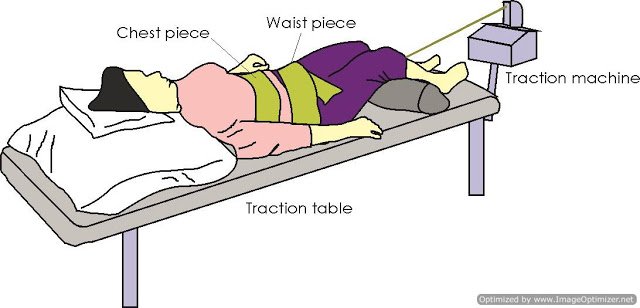
The control panel allows precise setting of hold time (traction) and release time (relaxation). Detailed protocols for different diagnoses are beyond the scope of this article and should be determined by the treating clinician.
How to apply lower back traction at home
Home lumbar traction devices exist and can be useful for selected patients under professional guidance.
If a home unit is recommended, start with a low force (often well below one-third of body weight), progress gradually, and stop immediately if symptoms worsen. Never self-prescribe high-force traction without assessment. A qualified physiotherapist should demonstrate correct setup, force selection, and safety checks first.
You can explore a home-use option such as the lumbar traction kit, but only after professional advice.
Final word
Traction is widely available in physiotherapy clinics and can be helpful for carefully selected patients with low-back and radicular symptoms. It is not appropriate for every case of backache.
Important: The information in this post is for educational purposes only. Lumbar traction should be performed only under the supervision of a qualified physiotherapist or other appropriately trained clinician after a proper assessment. Self-treatment carries risks.
Keep reading: 3 Best sleeping positions for sciatica for quick relief

The author is a physiotherapist who has been practising for the last 17 years. He holds a Bachelor's in Physiotherapy (BPT) from SVNIRTAR (Swami Vivekananda National Institute of Rehabilitation and Research), one of the prestigious physiotherapy schools in India.
Whatever he learns dealing with his patient, he shares it with the world through blogs and e-books. He also owns a YouTube channel, "Sunit Physiotherapist" with over 8 lakh active subscribers. Here, he shares everything he gets to learn serving the patient.



Glad that you are improving with your pain
Mechanical traction is helping me, I have disc bulge between l5-s1, that is compressing nerve root. In physical therepy they used your method above, but it is 60 seconds on, 20 off. The pull was much higher though, started at 150 lbs and after several weeks worked up to 180 lbs. (I am 240 lbs) much higher than your 1/3 calculation. I am sore afterwords but it is hel
Ing to relieve the pain and nerve root complications (avoiding the surgery that was recomended)
Pingback: Physical Therapy for Sciatica Nerve Pain - Physiosunit
Hey, awesome site. I came across this on Google, and I am pleased. I will be definitely coming back here more often. Wish I could add the conversation and bring a bit more to the table, but am just taking in as much info as I can at the moment. Thanks for sharing. miss me tablet
Keep Posting:)
great article!!!!!This is very importent information for us.I like all content and information.I have read it.You know more about this please visit again.
SensualKart Flavoured Lubricant