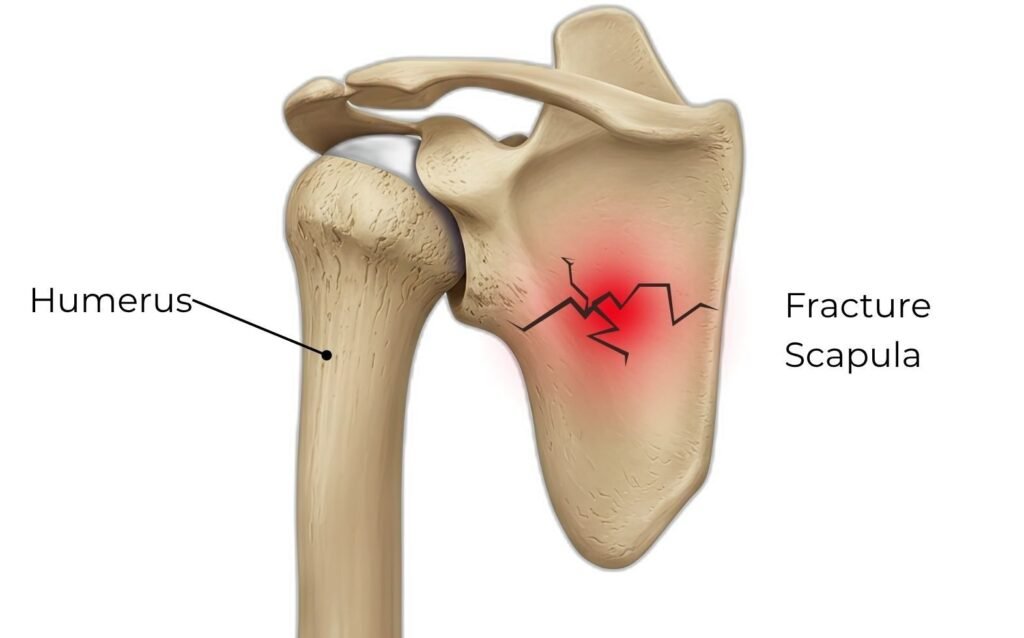
In this post, we’ll talk about scapula fractures. Let’s take a closer look at a fractured scapula with the help of the diagram below. The scapula and the humerus, together forms the scapulo-humeral joint, which is the most important joint in the shoulder girdle. As you can see, the fracture on the flat body of scapula is what it is referred to as fracture scapula. 1
So, let’s get details on the cause, types of fracture and treatment of scapula fracture. But, let’s start with its anatomy.
Anatomy of the Scapula
The scapula is a flat bone that, along with the humerus, forms the shoulder girdle. The shoulder girdle consists of three joints:
These together form the shoulder girdle. And the scapula bone is located at the back of our shoulder.
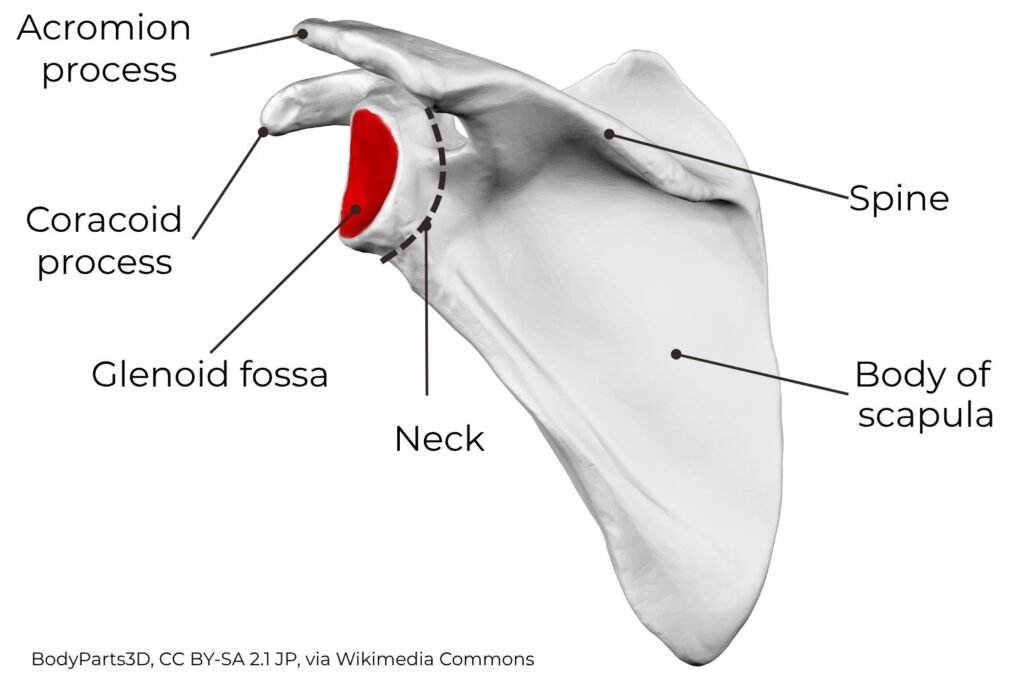
As shown in the diagram, the flat bone is our scapula. The red colored cavity is the glenoid cavity. The ball of the humeral head fits into this, forming the shoulder joint, also called as the scapulo-humeral joint. You can also see the acromion process and the coracoid process. The horizontal line is the spine of the scapula and the of the scapula is the body of the scapula.
Types of Scapula Fractures
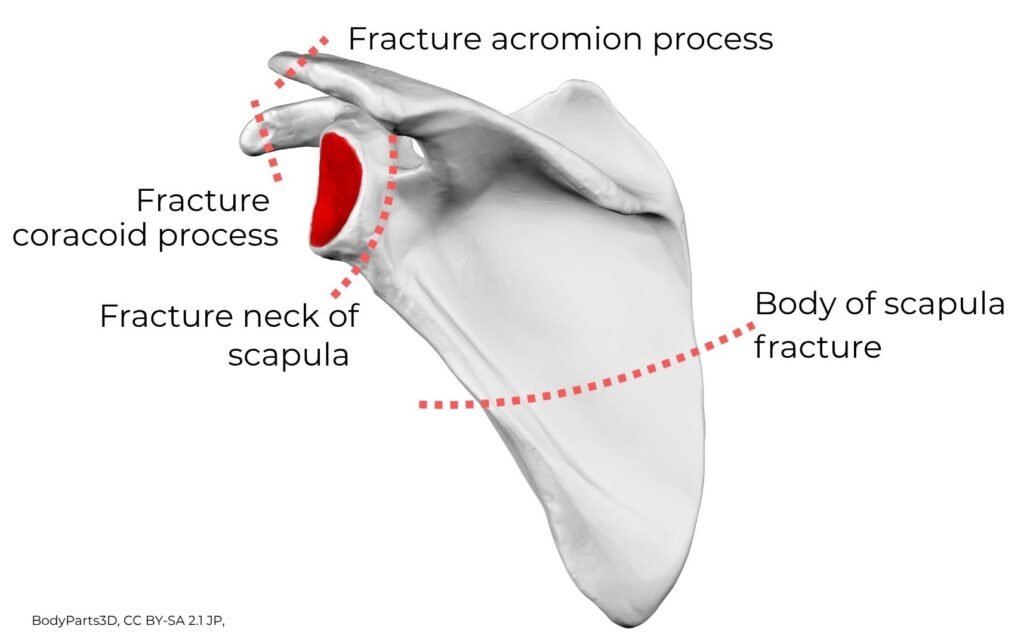
Fractures of the scapula can occur on four different sites:
- Body of the scapula
- Neck of the scapula
- Acromion process
- Coracoid process
Mechanism of Injury and Clinical Features
What is its mechanism of injury? Direct trauma and injury. Direct trauma occurs when our body is exposed to high impact force or high impact trauma, causing a fracture in the scapula. 2
What are its clinical features?
- Swelling around the shoulder
- Tenderness on palpation
- Painful movement of the shoulder
Fracture of the Body of the Scapula
We can classify the fracture of the body of the scapula using the BADO classification: 3
- Fracture at Two or Less Points – The body of the scapula is fractured at two or fewer points (a simpler, single fracture line).
- Fracture at Three or More Points – Fracture exists at more than three points in the body of the scapula (a comminuted or multi-fragmentary fracture).

Treatment
For fractures anywhere in the scapula — whether in the body, neck, coracoid process, or acromion process — conservative treatment is always the primary treatment approach. 4
Fracture of Body of Scapula
A simple shoulder sling is given for 10 days. As soon as the pain subsides, mobilization is started by a physiotherapist.
Fracture of the Neck of the Scapula
When a fracture occurs at the neck of the scapula (between the glenoid fossa and the body), the following happens:
- Dropping of the shoulder occurs due to the weight of the arm pulling down the glenoid-humeral complex.
- The length of the arm appears to increase to the onlooker.
Treatment: A triangular sling is given for 10 to 14 days, followed by shoulder mobilization exercises.
Fracture of the Acromion Process
The acromion process forms the bony tip of our shoulder and articulates with the clavicle at the acromioclavicular joint. A fractured acromion process is usually displaced.
Treatment:
- Immobilization with a sling for 10 to 14 days
- Followed by shoulder mobilization exercises
- In cases of severely comminuted fractures, surgical excision of the displaced fragment may be required
Fracture of the Coracoid Process
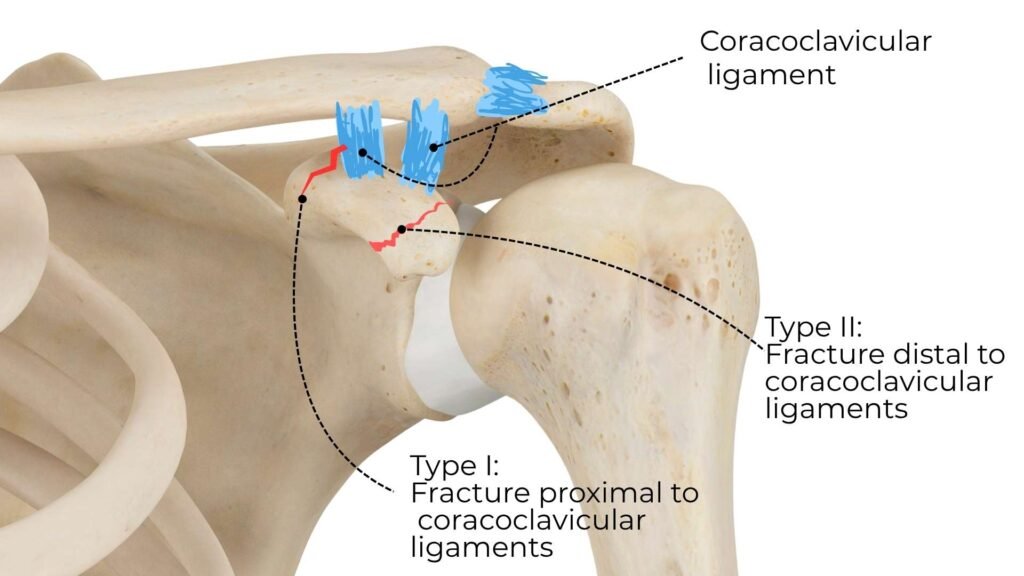
According to the Ogawa Classification, coracoid process fractures are divided into two types: 5
- Type I – Fracture occurs proximal to the coracoclavicular ligament (near the base of the coracoid process, closer to the ligament attachment).
- Type II – Fracture occurs distal to the coracoclavicular ligament, angling toward the tip of the coracoid process.
The coracoclavicular ligament runs between the coracoid process and the clavicle, providing important shoulder stability. Type I fractures are considered more unstable due to their proximity to this ligament.
Treatment: Conservative treatment is the treatment of choice. Immobilization is given in a sling for 10 to 14 days, followed by mobilization exercises.
Conclusion
Scapula fractures may not be the most common injury, but understanding the anatomy and classification helps in accurate diagnosis and effective rehabilitation. Conservative treatment with sling immobilization and early mobilization remains the gold standard for most types.
If you’d like to see how scapula fractures fit into the bigger picture, check out our complete guide to bone fracture types and classification, covering fracture patterns across the whole skeleton.
I hope this post gave you a clear understanding of scapula fractures. If you found it helpful, do share it with your peers and leave your thoughts in the comments below. Keep learning and stay curious!

The author is a physiotherapist who has been practising for the last 17 years. He holds a Bachelor's in Physiotherapy (BPT) from SVNIRTAR (Swami Vivekananda National Institute of Rehabilitation and Research), one of the prestigious physiotherapy schools in India.
Whatever he learns dealing with his patient, he shares it with the world through blogs and e-books. He also owns a YouTube channel, "Sunit Physiotherapist" with over 8 lakh active subscribers. Here, he shares everything he gets to learn serving the patient.