This lesson is part of our full Exercise Therapy Video Lessons course for BPT 1st year, which covers mechanical principles, exercise therapy and massage, muscle strength, and joint movement in sequence with quizzes.
Exercise therapy recognizes five fundamental starting positions — standing, kneeling, sitting, lying, and hanging
Each position serves distinct clinical purposes based on a patient’s abilities and rehabilitation goals. Lying suits early-stage recovery and static exercises, sitting benefits those unable to kneel or stand, kneeling targets hip and trunk control, and hanging offers spinal stretch for appropriate candidates.
In this article, we’ll discuss starting positions — an important chapter in exercise therapy. We’ll cover the different types, their effects, and their uses in detail.
What is a Starting Position?
The posture from which movement is initiated is known as the starting position.
Whenever we, as physiotherapists, teach exercises to our patients, we have to start with a particular starting position. For example, for static quadriceps exercises (knee strengthening), the best starting position would be the long sitting position.
The Five Fundamental Starting Positions
There are five different fundamental starting positions:
- Standing
- Kneeling
- Sitting
- Lying
- Hanging

1. Standing
Standing is the most difficult fundamental position of all five. This is because:
- The body has to be balanced on a small base of support (the feet).
- It must be balanced directly against gravity.
- It requires coordination of many muscle groups.
- The centre of gravity is high — around the second sacral vertebra (S2).
Body Position in Standing
- The feet will be externally rotated, with an angle of approximately 30° (not more than 45°) between them.
- The knee will remain in extension.
- The pelvis will remain stabilised above the hip.
- The spine will remain completely erect and straight.
- The neck will remain straight.
- Eyes remain straight and facing forward.
- The chest will remain elevated, with shoulders downward and retracted, causing the chest to protrude forward.
Muscles Working in Standing
To maintain a standing position, our anti-gravity muscles work — the muscle group that works against gravity. Working from feet upward:
- The small intrinsic muscles of the foot work to keep the foot flat.
- Plantar flexors, dorsiflexors, and evertors work together to stabilise the leg above the foot — explained by the three-guy pole concept (three ropes stabilising a pole from different directions).
- Knee extensors bring and maintain the knee in extension.
- Hip extensors and hip flexors together stabilise the pelvis above the hip.
- Extensors of the spine keep the spine fully extended and straight.
- Prevertebral and postvertebral neck muscles together stabilise the neck in a fully extended position.
- Palms face internally with hands resting at the sides.

Effects and Uses of Standing
- Centre of gravity is high, making it the least stable of all positions.
- If standing is perfectly balanced, muscle work is minimal. Any deviation significantly increases muscular effort.
- Suitable for patients who can maintain it correctly — for example, shoulder TheraBand exercises performed in standing.
2. Kneeling
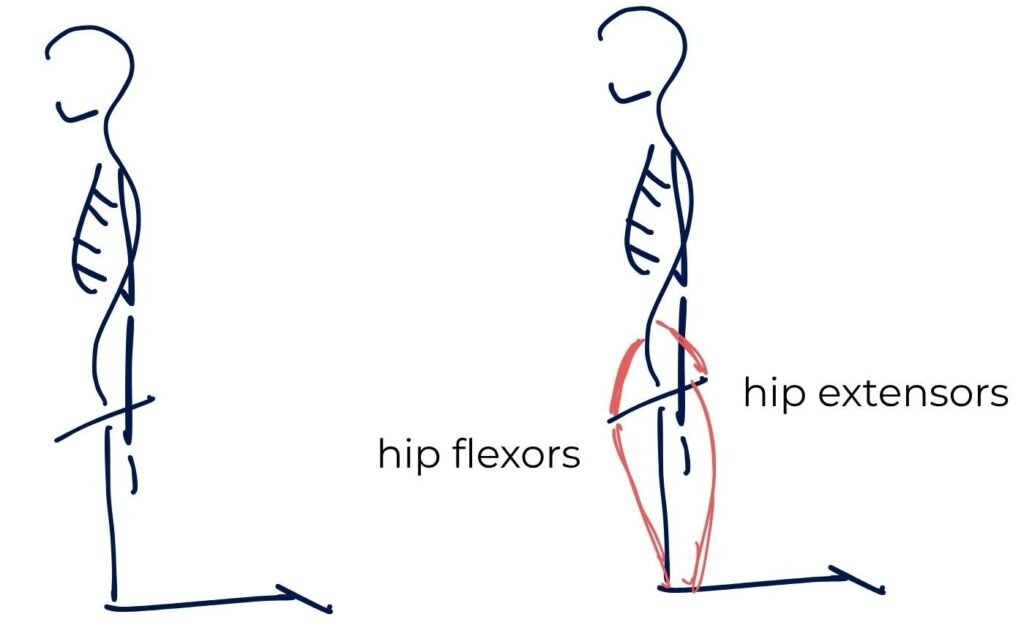
In the kneeling position, the body is supported on the knees, which are together or slightly apart. The foot is in plantar flexion. The centre of gravity is much lower than in standing.
Muscles Working in Kneeling
- Knee extensors and knee flexors work in coordination to stabilise the femur above the knee.
- Hip flexors and hip extensors have to work a little harder than in standing to balance the pelvis over the hip joint.
- All other body muscles work the same as in the standing position.
Effects and Uses of Kneeling
- Used to train control of the hip joint and lower trunk.
- Especially useful for patients with paraplegia, hemiplegia, or quadriplegia.
- Helps in strengthening and stabilising the hip joint and lower trunk area.
3. Sitting
Muscles Working in Sitting
- Sitting is a comfortable position — there is no significant muscle work in the legs because the thighs are well supported.
- Muscle work in the upper trunk is similar to the standing position.
- The key difference: hip flexors have to work harder to balance the lower trunk above the hip.

Effects and Uses of Sitting
- A comfortable position suitable for those who cannot kneel or stand.
- Used for patients with hemiplegia who cannot yet manage kneeling or standing.
- Trunk swing exercises (left, right, front, back) strengthen the lower trunk.
- Ball-throwing exercises can be prescribed to improve balance.
4. Lying
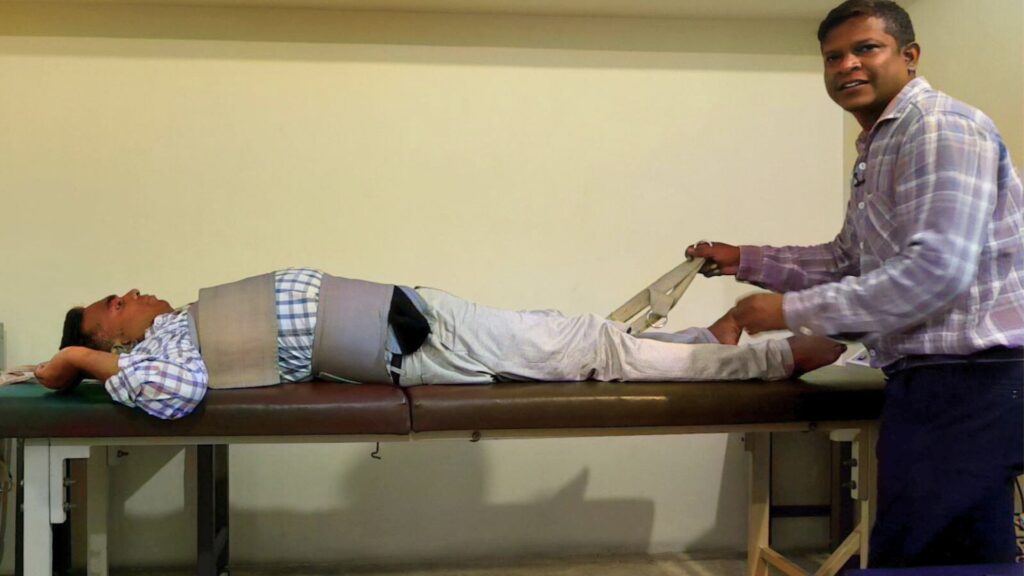
The lying position is the easiest of all fundamental positions. The entire body — upper trunk and legs — is supported on a platform or couch.
Muscles Working in Lying
- Hip flexors and hip extensors work in coordination to maintain the lumbar lordosis curve.
- Muscles on the sides of the neck (lateral neck muscles) work in coordination to keep the neck in a neutral position.
- Hip adductors (inner thigh muscles) work to keep the feet in a neutral position and prevent external rotation of the lower limbs.

Effects and Uses of Lying
- The trunk is completely relaxed.
- Its alignment is equivalent to the standing position, making it suitable for static posture training.
- Static exercises can be prescribed: static knee extension (knee press), ankle press exercises.
- Ideal starting point for quadriceps strengthening or hemiplegia rehabilitation before progressing to sitting or standing.
5. Hanging
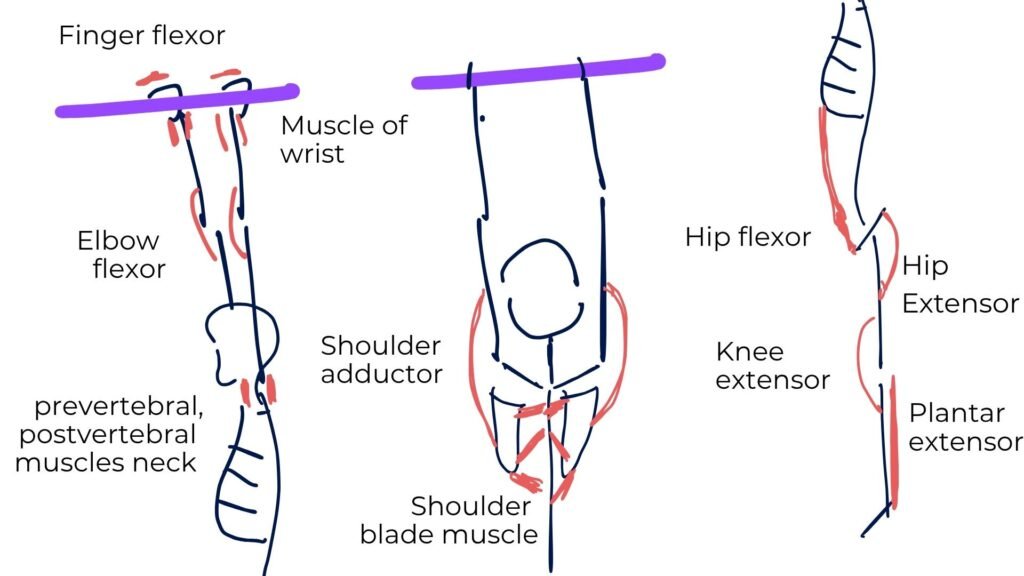
In the hanging position, the body is suspended by grasping a horizontal bar. The forearms are pronated, arms completely straight, and shoulder-width apart.

Muscles Working in Hanging
- Finger flexors grasp the bar strongly to bear the entire body weight.
- All muscles of the wrist joint work together to stabilise the wrist and prevent dislocation.
- Elbow flexors stabilise the elbow joint.
- Prevertebral and postvertebral neck muscles work together to keep the neck straight and neutral.
- Shoulder adductors transfer body weight through the shoulders and stabilise the upper trunk.
- Shoulder internal rotators maintain the retracted shoulder position.
- Shoulder blade (medial) muscles squeeze and keep the shoulders retracted.
- Hip flexors and hip extensors work together to keep the spine and hips straight.
- Knee extensors work slightly to maintain lower limb alignment.
- Plantar flexors work to keep the toes pointed downward.
Effects and Uses of Hanging
- Requires strong upper back and arm muscles.
- Suitable only for those where muscle strength and body weight are well-balanced.
- Not recommended for obese or overweight patients.
- Creates a stretching sensation in the spine — children particularly enjoy this position.
FAQ

The author is a physiotherapist who has been practising for the last 17 years. He holds a Bachelor's in Physiotherapy (BPT) from SVNIRTAR (Swami Vivekananda National Institute of Rehabilitation and Research), one of the prestigious physiotherapy schools in India.
Whatever he learns dealing with his patient, he shares it with the world through blogs and e-books. He also owns a YouTube channel, "Sunit Physiotherapist" with over 8 lakh active subscribers. Here, he shares everything he gets to learn serving the patient.