In this lesson, we will learn about the faradic type of current and what a modified faradic current is. We’ll also learn its physiological effects and its indications.
So, what is a faradic type of current?
Faradic current is a type of short-duration interrupted direct current. We have learned in the previous lesson that IFT and TENS are short-duration currents.
Similarly, faradic current is also a short-duration current; the only difference is that it is an interrupted direct current, and its pulse duration ranges from 0.1 to 1 millisecond, and its frequency is 50 to 100 Hz.
History of faradic current
If we understand a little about the history of faradic current, then it will be easier for us to understand further. During the 19th century, Michael Faraday, a scientist, first introduced faradic current.
But at that time, the faradic current was produced by a faradic coil. This is a kind of induction coil that was connected to a direct current source, a battery. When direct current passes through the induction coil, it produces faradic current, which was then used to stimulate the muscle for contraction.
But there was a problem: the faradic current that was used could achieve muscle stimulation, but it was painful and was an uncomfortable feeling for the patient.
One reason for this is that it produces an uneven alternating current. Let’s try to understand why it happens so.
You can see in the figure that, on one side, there is a normal alternating current, and on the other side there is an uneven alternating current, which is the faradic current of that time.
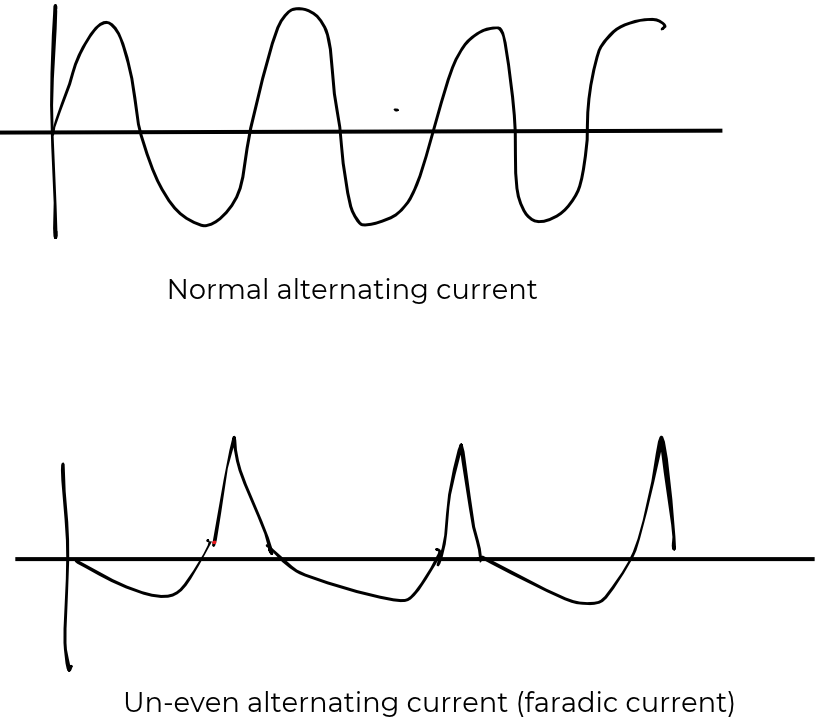
In normal alternating current, notice that the waveform is even; that is, the height of the trough is the same as the height of the crest. On the contrary, in uneven alternating current, the height of the crest is much more than the height of the trough. Also, the first wave’s intensity is low, but its duration is long. But the intensity of the second wave is quite high, but its duration is short.
So, this type of current was used to achieve muscle contraction, but the patient did not like it because it used to give a painful experience.
Today’s modern electric muscle stimulator rectifies this and forms a new type of waveform. How? Let me explain.
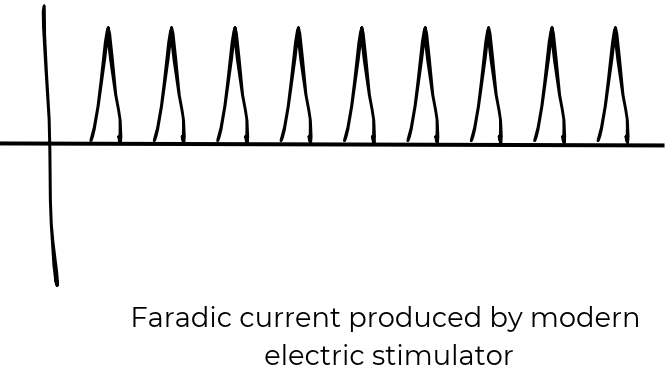
In the figure, you can see the current produced by the modern electric stimulator machine. You can see it is a unidirectional current; each pulse lasts about 0.1 to 1 millisecond, followed by a longer pause before the next pulse (about 19 milliseconds at 50 Hz).
In a way, it is an interrupted direct current, with the help of which we achieve muscle stimulation and for the patient, it is also a comfortable experience. There is no discomfort felt, but this alone was not enough; the current had to be modified a little more, so we moved ahead with the modified faradic type of current.
Modified faradic current
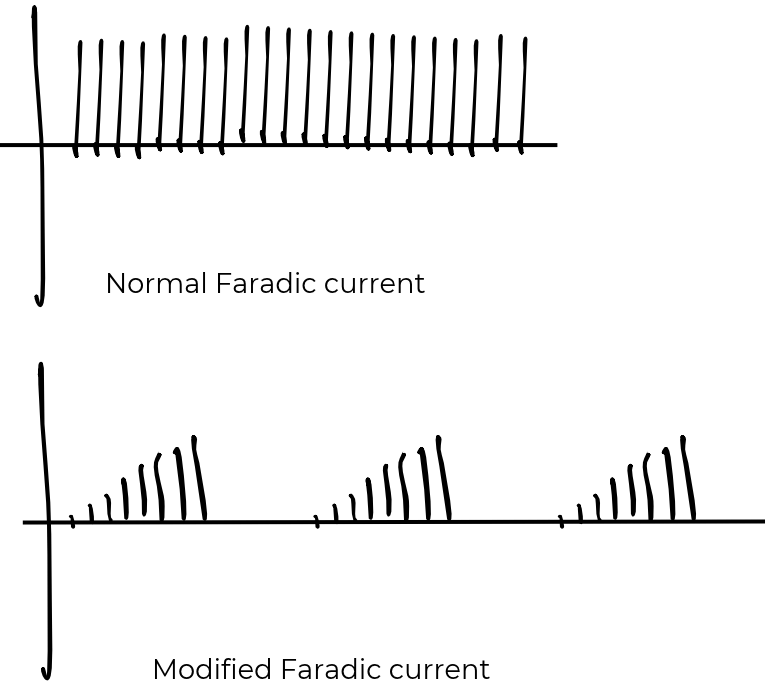
Why did we need to modify the faradic current when we are already achieving comfortable muscle stimulation? See, there was another problem here: the modern muscle stimulator, which was giving the faradic current, was continuous; that is, there was no rest period; it was continuously contracting the muscles.
Due to this, fatigue develops in the muscle, and other types of problems start developing. So to rectify this thing, the faradic current is again modified and it is surged so that the contraction rises and falls like a normal voluntary muscle contraction, with a rest period in between.
In a normal voluntary muscle contraction, the muscle contracts, then relaxes, then contracts, then relaxes again. So, it was very important to achieve this so that we could achieve our purpose. So, this process of modification of faradic current is called surging.
What is this surging?
Referring to the figure, on one side is the normal faradic current and on the other side is the modified faradic current. In a normal faradic current, there is a current of constant intensity. With constant intensity, it stimulates the muscle constantly without a rest period in between which can give rise to other complications.
So, to rectify this, modified faradic current is used. By modifying the faradic current, the intensity gradually rises and then there is a sudden fall followed by a rest period. After the rest period, the intensity increases again and then there is a sudden fall, then there is a rest period. This mimics the contract–relax pattern of a normal voluntary contraction.
We can achieve surging of faradic current in three ways; the first one is surging based on duration.
Surging based on duration
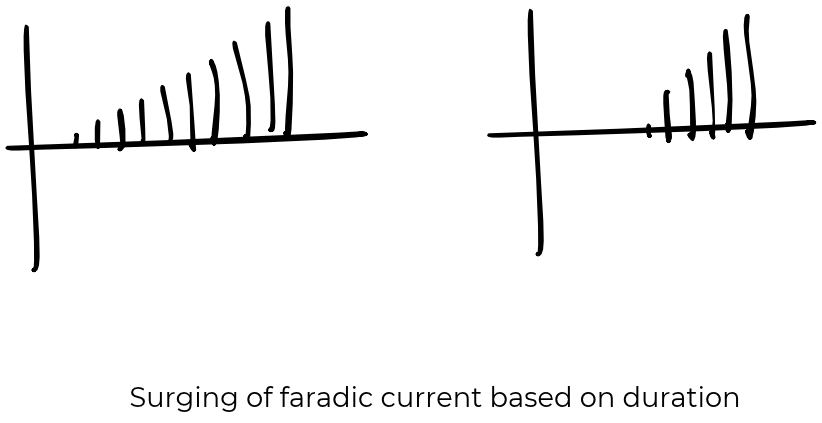
Look at the duration of intensity, the first wave in which its duration is long, second one’s duration is short.
Let me simplify this: suppose you water your plants in your garden with a pipe. So suppose you open the tap for only 10 seconds, then close it for some time, then open it for 10 seconds, then close it. So the water that is coming out of the pipe for 10 seconds is your duration of intensity; you can increase or decrease this according to your needs.
If you want a longer contraction, you keep the tap open for 15 seconds instead of 10; for a shorter one, you close it sooner. Changing how long the tap stays open is changing the surge duration.
With this, there is muscle contraction and a period of rest as well. This prevents fatigue of the muscles. So this is a kind of surging which is based on duration. The other kind of surging is surging based on interval.
Surging based on interval
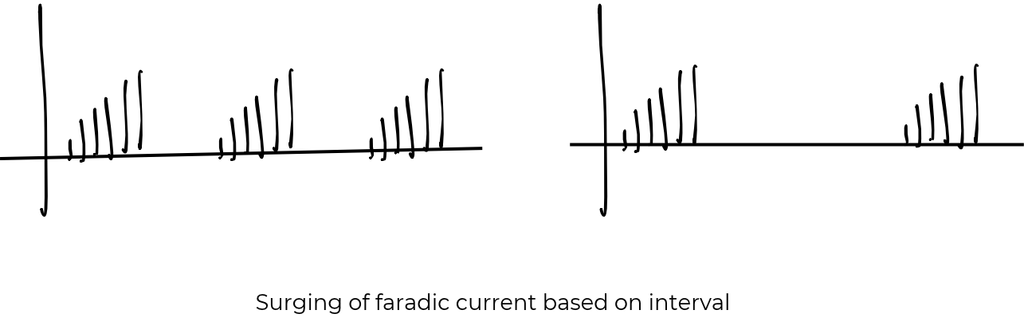
You can see in the diagram that there is a period of intensity. Between two intensities, there is a gap, which is an interval or rest period. So the difference between the two is that in one the interval is short, and in the other the interval is longer.
Let me explain it again with my pipe example, you left the water in the pipe for 10 seconds and then gave a rest period for 10 seconds; then you left the water for 10 seconds, then gave a rest period for 10 seconds.
So here, the 10 seconds is your interval. You can reduce this interval to 5 sec, or you can increase it to 15 sec as per your need; So this is the second type of surging. The third type of surging is surging based on waveform.
Surging based on waveform
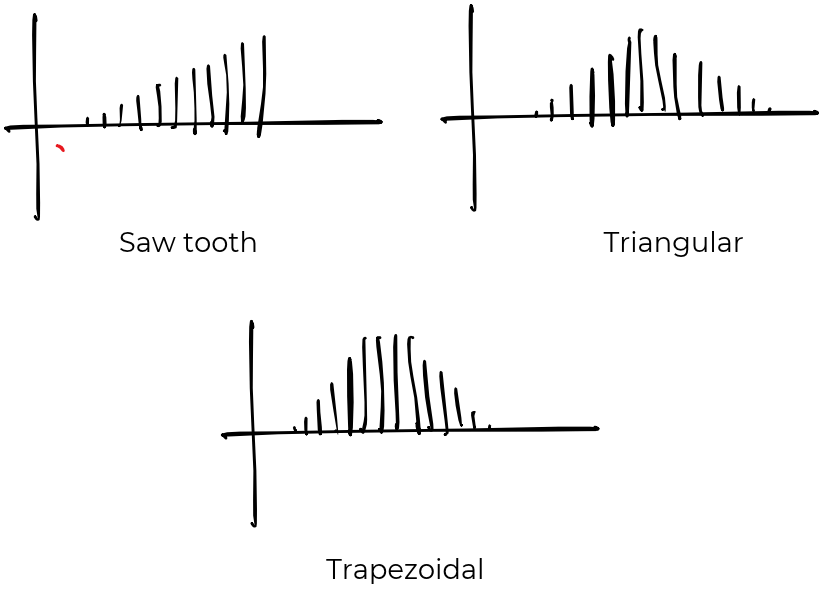
Finally, surging based on its waveform. The first waveform is the sawtooth: the intensity rises gradually and then drops suddenly, forming a shape like the teeth of a saw.
Then the second waveform is triangular. In the triangular waveform, the intensity rises gradually to a peak and then falls gradually, forming a triangle. And the third one is trapezoidal; it forms a trapezoidal shape in which the intensity gradually increases, then it forms a flat point where it remains constant, then gradually it decreases, forming a trapezoidal shape.
So, according to the effect we want to achieve by stimulation, we can choose the surging and set it in our machine.
Physiological effects of faradic current
- Stimulation of sensory nerve: When we are giving faradic current to the patient, then along with muscle stimulation, he also gets a slight pinprick-like sensation; this is because the sensory nerve is also getting stimulated here.
- Redness of skin due to vasodilation: Due to the reflex of the sensory stimulation, vasodilation occurs and the blood circulation increases. Vasodilation means the dilation of blood vessels due to which blood circulation increases. This produces redness of the skin called erythema. This is why after muscle stimulation for 15 to 20 minutes, where the electrode is placed, there is slight redness.
- Stimulation of motor nerves: We already know that we use faradic current for muscle contraction. It is obvious that faradic current contracts muscles by stimulating the motor nerves. So, the physiological effect of voluntary muscle contraction and muscle contraction achieved by faradic stimulation is the same.
- No stimulation of denervated muscles: faradic pulses (0.1–1 ms) are too short to stimulate denervated muscle, which needs much longer pulses (about 100 ms or more), such as interrupted direct (galvanic) current.
Indications of faradic current
- Muscle strengthening: Faradic current is the best modality for strengthening the weak muscles. Suppose a patient has a fracture of the patella, which is surgically stabilised with a wire, followed by the entire knee and leg being immobilised in a plaster cast for six weeks. After six weeks of immobilisation, the muscles of the thighs or lower legs become weak because of disuse. We make them stronger by using faradic current.
- Muscle re-education: What is muscle re-education? Sometimes a patient cannot contract a muscle voluntarily even though its nerve supply is intact, for example because of pain, swelling, or long disuse after surgery. Faradic current produces the contraction for them, which helps them regain the feeling of how the muscle should work. The patient tries to contract along with the stimulation and gradually learns to contract the muscle on their own again. This works only where the nerve supply is intact; a fully denervated muscle will not respond to faradic current.
- Improve Venous and Lymphatic Drainage: Inside our muscles there is lymphatic fluid and blood vessels. When the muscles contract, it disperses the fluid from there; when it relaxes, the fluid again collects there. So in a way, the contraction, relaxation, contraction, relaxation of the muscles works like a pump; we call it the muscle pump. So suppose someone is complaining of oedema, swelling; if we give faradic current to the feet, then through the muscle pump, it disperses the lymphatic fluid that has accumulated there and helps in reducing the swelling. So, this is very helpful in reducing swelling and oedema.
- Prevention and loosening of adhesions: Normally, the muscle fibres inside the muscle bulk are free and loose. Because of oedema and long-term immobilisation, the muscle fibres adhere to each other, and the muscle becomes stiff, and a lump starts forming there. So, in this condition, if we give faradic current, then the muscle pump gets activated again, and blood circulation improves there. Due to which the muscle fibres slowly start getting detached from each other and prevents adhesions or lumps formation in the muscle.
I hope this lesson was clear. If anything was confusing, ask in the comments, and I’ll explain it or cover it in a future video.

The author is a physiotherapist who has been practising for the last 17 years. He holds a Bachelor's in Physiotherapy (BPT) from SVNIRTAR (Swami Vivekananda National Institute of Rehabilitation and Research), one of the prestigious physiotherapy schools in India.
Whatever he learns dealing with his patient, he shares it with the world through blogs and e-books. He also owns a YouTube channel, "Sunit Physiotherapist" with over 8 lakh active subscribers. Here, he shares everything he gets to learn serving the patient.