In this lesson, we will learn about shoulder joint arthrokinematics and osteokinematics. This is the second part of shoulder joint biomechanics. In the first part, we briefly discussed shoulder anatomy.
- Arthrokinematics is the movement of the joint surfaces on each other, for example the humeral head moving on the glenoid fossa.
- Osteokinematics is the movement of the bones through space, for example the arm moving into abduction.
You can also watch the video version of this lesson. So, let us start.
Shoulder arthrokinematics
Whenever we move the shoulder, three types of arthrokinematic movement can occur at the glenohumeral joint:
- Rolling
- Gliding (sliding)
- Spinning
So how does this happen? What’s the difference between rolling and gliding?

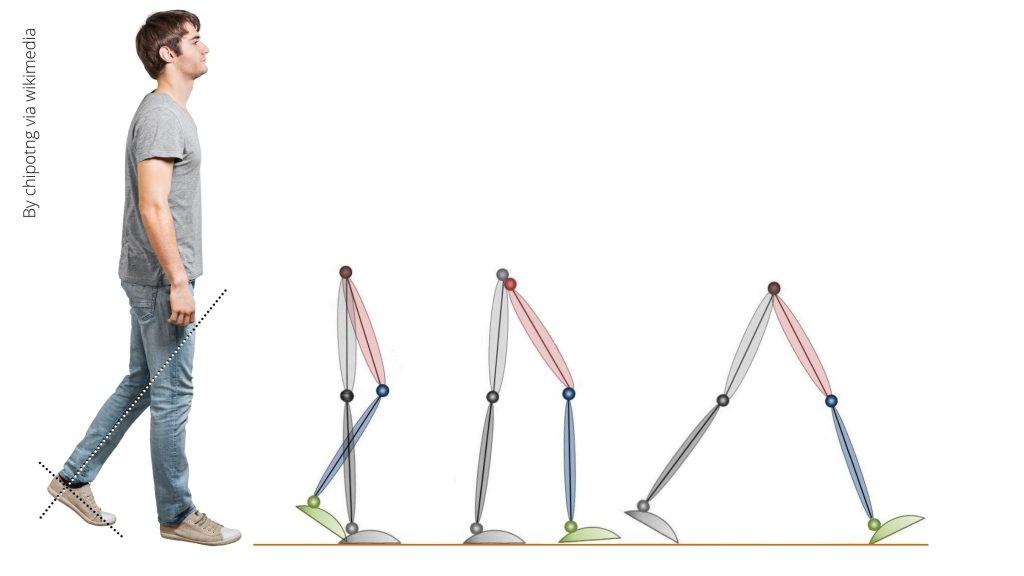
Let’s consider a ball. You can see in the figure two kind of motion of a ball. The first one is a ball rolling, and the second one is sliding or gliding. Try to note the difference.
Now, coming back to the shoulder joint, we can compare the humeral head to the ball. In a normal shoulder position, the axis of the humeral head aligns with the axis of the glenoid fossa.
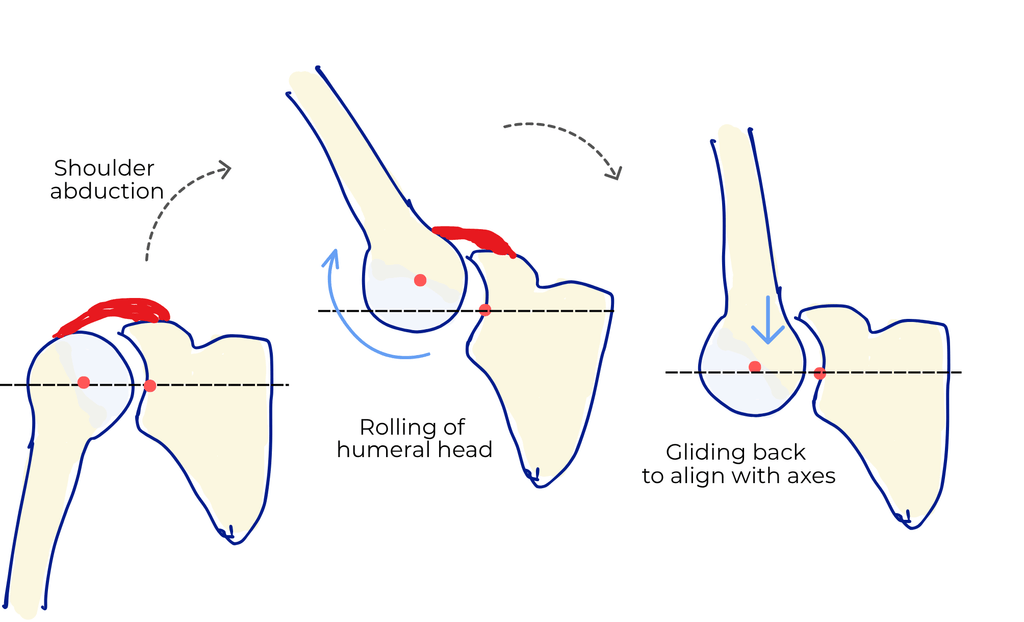
When our shoulder goes into abduction, first the head rolls over the glenoid fossa. As you can see in the figure, the head of the humerus is rolling away from the axis. But to maintain the abduction motion in the axis, the muscles again pull and slide it back into the position of the axis.
In shoulder abduction, the head will first roll, and then it will slide back to its axis.1 So, during every shoulder motion, there is gliding or sliding of the humeral head.
So, let me sum up: in shoulder abduction, there is inferior gliding; in adduction, there is superior gliding. There’s posterior gliding in medial rotation, and anterior gliding during lateral rotation.2
However, in shoulder flexion and extension, there is a spinning movement. Like a spinning ball, the humeral head spins in the glenoid fossa. Compare this with the arthrokinematics of the knee joint.
Shoulder osteokinematics
The shoulder is the most freely movable joint of our body; it has the highest degree of freedom. The shoulder joint allows elevation, abduction, adduction, flexion, extension, external rotation, internal rotation and circumduction. Almost all movement happens in the shoulder joint.
But abduction is the most important of these, so let us discuss about abduction in this lesson. The full range of shoulder abduction is from 0 to 180 degrees, of which about 120 degrees occurs at the glenohumeral joint and about 60 degrees is due to scapular rotation.3
In the shoulder abduction range from 0 to 30 degrees, the movement purely happens in the glenohumeral joint. As we increase the abduction to 90 degrees, the scapulae also rotate along with glenohumeral joint movement.4
So, at 90 degrees of shoulder abduction, there occurs rotation of the scapulae + glenohumeral joint movement. This is to facilitate the greater tuberosity to clear the coracoacromial arch without impinging the soft tissues around it.5 Then we further abduct the shoulder from 90 to 180 degrees.
Frequently asked questions

The author is a physiotherapist who has been practising for the last 17 years. He holds a Bachelor's in Physiotherapy (BPT) from SVNIRTAR (Swami Vivekananda National Institute of Rehabilitation and Research), one of the prestigious physiotherapy schools in India.
Whatever he learns dealing with his patient, he shares it with the world through blogs and e-books. He also owns a YouTube channel, "Sunit Physiotherapist" with over 8 lakh active subscribers. Here, he shares everything he gets to learn serving the patient.