In this lesson, we will learn about static electricity. There are two types of electricity, ie, current electricity and static electricity. Static electricity builds up on the surface of insulating materials, like this cloth and glass, which are non-conductors. Remember our children’s play in school: we used to rub the rulers (made of plastic) on our hair and then attract the small pieces of paper; this is the simplest example of static electricity.
So, what is static electricity? Let’s learn everything about this.
What is static electricity?
Static electricity is the buildup of electric charge on the surface of an object. They are static because there’s no electricity flowing here; it just remains static there. If we rub two surfaces together, the electrons get transferred from one surface to the other. So, the one that is gaining electrons becomes negatively charged, and the one from which electrons are being lost becomes positively charged.
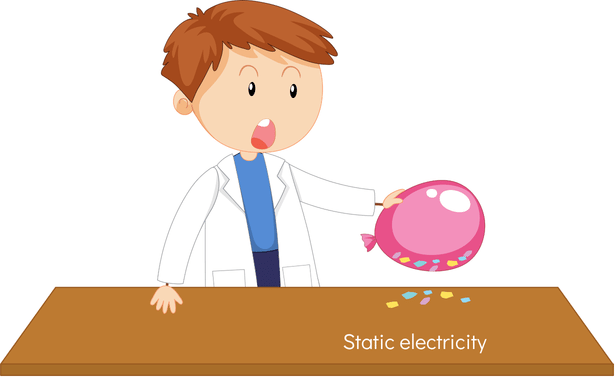
Let us try to understand it with an example. As you can see in the image, after rubbing the balloon on hair, there is an exchange of electrons between the hair and balloon surface. The surface to which the electrons are getting transferred gets negatively charged, and the one that is losing the electrons gets positively charged.
After that, when the child brings this charged balloon near the piece of paper, it is attracted due to the static electricity of the electrons.
Properties of static electricity
Let us understand the properties of static electricity. Static electricity is always built up on the surface of a non-conductor object. On a conducting object, the charges get spread, but on a non-conducting surface, the charges are held on the surface of the object.
So, what are the properties of static electricity?
- The charges are spread evenly over the even surface, but if the surface is pointed or has a corner, then the charges get concentrated on the pointed surface.
- If a body is charged, then it continuously tries to come to the neutral state. If it is positively charged, it does so by gaining electrons. And if it is negatively charged, then by losing electrons, it tries to come to a neutral state. This process creates an area of influence called an electric field. This process creates an area of influence around that body. We call that area an electric field.
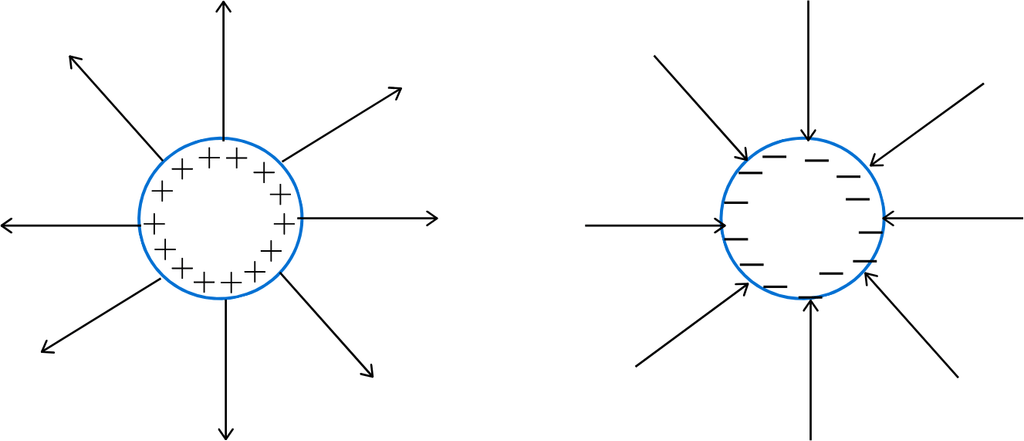
- We can represent the electric field around a body by a line of force which guides the electrons or free positive charges in it to travel on that line. Here you can see that this is a charged body which is positively charged. It is charged, so this line in it becomes a line of force.
Properties of line of force
Here are some properties of lines of force.
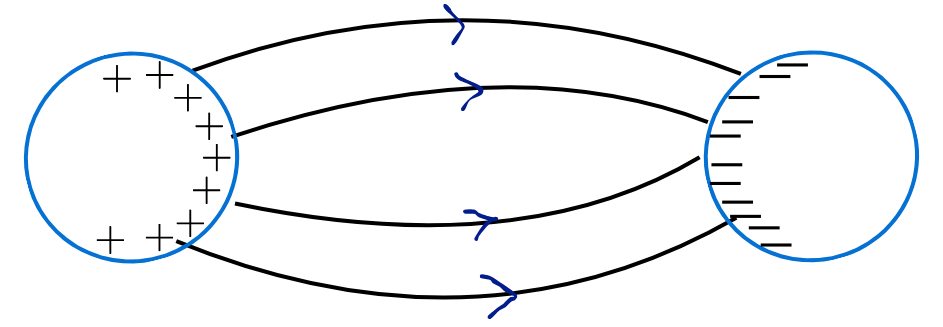
- Isolated charged bodies have straight lines: If there is a charged body and it is isolated, there is no other charged body around it, then its line of force is always straight. As you can see in this figure, one is a positively charged body, and there is a negatively charged body, and the line of force in them is straight.
- This line of force passes through a conductor more easily than it does through an insulator.
- Compared to an insulator, the lines of force are concentrated on the surface of the charged bodies closest to each other. Each object has an influence on the other. In this figure, you can see a positively charged body and a negatively charged body. Observe that, under the influence of the positively charged body on the negatively charged body, the negative charges are concentrated in the area of influence and vice versa.
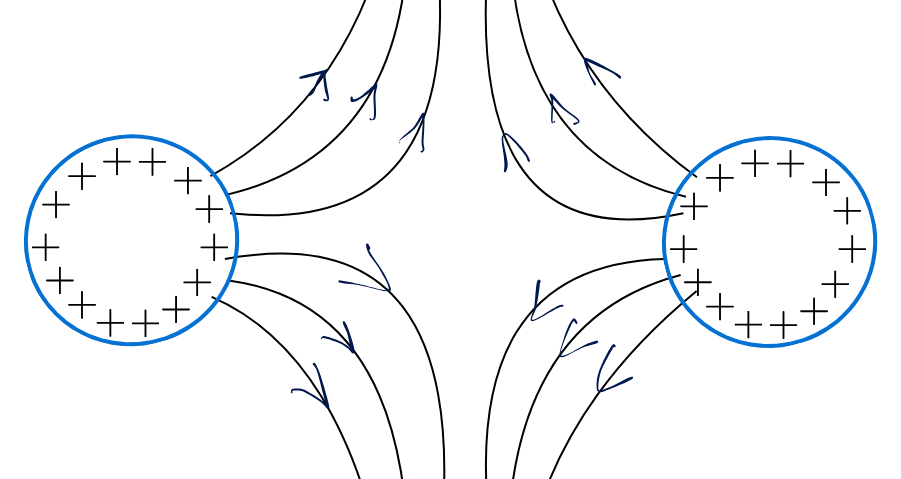
- The lines of force repel each other. In the image, there are two positively charged bodies; as you can see, the lines of force are repelling each other and has taken a curved formation.
So now we move on to potential and capacitance.

The author is a physiotherapist who has been practising for the last 17 years. He holds a Bachelor's in Physiotherapy (BPT) from SVNIRTAR (Swami Vivekananda National Institute of Rehabilitation and Research), one of the prestigious physiotherapy schools in India.
Whatever he learns dealing with his patient, he shares it with the world through blogs and e-books. He also owns a YouTube channel, "Sunit Physiotherapist" with over 8 lakh active subscribers. Here, he shares everything he gets to learn serving the patient.