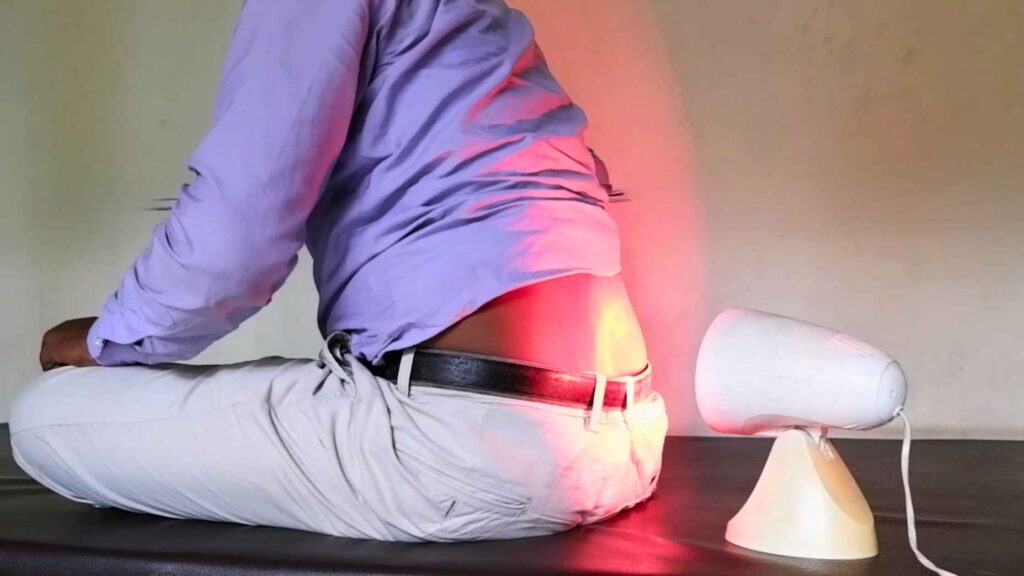
In this lesson, we will talk about magnetism. We will cover its properties, the difference between the non-magnetised state and the magnetised state and the magnetic field. We will start by understanding the molecular theory of magnetism.
Molecular theory of magnetism
Whether a material is magnetic or non-magnetic depends on the molecular magnets inside it. Every material has small molecules inside it that work like a molecular magnet.
So, what are these molecular magnets?
We will try to understand this with a figure. Look at the figure: one is a non-magnetised material, and the other is a magnetised material. In both of them, these are small molecules which have a north pole and a south pole; these small molecules are molecular magnets.
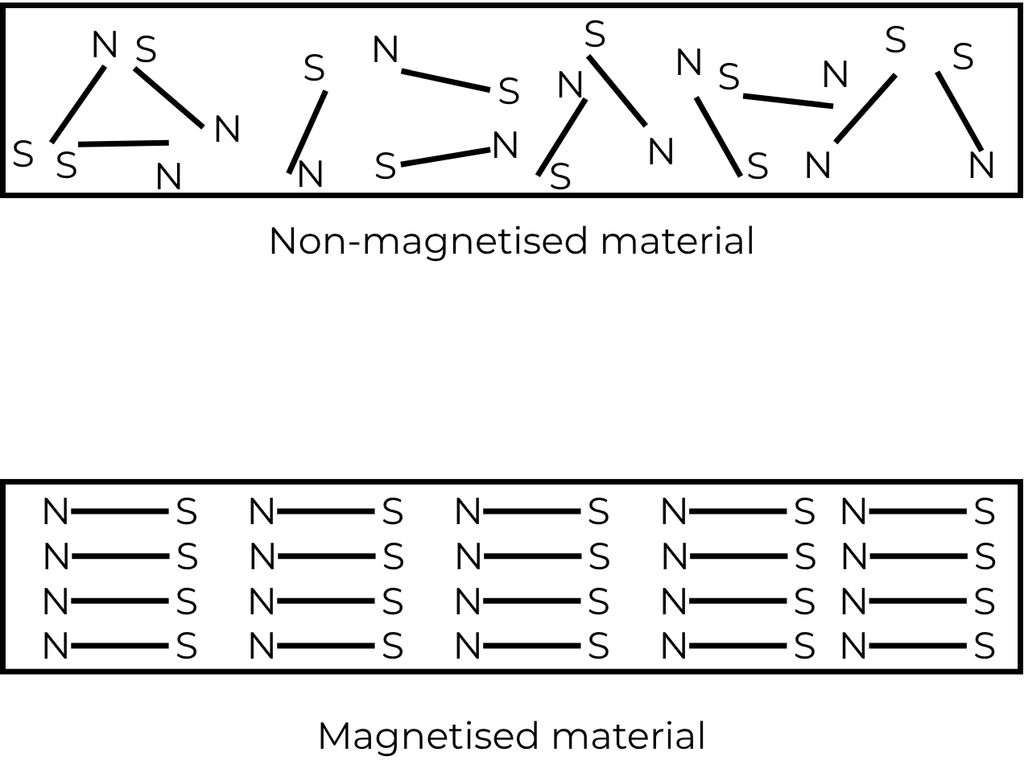
Electrons keep moving in every atom. These electrons give a north pole and south pole to that molecule. The nature of the arrangement of these molecular magnets decides whether the material is magnetised or non-magnetised.
Non-magnetised state
So in a non-magnetised state, the molecular magnets remain scattered and arranged in a haphazard way. They are not arranged in any particular order. Due to this, they cancel out each other’s effect, and there is no magnetism of any kind in it.
You can understand this by referring back to the figure with molecular magnets. The material on the top is in the non-magnetised state. Here you see that the molecules are arranged in a haphazard way; this cancels out each other’s effect, and there is no magnetism of any kind in it.
Exactly the opposite of this is the magnetised state.
Magnetised state
In a material in a magnetised state, the molecular magnets are arranged in such a way that the north pole of all the molecular magnets will be aligned in one direction and the south pole in the opposite direction.
Observe the arrangement of molecular magnets in the material in a magnetised state. This makes one end of the material the north pole, and the other end the south pole.
Electromagnetism
Now, suppose we pass current through any wire, let’s say it is a metallic wire; then it also acts like a magnet. As long as the current flows in it, the magnetism remains in it, but as soon as we stop the current in it, the magnetism also gets released from it. We call this electromagnetism.
Now, look at the image: there are two types of metals, one is steel, and the other is soft iron.
What is the difference in the magnetism between them?
Steel acts like a permanent magnet. This is because the bond between the molecular magnets inside the steel is very strong. They hold each other very tightly and their order does not get disrupted so easily. Because of this, its magnetism is retained, and it works like a permanent magnet.
Exactly the opposite of this is what happens in soft iron. The molecular magnets in it are very loosely held with each other, and the friction between them is quite weak. Due to which it can very easily be converted into magnetism and just as easily it can lose the magnetism.
So, that is why soft iron is used in all the transformers and electrical equipment we see around us, so that when current passes through them, they act like a magnet, and as soon as we switch off the current, they lose their magnetism.
What are the properties of a magnet?
Magnets have a north and south pole
Every magnet has a north and south direction. Let me explain it to you this way: see, our Earth acts like a huge magnet, which has a north pole and a south pole.
So if we leave any magnet to float freely, then ultimately it aligns with the Earth’s magnet; that is, the north pole of that magnet gets aligned with the Earth’s north pole and the south pole of that magnet gets aligned with the Earth’s south pole,
Like poles repel each other
The like magnetic poles repel one another. We know that if we bring two magnets and their north poles face each other, then they repel each other. This is because of the property of magnets in which like poles repel each other.
But if we reverse this, one magnet will have a north pole, and the other magnet will have a south pole, then they will attract each other; that is, unlike poles attract each other.
Like repels; unlike attracts.
Property of transmission of magnetism
That is, we can transfer magnetism from one material to another material. Let’s try to learn this with the help of a figure.
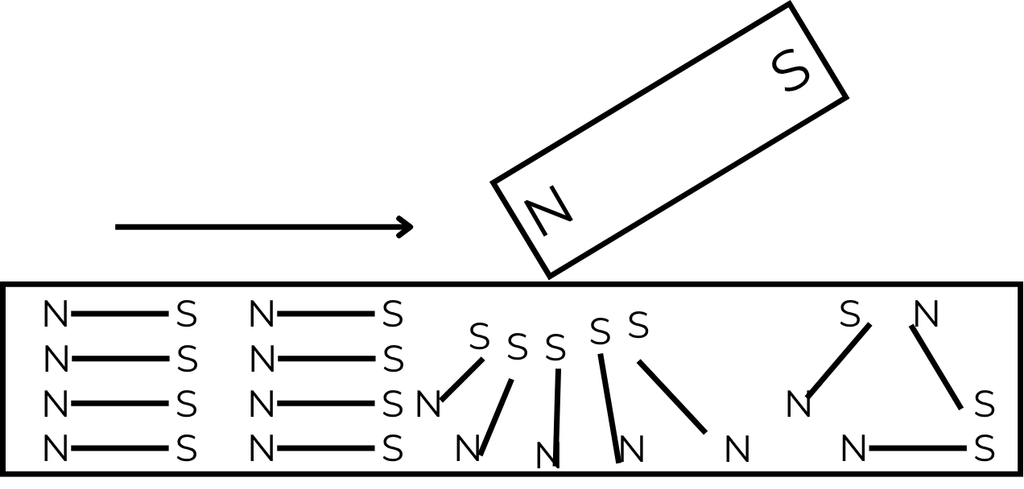
In the figure, one is a non-magnetised material, and one is a magnetised material. We will rub the north pole of the magnetised material on a non-magnetised material, from one end to the other end.
We are rubbing the north pole of the magnet on it, which attracts the south pole of the non-magnetised material and arranges the molecular magnets accordingly.
When we keep repeating this process again and again, slowly, its molecular magnets start getting arranged. In the beginning, the molecular magnets of this non-magnetised material are not arranged orderly; they are arranged haphazardly. But when we rub a magnet on it, it starts getting arranged, making one end the north pole and the other end the south pole.
And eventually the property of magnetism transfers from the magnetised material to non-magnetised material, transforming it into a magnetic material.
Every magnet has its own magnetic field

What is a magnetic field? A magnetic field is an area of influence around a magnet. Look at this figure; it has its own influence in this area. It has its own power, due to which, if it finds any suitable material in this area, it automatically attracts it towards itself.
This zone of influence, we call it a magnetic field. The magnetic field is made up of magnetic lines of force.
Properties of magnetic lines of force
- Magnetic lines of force travel from north to south: You can see in this figure that the magnetic line of force starts from the north and it is flowing in the direction of the south.
- Magnetic lines of force attempt to take the shortest route possible: Referring to the image, take a line of force; it starts from ‘N’ and travels towards ‘S’. Like a stretched elastic band, each line tends to take the shortest possible path from N to S, but lines also repel one another sideways, which is why they curve outward instead of running in straight lines.
- Magnetic lines of force travel easily through magnetic material: They can travel very easily in some materials like metal, then some other material like wood.
Magnetic effect of the current
When a current flows through a wire, it creates a magnetic field around itself, and the direction of flow of these magnetic lines of force is clockwise. We can understand this thing by Maxwell’s screw rule and the right-hand thumb rule.
Maxwell’s screw rule

You can see in the image of a screw that has to penetrate the wood. When we rotate this screw clockwise with the help of a screwdriver, only then will it penetrate the wood. So the direction of movement of the screw becomes your direction of flow of current.
But the direction in which we screw it, that becomes the direction of magnetic line of force. So, the direction of the magnetic line of force is clockwise when you look along the direction of current flow.
Suppose if we unscrew the screw, then the direction of flow of current will be upwards, and the direction of its magnetic line of force will be anticlockwise.
Right-hand thumb rule
We can also understand this with the help of the right-hand thumb rule as well. Suppose I hold a bar with my right hand. The bar represents an electrical wire, and the current is flowing through it. So the direction of my thumb will depict the direction of flow of current, and the direction of my fingers will depict the direction of flow of the magnetic lines of force.
Electromagnetic field
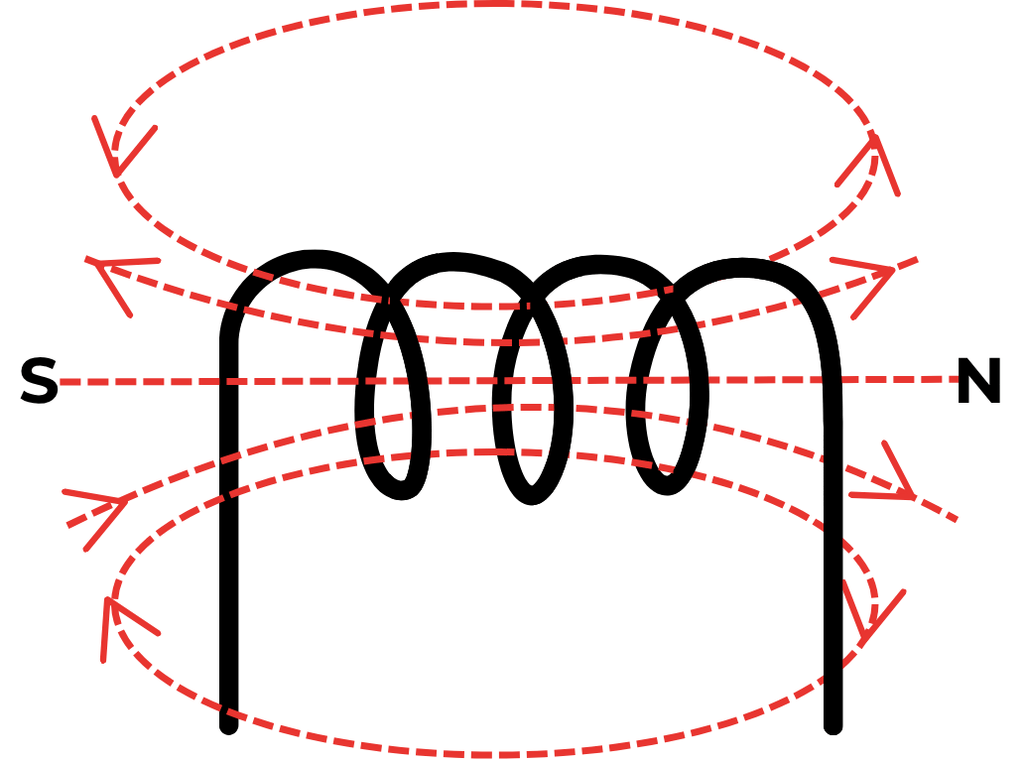
Look at the figure of an electromagnet with an electromagnetic field. In an electromagnet, the metallic wire is coiled around a soft iron core. When current passes through it, the magnetic field generated gets concentrated inside the coil. This makes one end of this coil the north pole and the other end the south pole.
So, in this way, this entire coil acts like a magnet.
Clinical relevance of magnetism and electromagnetic fields
The principles in this lesson are the basis of some tools we use in physiotherapy practice. Like shortwave diathermy, which uses a high-frequency electromagnetic field to produce deep heating in tissues.
However, it is contraindicated in patients with a cardiac pacemaker or metal implants, because the magnetic field can interfere with the device.
Frequently asked questions

The author is a physiotherapist who has been practising for the last 17 years. He holds a Bachelor's in Physiotherapy (BPT) from SVNIRTAR (Swami Vivekananda National Institute of Rehabilitation and Research), one of the prestigious physiotherapy schools in India.
Whatever he learns dealing with his patient, he shares it with the world through blogs and e-books. He also owns a YouTube channel, "Sunit Physiotherapist" with over 8 lakh active subscribers. Here, he shares everything he gets to learn serving the patient.