In this lesson, we will study current electricity. You learned that static electricity exists in an insulating body. Current electricity is the flow of electrons, i.e, electricity is flowing here. That is why we call it current electricity. (If you need a refresher on atoms, electrons and how electron transitions produce electromagnetic radiation, start with Atom and Atomic Structure in Electrotherapy.)
So, let me explain it to you.
Current electricity
Electric current is generated by the movement of charged particles in the conductor. As I just mentioned, electric current is generated by the movement of charged particles in the conductor. This does not occur in insulating objects, but in conductors, that is, metals.
Traditionally, current has been described as flowing from positive to negative, even when two electrons flow in the opposite direction. Okay, but what actually happens is that the electrons flow from negative to positive. It is crucial to differentiate electronic fusion to explain the flow of current. And the flow of electrons is different.
The flow of current is from positive to negative and the flow of electrons is from negative to positive. So, whenever we study the flow of current, electric current, it always flows from positive to negative.
So now the next point is the factors essential for the production of electrical current. What factors are required to produce electrical current?
Factors essential for production of electrical current
The first factor is potential difference, then the second point is the conducting pathway between two points of potential difference.
Potential difference
First of all, there should be a potential difference. And the conducting path between the two points of potential difference also influences the production of electrical current. (If you need a refresher on how potential difference is produced, it’s covered in the previous lesson on heat transmission and electrotherapy physics.)

So, to understand this, let me try to explain it to you with a figure. In the figure, on the left side there is a positively charged body and on the right side there is a negatively charged body, that is, there is a potential difference here.
So, in this condition the current flows from positive to negative.
Next, between the positively and negatively charged body a conductor is placed, that is, let’s take any metal. So, here also the electric current is flowing easily because it is flowing through the conductor, okay.
There is another condition where the left and right side body is positively charged. But, as you can see in the figure, the positive charge on the left side body is more than that of the right side. This again creates a potential difference and the current flows towards the lesser potential, okay.
But it’s the exact opposite in the next condition. You can see, both the body is negatively charged, but the left side body is more negatively charged than the right side body.
In this condition, the current will flow in the opposite direction, okay, from where there is less negative charge, the electrons will flow from there and towards the place where there is more negative charge, it will flow in that direction.
Now we move on to the next point which is electromotive force,
Electromotive force (EMF)
Electromotive force is the driving force. Force that propels electrons through the conductor between points of potential difference.
So what is electromotive force?
It is the force that propels electrons, pushes them from one potential difference to another through a conductor. The electromotive force increases with higher potential difference. And both are quantified in volts.
So, the greater the potential difference, the greater will be the electromotive force, which means that the more force it will take to propel and push the electrons to travel. And we quantify this also in volts.
Now, in the next point, we will study resistance.
Resistance
When an electron is flowing through a conductor, it encounters resistance, which means that someone tries to stop it. It does not remain in complete free flow. The unit of electrical resistance is ohm.
A conductor made of specific material, length and cross section area at a particular temperature will consistently have the same resistance. For example, lets say a conductor made of steel, has a specific length, a specific cross section and a specific temperature, and will have the same resistance at all those specific points.
It shows that if there is a difference in anything, suppose the length increases or its cross section increases or there is a variation in temperature, then its tension also varies there, it increases or decreases.
Okay, now we move on to the next point, the intensity of electric current.
Intensity of electric current
The intensity of electric current represents the flow of electrons through a conductor per second. That is, how much electric current is there, what will it represent? That is the amount of the rate of electrons that flow through a conductor at a particular point.
Suppose this is a conductor and there is a particular point here. At what speed or at what rate are electrons flowing through this particular point, we call that thing the intensity of electric current.
The electric current is quantified in amperes with n ampere denoting the flow rate of n electrons per second.
What does ampere mean?
One coulomb of an electric flow in one second. There is current flowing through the electrodes.
After that what is Ohm’s Law?
Ohm’s law
Ohms Law describes a consistent connection between the current in a conductor, the applied electromotive force and the resistance of the conductor. (For those interested in the history, a peer-reviewed study analyzing Georg Ohm’s original 1826 laboratory notes traces exactly how he arrived at this law.)
So friends, what is Ohms Low?
It is a connection between these three things: electric current in the conductor, then the applied electromotive force and the resistance provided by the conductor. How much resistance is there in the conductor, how much electric current is flowing and with how much force is it flowing. The relation between all these is explained by Ohms Low in simple terms.
In simple words, Ohm’s Law means that the magnitude of the electric current is proportional to the electromotive force, that is, the greater the electromotive force, the greater the resistance of the electric current.
The greater the resistance, the greater the magnitude of the electric resistance being the sum of the individual resistances.
Okay, don’t get confused, let me explain it to you with a diagram.
Resistance in series
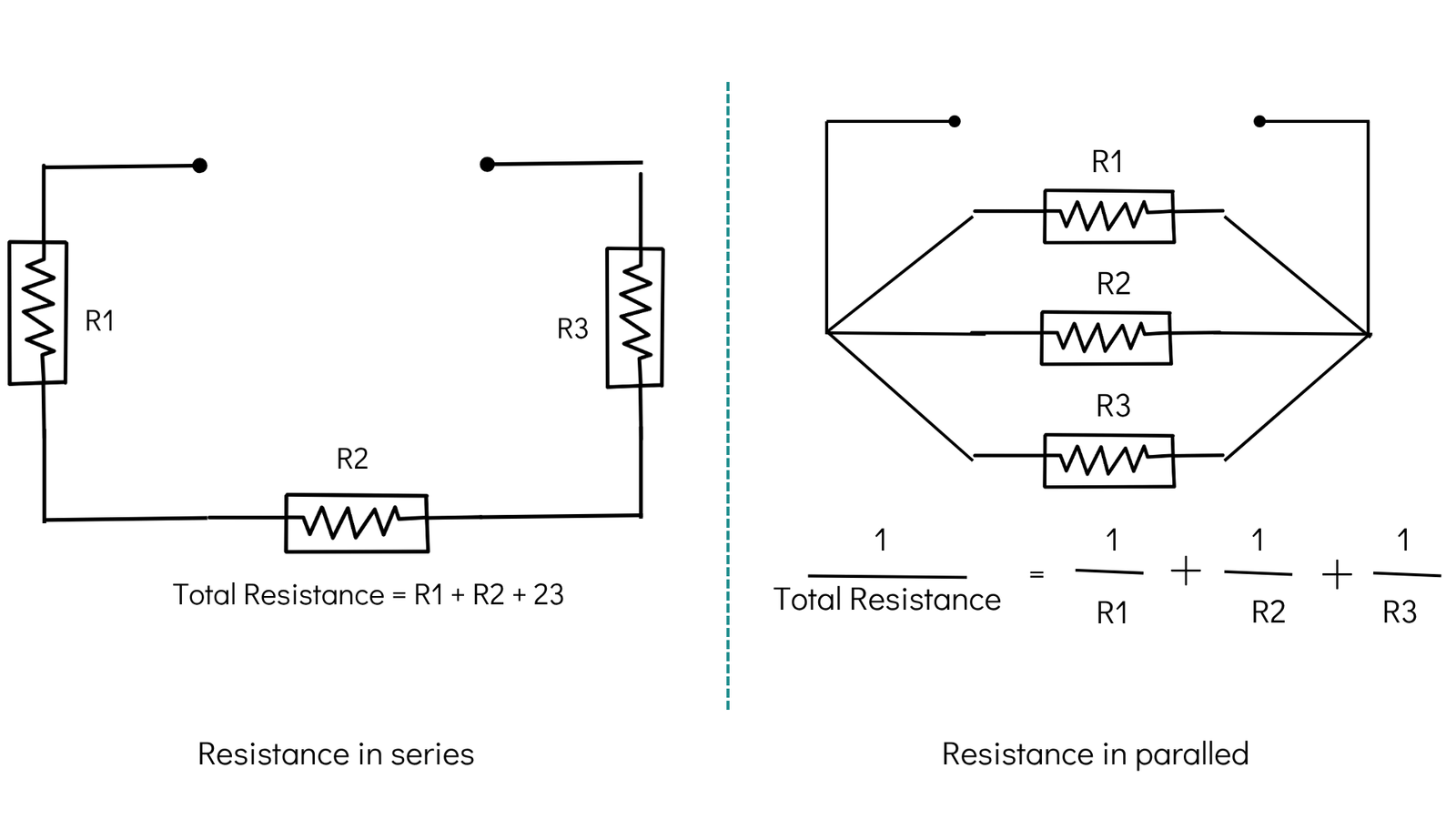
There are three resistance, let’s say R1, the second resistance R2 and this is the third resistance R3. The current starts flowing from point A. It passes through R1, then it passes through R2 and then it passes through R3 and this electric current reaches from point A to point B.
So what will be the total resistance here?
Because, the current is passing through all these three resistances, hence the total resistance will be R1 + R2 + R3, that is, the sum of all these three resistances will be its total resistance.
Resistance in parallel
Now there is another condition in which the resistances are parallel. Let me explain this to you again through the diagram.
So look at this diagram, the three resistance are arranged in parallel to each other. From point A the current started flowing. Okay, as all the resistances are connected in parallel, the current will flow through each resistance simultaneously.
The current flowing from each resistance meets at a single common point and reaches point B.
So what does Ohm’s law say? Suppose the highest resistance is in R2 and the lowest resistance is in R3, okay.
Then the highest resistance in R2 will have the least current, the least current will pass through the R2. And the lowest resistance is in R3, so the maximum current will pass through it. Similarly, the current will pass through R1 according to its resistance.
So, what will be its resultant resistance?
Its total resistance will be:
1/Resistance = 1/R1 + 1/R2 + 1/R3
Now let us move on to the thermal effect of the electrical current.
Thermal effect of the current
If an electric current is flowing through a conductor, some of its energy gets converted into thermal energy, that is, it gets converted into heat. This heat generated can be calculated using the Joules current.
According to Joules current, the heat produced in a conductor is directly related to the square of the current, the resistance, and the duration of the current flow. 1
Q=I2×R×t
Now we move on to the electromagnetic spectrum.
Electromagnetic spectrum
Finally, the electromagnetic spectrum. So, in the electromagnetic spectrum the radiations of different wavelengths are arranged in different places.
As you can see in the figure, there is visible radiation. On the left and right of the visible radiation, you can see radiations of other wavelengths.
For example, you can see the ultraviolet radiation, next to it is the X-rays. Then comes gamma rays next is the cosmic rays. On this side of the visible rays are infrared rays and radio waves.
So the wavelength of radio waves is 0.1 millimeter to 100 km. Infrared rays, its wavelength is 750 nanometers to 4 mm, okay, visible light has a wavelength of 400 nanometers to 750 nanometers.
Visible light means the light that we can see, so its wavelength is from 400 nanometers to 750 nanometers. Then that of ultraviolet is from 0.1 nanometer to 400 nanometers and then we use X-ray for our medical investigation and gamma rays is 0.1 pm to 100 nanometer, okay, 2
So this is its wavelength and in the electromagnetic spectrum and you do not need to go too deep.
I hope that you must have got clear about electric static electricity and current electricity, my concept may be If there is any shortcoming in the lecture, please comment in the comment box and I will try to fill that shortcoming.
This same electrical energy also drives other physiotherapy modalities you’ll study later. In therapeutic ultrasound, for instance, electric current is passed through a piezoelectric crystal inside the transducer head, converting it into high-frequency mechanical vibrations used for deep tissue heating and healing.
FAQ

The author is a physiotherapist who has been practising for the last 17 years. He holds a Bachelor's in Physiotherapy (BPT) from SVNIRTAR (Swami Vivekananda National Institute of Rehabilitation and Research), one of the prestigious physiotherapy schools in India.
Whatever he learns dealing with his patient, he shares it with the world through blogs and e-books. He also owns a YouTube channel, "Sunit Physiotherapist" with over 8 lakh active subscribers. Here, he shares everything he gets to learn serving the patient.